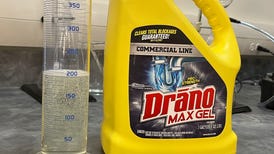
Can baking soda curb global warming?

Some scientists have proposed compressing carbon dioxide and sticking it in underground caves as a way to cut down on greenhouse gases. Joe David Jones wants to make baking soda out of it.

Jones, the founder and CEO of Skyonic, has come up with an industrial process called SkyMine that captures 90 percent of the carbon dioxide coming out of smoke stacks and mixes it with sodium hydroxide to make sodium bicarbonate, or baking soda. The energy required for the reaction to turn the chemicals into baking soda comes from the waste heat from the factory.

"It is cleaner than food-grade (baking soda)," he said.

The system also removes 97 percent of the heavy metals, as well as most of the sulfur and nitrogen compounds, Jones said.

Luminant, a utility formerly known as TXU, installed a pilot version of the system at its Big Brown Steam Electric Station in Fairfield, Texas, last year. Skyonic, meanwhile, hopes to install a system that will consume the greenhouse gas output of a large--500 megawatts or so--power plant around 2009. Skyonic is currently designing one of these large systems.

"It has been working pretty well. It does present a potential solution to emissions," said a representative for Luminant. "But right now there is still a lot of work to be done."

If the concept works on a grand scale, it could help change some of the pernicious economics and daunting engineering challenges surrounding carbon capture and sequestration.

Photos: Fumes turned baking soda

Carbon capture likely will be required to curb global warming, according to many scientists and companies that are currently experimenting with ways to effectively bury or fix greenhouse gases as they come out of smokestacks. Coal accounted for 26 percent of energy consumed in 2004 worldwide, according to the U.S. Energy Information Agency, and will grow to 28 percent by 2030. Coal also accounted for 39 percent of carbon dioxide in 2004 (behind oil) but is expected to pass oil for the No. 1 spot in 2010.

What about replacing every incandescent bulb in America with compact fluorescents? The benefits are eradicated by the carbon dioxide emitted by two coal-fired plants over a year, according to Ed Mazria, founder of Architecture 2030, a nonprofit that encourages builders, suppliers, and architects to move toward making carbon-neutral buildings by 2030.

Unfortunately, a lot of the proposed solutions for sequestration involve large amounts of capital and risk. If you bury carbon dioxide underground, it could always leak out. Other ideas include pumping it into underground saline aquifers or porous rock formations.

Because it's a solid, storing baking soda is simply easier, and it allows greenhouse gas emitters to store a lot of carbon in one place. The stuff piles up: A 500-megawatt power plant will produce approximately 338,000 tons of carbon dioxide a year. Multiply that weight by 1.9 and you get the number of tons of baking soda that the plant will produce. Still, it can be sold, stored in containers, used for landfill or buried in abandoned mines.

"If you can use the waste heat, it strikes me as a potentially feasible approach," said Alex Farrell, an assistant professor in the energy and resources group at the University of California at Berkeley. "I'm not willing to throw any of the ideas out yet."

On top of that, the byproducts of the different reactions--chlorine, baking soda, hydrogen (a byproduct from making the sodium hydroxide that gets mixed with the carbon dioxide), and chlorine--can be sold to industrial users. In all likelihood, the chlorine and hydrogen will have a higher market value than the baking soda, but baking soda does have its buyers. It is often used as an industrial abrasive. Besides, baking soda today gets mined--an expensive process. Skyonic's byproduct would obviate the need to dig holes in the ground.

Other start-ups are trying to develop salable products out of carbon dioxide. Greenfuel Technologies wants to capture carbon dioxide and feed it to algae farms. Greenfuel then sells the algae to biodiesel manufacturers.

Making biodiesel from algae, though, remains in the experimental stage. Similarly, Novomer wants to turn carbon dioxide into plastics, while a few other start-ups are coming up with liquid fuels derived from the gas.

These approaches, however, result in byproducts that are more experimental than cranking out baking soda. Greenfuel, for instance, has been forced to delay a prototype in Arizona.

There's another benefit to Skyonic's system, Jones said. Because the system captures metals and acid gases, it can replace the $400 million scrubbers that power plants currently have to install. Skyonic's system will probably cost about the same amount as a scrubber. Although the capital budget will be equal, power plant owners will get a salable byproduct and avoid carbon taxes, which may be imposed in the future.

Jones, a chemical engineer, came up with the idea for the company while watching TV with his sons. The Discovery Channel had a show about traveling to Mars, and experts offered up their ideas for getting rid of carbon dioxide. Jones told his sons that the experts had it wrong. Creating sodium bicarbonate would probably be the best solution.

He then went to his PC and began to research the subject on Google. He didn't find a lot of answers, but one posting referred to a 1973 textbook Jones remembered. He'd bought it for a class at the University of Texas. In fact, it was on the shelf right behind him.

He opened it up to the relevant page and there was the passage he wanted, underlined years earlier by Jones himself.

More from News.com on this story's topics

Global warming

RSS feed

Manufacturing

RSS feed

See more CNET content tagged:
soda, carbon, global warming, plant, energy

Add a Comment (Log in or register) 3 comments (Page 1 of 1)
skyionic
by justguess February 20, 2008 4:33 PM PST
My initial understanding of this subject was less than that; I am even more perplexed after having read this article! Sad to say, I truly thought that this was a revolutionizing environmentally-safe breakthrough. Boy, was I out of my league. I didn't even know that baking soda today must be mined out of a mountain! I wanted to believe in this so bad, I guess, that I only heard what I wanted to hear: took CO2, made household brand baking soda. I think that the bigger picture is blindsighting a great many more than just myself, though. Chlorine as a byproduct; not good, definetly not good. Sure everybody loves to bleach the hel out of everything but what good has it done for the health of our oceans? As if this was not bad enough, though, now the hip trend that is revolutionizing pollution's possibilities and taking it to another level of deadly with carbon sequestration? Are you serious? This is really the best that you guys can come up with? I have absolutely no credentials when it comes to such topics but even I can see the downside to this one. Always prepare for the worst. In this case, there is no precautionary measures to take. Hence, what the hel are you guys thinking trying to inject CO2 underneath any part of the planet!! Come on! Quit kickin' a dead horse; it's already dead! You guys can do much better, I am sure. And when you do, I will be there to put my money where my mouth is.
Reply to this comment
It wont work
by hariaparajith February 25, 2008 1:46 PM PST
I am chemical engineer and I did some calculations based on their reactions. Here are the results To treat carbon emission from a 500 MW plant, you need roughly 3.2 million tons of sodium hydroxide. For producing each ton of sodium hydroxide you need 2.4 MWh of electricity (Diaphragm process).Total electricity needed to produce sodium hydroxide is much more than the power plant produce. (Trust me...i checked my calculations million times) Then you have to transport and handle 6.7 million tons of baking soda. (150,000 truck loads) it took me 10 min to do these calculations. I cant believe this guy started a company without considering any of these. The worst thing is he even found a sponsor who gave him millions of dollars to try this out.
Reply to this comment
by Brad Hansen June 5, 2008 4:44 PM PDT

I'm just repeating the prior comment, but testing HTML tags (since cnet doesn't seem to publish which ones work).

I am chemical engineer and I did some calculations based on their reactions. Here are the results:

  • To treat carbon emission from a 500 MW plant, you need roughly 3.2 million tons of sodium hydroxide.
  • For producing each ton of sodium hydroxide you need 2.4 MWh of electricity (Diaphragm process).Total electricity needed to produce sodium hydroxide is much more than the power plant produce. (Trust me...i checked my calculations million times).
  • Then you have to transport and handle 6.7 million tons of baking soda. (150,000 truck loads).
Reply to this comment
Powered by Jive Software
RSS Feeds
Add headlines from CNET News.com to your homepage or feedreader.
Google
Yahoo
MSN
More feeds available in our RSS feed index.
Today's Top Stories
EA debuts new family, sports titles
Apple cuts price of flash-drive MacBook Air
LCD making worse for environment than coal?
Report: Yahoo sites get traffic boost from Google
Google Talk comes to the iPhone, iPod Touch
Most Popular Stories
Jobs, Apple directors face new backdating suit
'Netflix box' to carry more than just Netflix
IE 8 to have antimalware protection
Facebook-advertised boozefest spurs liquor ban
China's military tries out Segways
Markets

Market news, charts, SEC filings, and more

Related quotes

Dow Jones Industrials (0.65%) 73.03 11,288.54
S&P 500 (0.11%) 1.38 1,262.90
NASDAQ (-0.27%) -6.08 2,245.38
CNET TECH (0.00%) 0.00 1,580.18
  Symbol Lookup
Detroit auto show
Detroit auto show

Detroit auto show
On TechRepublic: 19 words you don't want in your resume
Advanced
search
Advanced
search
Visit other CBS Interactive sites