Wolfram Alpha shows data in a way Google can't
CNET News editor Rafe Needleman and reporter Stephen Shankland discuss their ups and downs with the search engine that computes.


- Shankland covered the tech industry for more than 25 years and was a science writer for five years before that. He has deep expertise in microprocessors, digital photography, computer hardware and software, internet standards, web technology, and more.


Wolfram Alpha is like a cross between a research library, a graphing calculator, and a search engine. But does Wolfram Research's "computational knowledge engine," set to debut publicly later this month, live up to its hype as a Web site that Google needs to be afraid of?
Wolfram Alpha creator Stephen Wolfram on Tuesday gave a demo of the service to a crowd of online reporters. Few have access to the private test version of the service itself, but we got access Monday night. We found it compelling, if limited.
We're eager to see this site develop. It does things with online information that Google does not. Here are our impressions of the current version of Wolfram Alpha.
Who's it for?
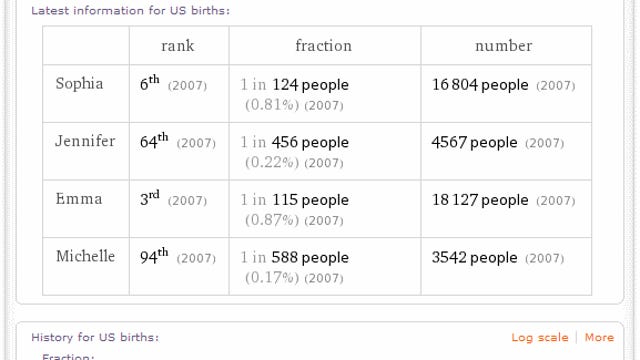
CNET reporter Stephen Shankland: Today at least, Wolfram Alpha is for the tech crowd--the kind of people who want to dig into the data. It's a great exploration tool to find out whether somebody who's 5 feet 5 inches and 160 pounds is overweight, the chemical properties of boron, and whether you're going to get a full moon during the evening of September 4 in Buenos Aires when you want to propose to your fiancee.
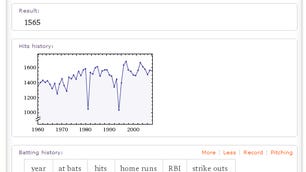
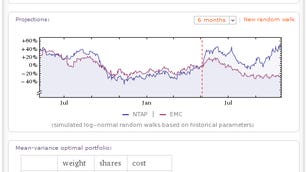
It'll tell you the family, genus, species, and caloric value of an apple, and it'll forecast Apple's stock price, but it won't give you apple pie recipes. It'll tell you the box office take of the first "Star Trek" movie, but it won't tell you the theater where you can see the newest "Star Trek" movie.
But a technical audience is still big. This could unlock a lot of data that students, research assistants, lawyers, marketing managers, financial analysts, and scientists might not have readily available. And those folks are important, too--just the kind of influential folks people with Web sites like to reach.
CNET Editor Rafe Needleman: I wouldn't dream of pointing my parents at this. It's too picky about syntax and not intuitive to get into. When I saw Stephen Wolfram give a demo of the system I was blown away. He ran through dozens of demos from weather to genetics to calculus to finance, each resulting in beautiful and informative results. But when I tried the service I'd say maybe only 10 or 20 percent of my queries actually worked.
Shankland: On the other hand, my dad has a Ph.D. and I most definitely will point him at it. He bought Wolfram Research's all-purpose computation software, Mathematica, though, so for him Wolfram Alpha is like preaching to the choir.
Needleman: My dad has a Ph.D., too, but in philosophy. There is no Wolfram Alpha for that.
Shankland: Yet. Alpha handles numeric data well, but loosey-goosey stuff like art or philosophy is tough. But maybe in some glorious future Alpha will be able to chart the trains of thought from the Enlightenment to the present.
Is it easy to use?
Needleman: You need a clear mind to take advantage of this service. Again, it's picky about syntax, and in the pre-release version we tried, if you got a query wrong--if it didn't return what you were looking for--it wouldn't offer you much in the way of help to refine the query. I kept trying to figure out how to correlate weather with earthquakes in San Francisco. I can get the data for weather. I can get it for earthquakes. So I know that Alpha has the information. But I can't figure out how to show them together.
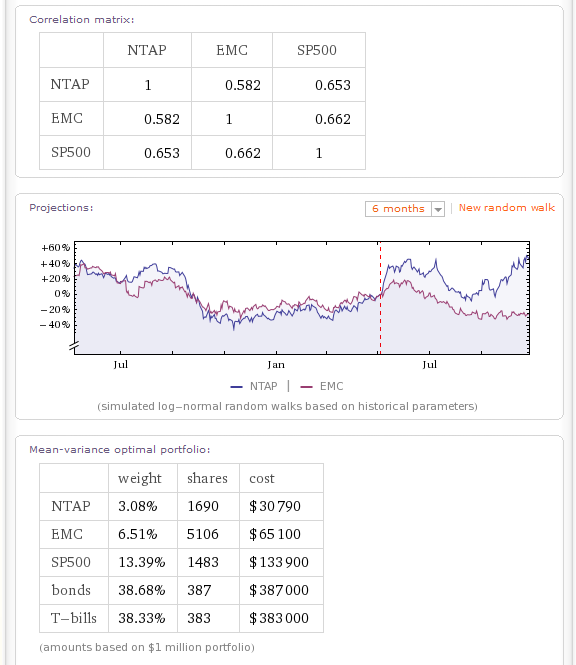
What the system does know is beautifully presented. Type in the name of a city, for example, and it will give you some fun stats on a clean and clear Web page. But from that sort of page you'll probably want to start exploring the data available: Maybe you want to know about population growth, economic information, or weather trends. Alpha doesn't give you hints as to what's available, nor a good way to drill into data. You have to take stabs at re-typing your query. I tried a variety of queries like "test scores san francisco schools" and "population of portland by year" and got, respectively, no result and a pointless result (533,429 person years: what is that?). The system that interprets Wolfram Alpha queries needs a little bit of help. It may be improved by the time the system is opened to the public, later this month, but I think that this will be the product's Achilles heel.
Shankland: Yeah, speaking of Greek mythology, asking Wolfram Alpha questions is like consulting the oracle. You don't know exactly what you're going to get, and how you craft your question has a lot of influence over the results you do get.
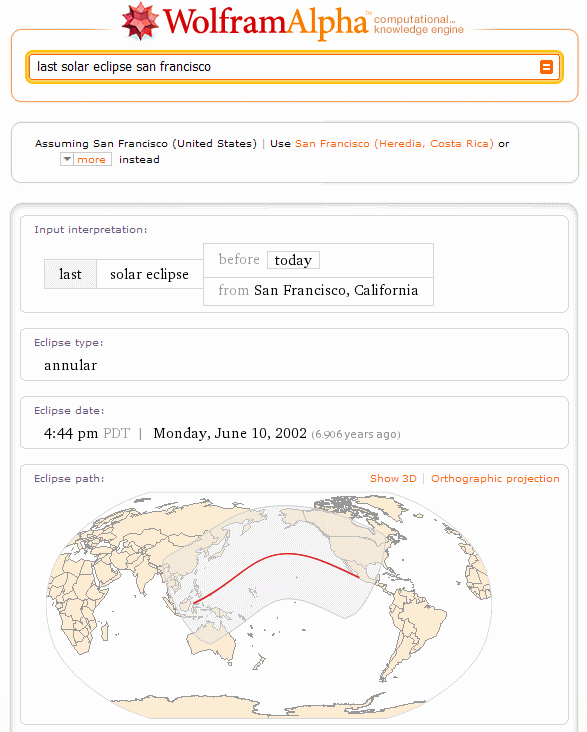
Here's an example of how picky it is. I typed in "next solar eclipse." It showed a great global map with the track one will take on July 21 across the Pacific Ocean and Asia--beautiful information, well presented, engaging. But then I tried a search for "last solar eclipse" and got the exact same result for a future eclipse. Even more mystifying: searching for "next solar eclipse San Francisco" and "last solar eclipse San Francisco" correctly show me the next and last. Given that it could understand "next" and "last" at least in some contexts, it looked to me like a wrinkle to be ironed out rather than big problem, but understanding what humans mean is one of those classically hard computing challenges.
The most fun with Wolfram Alpha right now, I think, is through exploring examples. It's too much like playing Pin the Tail on the Donkey right now, but Wolfram's examples get you thinking and learning fast about the service. I'd hope someday Wolfram Research's technology will get better at parsing ordinary folks' queries, though.
Should Google be worried?
Shankland: It should be aware, but not worried. This is no Google slayer for now. First of all, it's relatively limited to a technical niche. Google is of interest to everybody, and more people every day.
Needleman: Wolfram Alpha is not a Google killer, nor a Wikipedia killer for that matter. It's a very different thing. To be clear, it looks like it will do something Google does not do: Remix knowledge that can be quantified, and display it in understandable ways. Google has some experiments running that do this, but it's nowhere close to what Alpha is showing.
Here's the big difference: Google is really good at finding information that has already been put down somewhere, or answering questions that have already been asked and answered. That covers a lot of ground and a lot of research. Wolfram Alpha, though, can answer questions that have never been asked before, provided the data to create the answer exists in its corpus of facts and figures.
Also, when you're in the Alpha sweet spot, looking for hard data in an area that the system's curators have put effort into, it displays information beautifully. If you're refinancing a home, for example, simply entering "mortgage 6%" shows you more useful information and more clearly that you will get from Google or any bank. So for some basic queries it is competitive with Google. But will people accustomed to Google for 98 percent of their queries make an effort to try another engine when they've been mostly satisfied so far?
Shankland: It'll be a hard sell, I think. Google connects you rapidly to other sites with pregnancy calculators, mortgage calculators, and maps. Having that built into Wolfram Alpha is nice, but not necessarily enough to keep people coming back over and over.
But here's where I see an advantage to Alpha's approach: digging in deeper. Right now I wasn't happy with the ability to expand queries, follow one facet of an answer into an adjacent domain, or produce a more detailed graph of some data. But there are some abilities in that direction, and it most definitely could be expanded. Google's answer to that is to just try a whole new query with tweaked search terms.
Is there a business model?
Shankland: Here's another area where the Google-Wolfram comparison gets interesting. The good news for Wolfram is it has a plan to make money: it'll sell subscriptions to advanced users who want to do thing like blend their own custom data with Alpha's engine. The bad news is that that's a business dependent on a smaller, elite set. Google, on the other hand, has a business model that's shown a way to work based on use by just about everybody. There's a nice financial alignment between more users and more revenue.
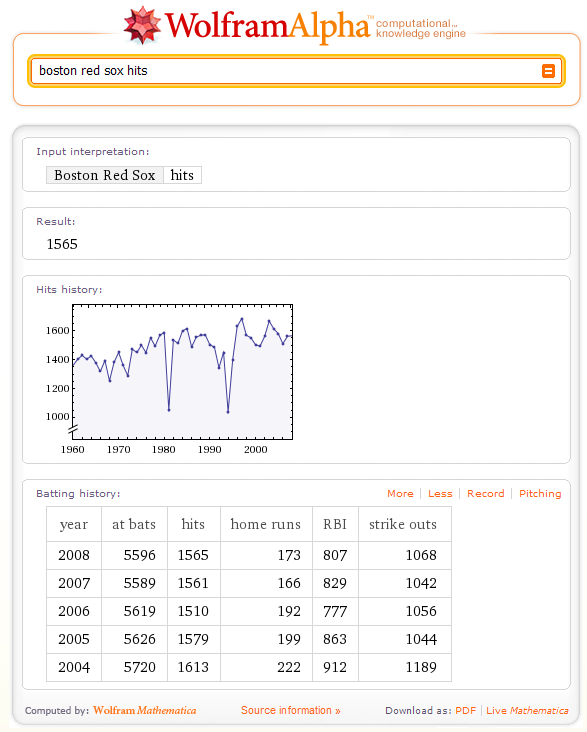
Needleman: It may look obvious to outsiders that Google should buy Wolfram Alpha--before, say, Microsoft does (Microsoft acquired semantic search company PowerSet last year). But I wonder if the models will mesh. Google Search is an automated juggernaut that scours the Web for all the information it can get its servers on, and links it all together. Wolfram Alpha is made up of human-approved data sets and millions of lines of human-created Mathematica code that parse the data. It's a different model. Alpha can't simply digest the world of data and expect to maintain quality output.
Shankland: But consider what Google is doing with its incorporation of curated data--the features it announced right during Alpha's public demo debut. Right now it's only government employment data, but it's shown with a nice graph, and Google teased at how many other data sets it has in mind. So I don't think the models are wholly incompatible.
Google has a lot of experience with curated data when it comes to mapping, too. It has to use somebody else's imagery, scrub it, process it, and merge it with its own systems. In fact, I could see an acquisition of Keyhole Systems, which led to Google Earth and Google Maps, as very much a template for a Google acquisition.
But let's bring this back to the here and now. There's an API for Alpha that could help the service catch on. It's a mashup expert's dream, and the fact that Wolfram licenses data not publicly available, then vets it to boot, means a lot of people will be willing to incorporate it on their Web sites.
Will it work at Internet scale?
Shankland: I'm sure Wolfram Research has the cautionary tale of the Cuil search engine's graceless launch in the forefront of its thoughts. Meeting the demands of the entire Internet is a huge challenge, and Alpha clearly uses a lot of processing power to answer queries. But Wolfram has been working for years on a version of Mathematica that takes advantage of computing power distributed over many servers, so I suspect they at least have a handle on some of the scaling issues. One handy factor, though: Wolfram Research won't have to spend outrageous sums of money on an army of servers to constantly scour the Internet for new Web pages and index the results.
Needleman: According to Stephen Wolfram, a real challenge for Alpha is processing complex or long queries, where you get a greater chance for what he called "artificial stupidity." But it's at the fringes of knowledge where millions of users hitting the servers with obscure requests will be taking up most of the processing power.
My other big concern with Alpha is that it requires ongoing human curation of data and algorithms to stay current. Wolfram says there are about 250 people working on it so far, and that people will not just be able to shovel their own data sets into the system to make them available to the public for computation. His company will have to approve the data to make sure it's consistent and, presumably, accurate. There is no sense of community ranking (which scales nicely) in Alpha as there is in Google or in Wikipedia.
Shankland: Yes. Google's genius is that it creates an algorithm to deduce the collective wisdom of the Internet. It's imperfect, to be sure, but it's plenty useful. I liked Alpha, and I hope it becomes as useful a tool, but realistically I see it as more bounded.