Unauthorized iPhone app stores emerging
Apple may have some competition when it comes to selling applications for the iPhone, as developers decide to launch their own stores to hawk unauthorized apps for the device.
The Wall Street Journal reported that a developer is planning to launch on Friday a new service called Cydia Store that could sell hundreds of iPhone applications. The apps aren't available through Apple's official store, and they require "jailbroken" iPhones. Such iPhones have software downloaded that modifies the device to run any application.
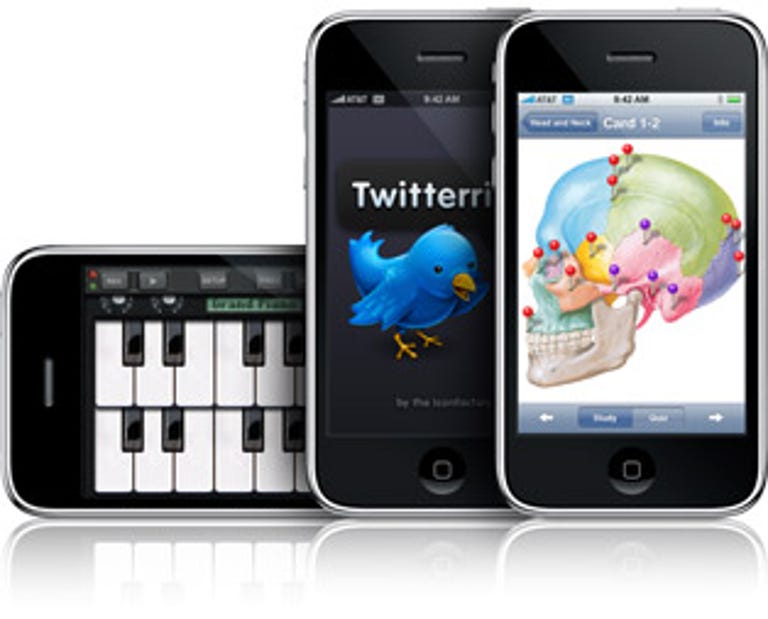
(Credit:
Apple)
The article also mentioned another developer, Rock Your Phone, which also plans to sell unauthorized iPhone apps. But this store won't require iPhones to be modified, the article says.
Some of the applications that will be found in non-Apple app stores are ones that Apple won't carry in its own store. For example, there is one application for turning the phone into a modem for laptops and another that turns the iPhone into a camcorder. Other applications might include adult games, which are not sold in Apple's App Store.
Apple launched its App Store back in July, and it has become wildly popular. Apple said in January that 15,000 applications are available through the App Store. The list grows daily. Downloads passed the 500 million mark in just over six months.
After Apple announced the App Store, other smartphone companies started jumping on the bandwagon.
In October, when T-Mobile introduced the G1, Google announced that it was creating an online app store for all its Android phones.
BlackBerry maker Research In Motion, followed suit with its own application store announcement. And last month at GSMA Mobile World Congress in Barcelona, Microsoft and Nokia announced their own application stores.
The idea behind these application stores is that giving independent developers access to the software and hardware will spur creative and innovative applications. In Apple's case, the company has provided the building blocks for developing new apps but has maintained strict control over what gets into the App Store and what does not. While Apple asserts it is trying to maintain quality and to protect the user experience, some developers have complained about the rejection of their applications. Others have complained that once in the App Store, it's difficult for their applications to be featured and discovered.
The real beauty of the App Store is its huge potential as a revenue driver for Apple, helping the company monetize the iPhone long after it's left the store shelf. Apple doesn't break out revenue from the App Store, but the company collects 30 percent commission on all apps sold through the store.
It's true that many applications are free. But there are also thousands of applications that cost 99 cents or more. Piper Jaffray estimates that Apple's App Store generated about $150 million in sales last year and projects that total sales will grow to $800 million this year, the Journal reported.
So far, Apple hasn't taken any legal action against companies preparing their own iPhone app stores. But the Journal noted that Apple appears to be preparing a legal case. Last month, the company filed a 27-page statement with the U.S. Copyright Office, making the case that modifying the software on the iPhone is illegal.
Whether this argument will hold up in court is yet to be determined. The Journal quoted a professor at University of California at Berkeley's law school who said that the developers have "a pretty good" defense under the Digital Millennium Copyright Act.
My prediction is that there will definitely be a good number of iPhone users who make the extra effort to "jailbreak" their phones and buy applications that Apple refuses to put in its own App Store. But the vast majority of iPhone users will stick with Apple's App Store. The reason: it's easy to use.
Still, if these rogue application stores gain any traction, Apple will fight. And it will likely fight hard.
Apple didn't respond to requests for comment on this story nor did it respond to requests from the Journal.
Marguerite Reardon has been a CNET News reporter since 2004, covering cell phone services, broadband, citywide Wi-Fi, the Net neutrality debate, as well as the ongoing consolidation of the phone companies. E-mail Maggie. 


-Mister Winky
:-(
Sounds great, though. Hope they survive the lawsuits.
Cydia has been around for months and months... and before that, 'installer' was around since just after the iphone came out.
Sheesh. Apple's stock drops a few gazillion points and all of the sudden, the old guard that made the iPhone worth owning in the early days is an upcoming menage engaged in "illegal" activities.
Give it a rest on the hype and poorly researched articles. Apple, you stop the guys at Installer and Cydia and I'm kissing you (and the 5 iPhones my family owns) goodbye.
sure you can benefit from 3rd party app stores
but the Security and overall experience might be different
and your Phone might end being a POS like n e other WinMO device slow buggy and slow again
As a long time Palm user, I've purchased and directly downloaded / installed Palm apps to my Tungsten T3 for years using web-based stores like PalmGear & Tucows.
Apple has certainly made it easy by pointing users to an AppStore app & using the iTunes store for the transactions, and their business model permits them maybe more direct revenue & veto power as a marketer, but the practice & method of delivery are nothing new.
Apple would never dare to do this because their apps are so rotten, the vast majority of users that pay for apps use them once and never again. Plenty of online research around this. Just demonstrates that the iDud "happy puppy" users are light on intelligence.
http://news.cnet.com/8301-1009_3-10154662-83.html
The Macintosh and base Linux kernel operating systems have dominated the top spots for vulnerabilities by operating system over the past three years
Mac's are actually the LEAST secure of the well known operating systems. Independent security firms have conventions each year and invite hackers from around the world to test the security of OS's, and Mac falls flat on its face. This past year it took under 2 minutes to gain control of a Mac running the newest OS at the time, and it was done through security holes in Safari, an Apple without any end user interaction. It was not until they changed the scope of the test to allow end user interaction that Vista's security was breeched, and then it was due to a security flaw in Flash, an Adobe product, that was caused when an end user clicked a link in a phishing email. Until that point, the Vista machine was untouchable. Linux was more secure than both, and I do believe it made it all the way without ever being hacked.
Mac users are not safer then a Windows users. Windows is under constant major attack which is why they have so many hot fixes, patches, etc. because their flaws are exposed so they CAN be patched and fixed and security hardened. As much as it may seem that Mac is becoming more popular, it is still less then 10% of the worlds market, so it is not really bothered with. They do not have a strong business presence as far as servers or desktops, so the large majority of people with malicious intent are not going to bother.
Look at it another way. Would you buy a car that has been crash tested from the front at high speeds, redesigned to withstand a front crash, then tested from the side, redesigned, and so on or pick one up that was tested against a fender bender and just say 'Well it took that 10mph hit well, it's safety rating must be nearly perfect!'.
Neither product is perfect by any means, but when it comes to security at least have a little bit of the facts and some real perspective on to what each product is really defending against.
You like drinking the M$ kool-aid I see.
Why is that always the response whenever anyone has anything to say regarding these two companies? It's either Apple-fanboy or M$-(insert 'witty' word here)? Do a little research and what I posted earlier comes from factual information, not 'kool-aide'. As far as security goes Linux is stronger then Windows, and Windows is stronger then Mac. So now what am I? I just said Linux is better then Windows, am I a penguin-hugger now? Or a Tux-fanboy? Perhaps I am eating the Linux-roast beef?
And while I do not own a Mac, I did use them for a good number of years so I am not 'hating' on Apple. Each product has their good points, and their bad just like everything else. Security just happens to be one of those areas where Windows (*takes a sip apparently*) and Linux (*hugs Tux*) have a step up on a Mac.
OSX if far more secure, from an idle perspective. It does not run Root files through the equivalent of Microsoft's Task Manager, you simply can't access those files by viral means. The most it could possibly do is to play with your process, user files, etc. But that's really only in theory, as there are no known viruses for OS X in the "wild" to my knowledge.
Ian Royal, consumers do have the option, though Apple isn't going to help you. Users are free to jailbreak or unlock their iPhone or iPod Touch at their own free will, you just have to live the consequence of having your warranty voided. Should the positives outweigh the negatives for you, you are indeed free to do so.
If Apple products are more "secure" it's because they limit what end customers can do. That's pretty much what this article is about. Here's the app store and we'll protect you from bad apps and censor them as we see fit. If you want to jailbreak your iphone, cool, but then we won't support you anymore. Of course, now that we're losing money, let's bring out the lawyers!
The ipod as a *device* is "okay" in my book. But I can only use itunes which, IMHO, sucks major arse. I don't want that POS on my machine. If you could bypass all the nanny restrictions apple put on its products, more people would buy them.
I did not make any mention of viruses in my posts, just the blanket term of 'security'. I am not an expert on OS X or Unix security, but I do know enough not to make the mistake of making a statement about viruses. I do agree with your statement about wild viruses for OS X, I've not heard of any either, another reason I omitted the term 'virus' from my post.
Also, I am well aware of the differences between an OS and a browser. The statement regarding Safari is still valid, regardless of prior knowledge. The same people attacking the Windows and Linux machines also had prior knowledge, and still could not gain access. The point still stands that there was a flaw in Safari that allowed someone to gain access in under two minutes. Again, I attribute that to the small market share and limited business presence. Maybe I should have qualified my statements a little and made it clearer that I was speaking more in terms of a business environment and gaining access to a machines resources, and potentially business resources (aka data). Again security, and not viruses.
All in all I guess it is a moot point for any OS really, since patches roll out to fix such flaws.
At least two "unauthorized app stores" including Cydia PREDATE the official apple app store.
The news today is that the developer of Cydia, which provided free software, is now opening something called Cydia Store, where they will charge for applications. "The Cydia Store is about providing a simpler billing channel to buy the already commercial applications in Cydia, like Snapture. With many iPhone applications being rejected by Apple's approval process, developers are searching for an alternative way to distribute their paid applications. Cydia Store will provide these developers and their customers with a viable solution."
I've had a jailbroken iphone with Cydia (or installer) on it since maybe 2 or 3 months after the iphone came out, and I mean the first iphone 2G. I've been recording movies on my iphone for over a year and yes, that is the best iphone app out there to me.
I think the guy who wrote this article is the cleaning crew guy who hacked into cnet's computers at night.
to license out it's product for any multiplier effect. Besides, it's not like competitors
don't and won't have handhelds that combo-up as phones, surfers, PDA's, cameras,
media players, GPS... -- found a cool site; Balkingpoints.com -- awesome satellite
camera view of earth
The phone is nice, but a Secure hold by it from Apple is a big turn off preventing changes that I would like to do. Also, if jailbroken, than you're in for some trouble if AT&T and Apple find out.
All the trouble Apple goes through just to keep people from having what they want. If the phone would run any old app, people wouldn't have to unlock them unless they wanted to change carriers.
Apple products are pretty good, but the company is every bit as "evil" as Microsoft is. More profit AT ANY COST. This is why I have never bought an Apple product, and I never will.
Why doesn't Apple just unlock the phones enough so people can put whatever they want on them? Is Apple afraid they can't compete? Imagine how upset people would be if Ford (for example) "locked" their vehicles so that only parts bought from a Ford Store would work. I bet we'd see people unlocking their vehicles enmass.
Taking MM's comment further: If you could buy a ford that wouldn't go above 65MPH for safety reasons, or a virtually identical mercury that could easily do 120MPH, which would you buy? What if the ford costs 20% more for the "safety" aspect?
If every company operated like Apple then the total USA economic would be upside down.
Levi jeans sold only at Levi stores. Ford cars only sold at the Ford factory.
Now go with the same thing with everything else. It is insane Apple is doing this and getting away with it.
And there're Levi stores, if you didn't know that. Apple products were found at CompUSA, independent computers stores that also sell Apple, and now Best Buy. Again, your points are all moot.
You can have your car serviced at 3rd party shops which includes the installation of 3rd party products (i.e. an alternator from autozone. Your waranty can't be canceled because you took your vehicle to jiffy lube and put in their brand of oil and filter or used goodyear tires or a walmart battery.
How is that more controlled than... you can only purchase and install products from a single company source, which not only controls what you can get, but takes 30% profit off the top. Attempts to force compliance include bricking the product with an update.
- by naga_k March 6, 2009 11:41 AM PST
- So Apple is suing that no one should modify their software. The next step would be to remove the software completely and something else on it.
- Like this Reply to this comment
-
Showing 1 of 2 pages (61 Comments)