• On TV.com: New TV sex symbol: Vintage black PORSCHE
March 23, 2009 10:42 PM PDT

OnLive could threaten Xbox, PS3, and Wii

by Daniel Terdiman
  • Font size
  • Print
  • 168 comments

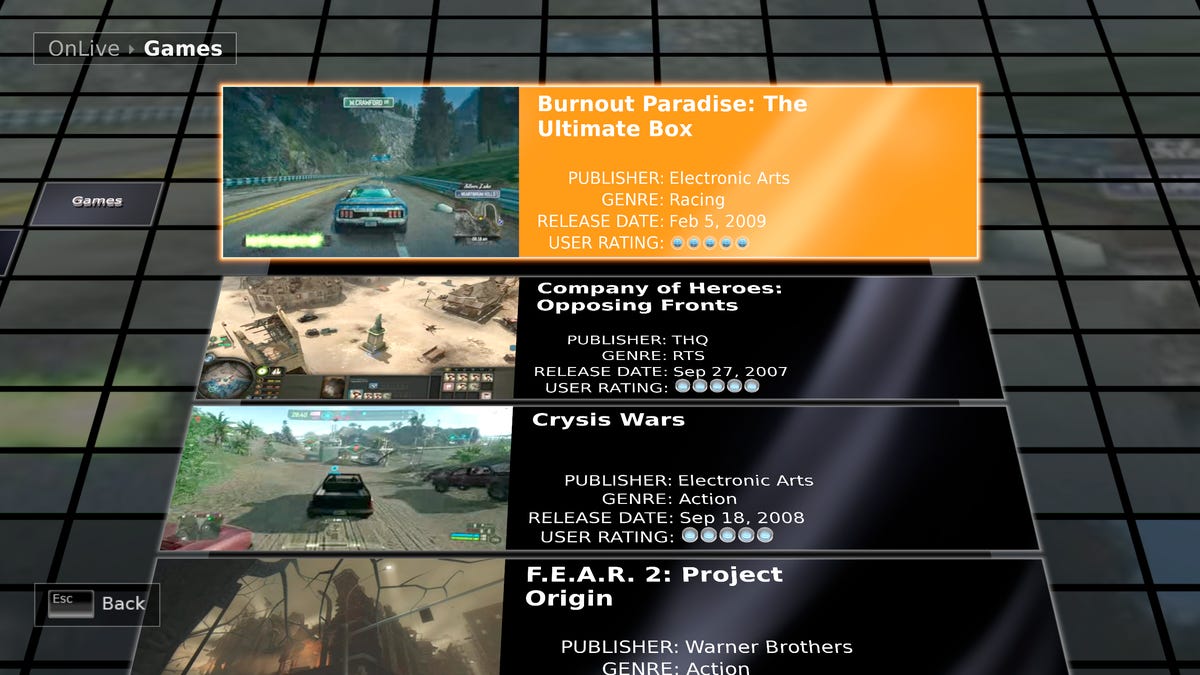
The OnLive system will be shown with 16 games from a series of major publishers during the Game Developers Conference in San Francisco this week. OnLive is aiming to upset the traditional video game business model.

(Credit: OnLive)

SAN FRANCISCO--Sony, Microsoft, and Nintendo, look out. Your traditional video game console business model may be in danger.

It's too early to tell how much danger, of course, but a start-up called OnLive announced a brand-new game distribution system Monday night that, if it works as planned, could change the games game forever.

OnLive, which was started by WebTV founder Steve Perlman and former Eidos CEO Mike McGarvey, is aiming to launch a system--seven years in the works--that will digitally distribute first-run, AAA games from publishers like Electronic Arts, Take-Two, Ubisoft, Atari, and others, all at the same time as those titles are released into retail channels. The system is designed to allow players to stream on-demand games at the highest quality onto any Intel-based Mac or PC running XP or Vista, regardless of how powerful the computer.

The system will also stream games directly to a TV via a small plug-in device, and players can use a custom wireless controller as well as VoIP headsets in conjunction with it.
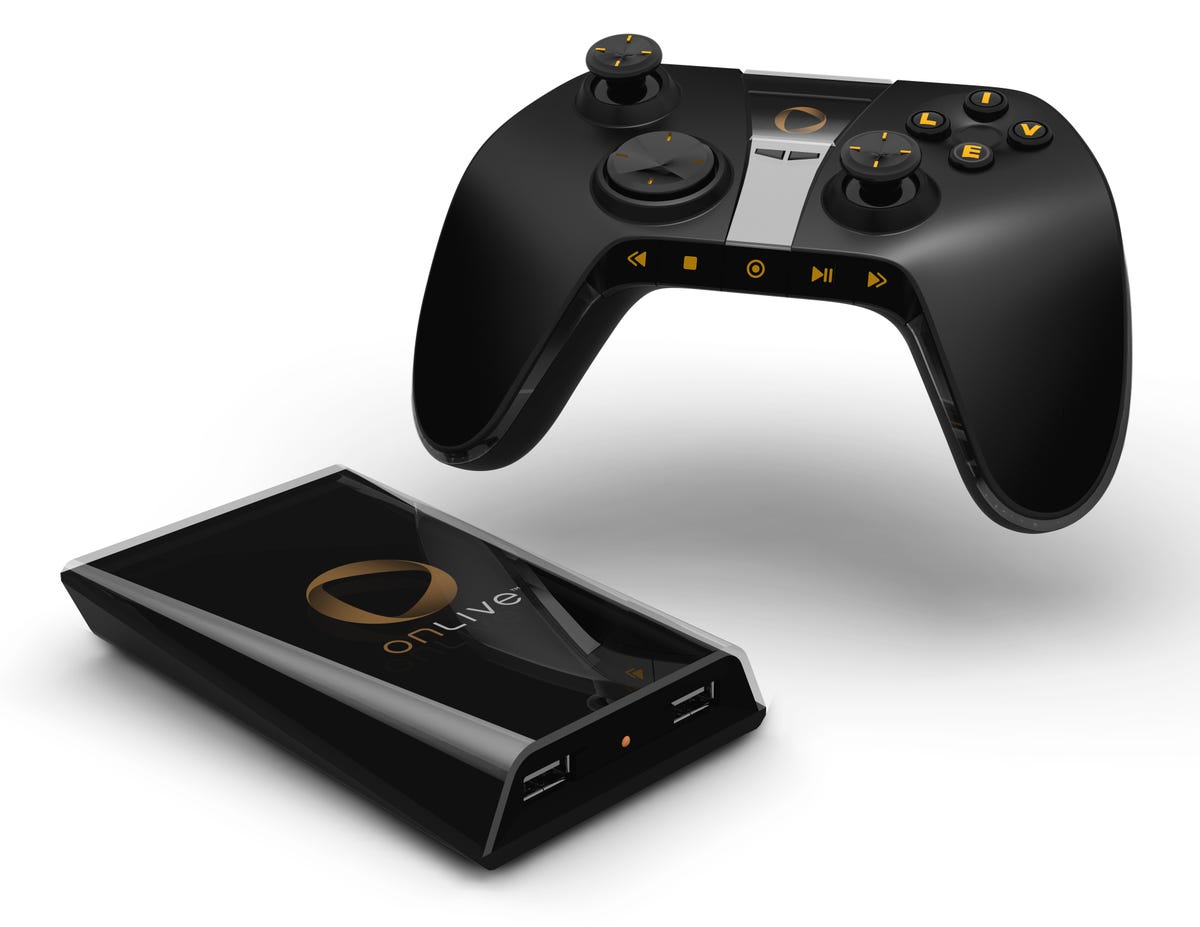
The OnLive system includes the ability to use wireless controllers similar to those available for standard console systems like the Xbox or PS3. It also has a small micro-console that will allow games to be streamed directly to a TV.

(Credit: OnLive)

Based here in San Francisco, OnLive timed its formal unveiling to this week's Game Developers Conference, where it will be showcasing the technology and 16 initial games it will launch with.

The service is currently in a closed beta, but is expected to go into a public beta this summer, and to launch this winter.

According to Perlman, OnLive's technology will make it possible to stream the games in such a manner--high quality, no matter what kind of system the user has--by virtue of a series of patented and patent-pending compression technologies. And instead of requiring users to download the games, OnLive will host them all and stream them from a series of the highest-end servers. Users will have only to download a 1MB plug-in to get the service up and running.

OnLive is hoping to capture a significant portion of the video game market share. In February, the industry posted one of its strongest months ever, with total sales of $1.47 billion, up 10 percent from a year ago. And in February, the Xbox, PS3 and Wii accounted for total sales of 1.42 million units.
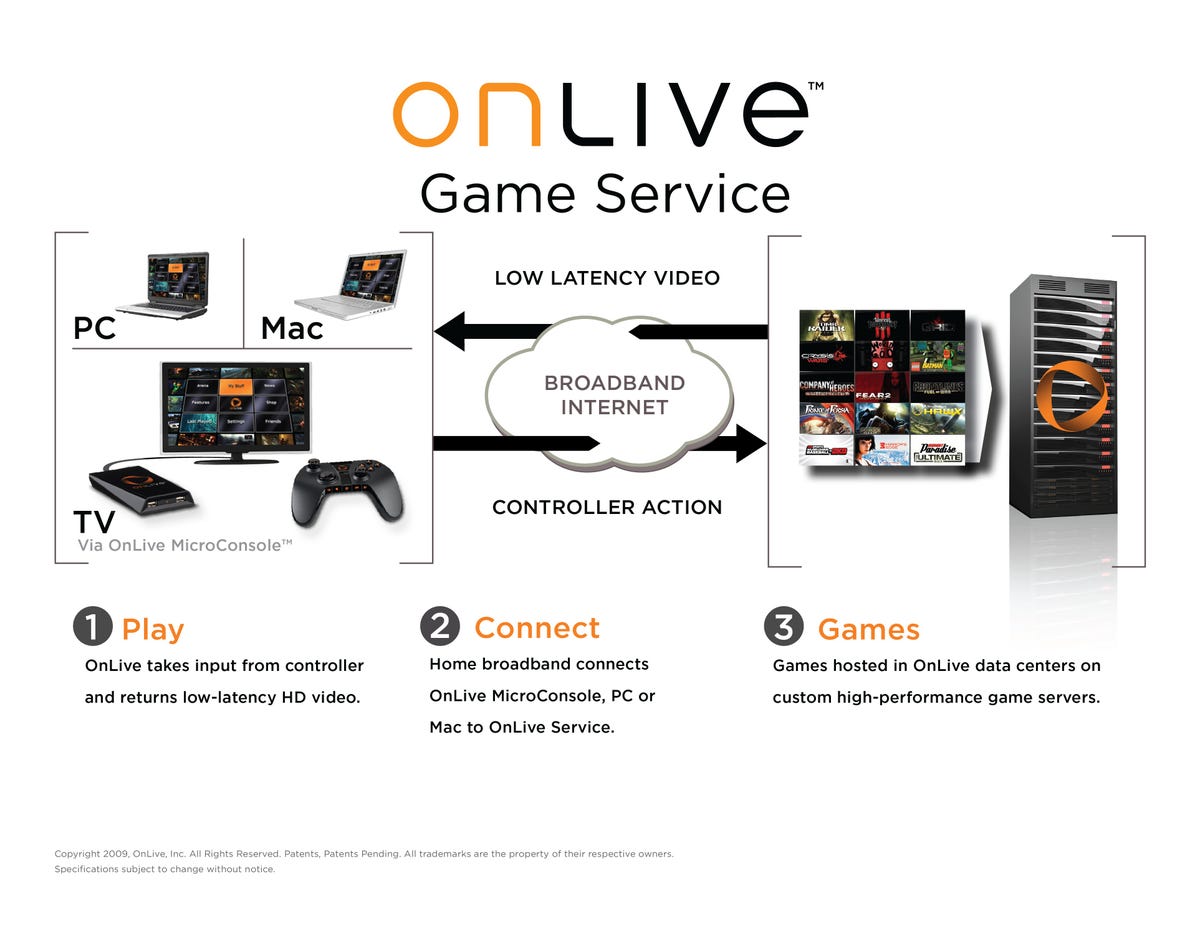
The OnLive system aims to bring cost-efficient instant and high-quality video games streamed to Macs and PCs.

(Credit: OnLive)

An intended benefit of this infrastructure, Perlman and McGarvey explained, is that users will be able to play streamed games via OnLive with no lag, so long as their Internet connections meet minimum thresholds. For standard-definition play, that would mean a minimum 1.5 Mbps connection, and for high-def, 5 Mbps.

That's obviously an essential feature, as it's hard to imagine anyone paying for a service like OnLive, no matter what games are on offer, if the user experience is inadequate. But the company promises that as long as users have the requisite minimum hardware, operating systems, and Internet connections, they should be able to have seamless play.

The upshot of this infrastructure model, Perlman said, is that OnLive is somewhat future-proof, meaning that players won't have to upgrade anything to keep on playing games on the system years into the future. Instead, the upgrades will happen on the back-end, with the company regularly boosting the power of the servers it uses to host and stream the games.

And while demos always have to be taken with a grain of salt, CNET News did see a real-time presentation of OnLive on at least two different computers and on a HD TV. Game play was as smooth and lag-free as advertised

So far, OnLive has yet to make its business model public, but what seems likely is some form of subscription service, where players will pay a monthly access fee and then pay additional costs, depending on whether they want to play games once, or buy them for permanent play.

The company also said that it will probably offer free trials of some or all of the games it offers, allowing consumers to decide whether they want to buy. OnLive recognizes that some players may use those trials as a way of deciding whether to buy such games from traditional retail stores, but Perlman and McGarvey suggested that as long as people are interacting with the OnLive system, they'll be happy.

It's clear that OnLive is modeling its system at least somewhat after Microsoft's hit Xbox Live service. So fans of multiplayer games won't be on their own. Rather, they'll have full access to multiplayer features of games built for them. And another interesting social feature is one that will allow users to digitally watch others play games in real time. The company thinks that users will find it exciting to watch the best players in action, even if they themselves are only kibitzing.

Perlman said that the concept of spectating in online game systems is, in and of itself, not new, but that OnLive presents the first time players will be able to look in on what others are playing without owning the games themselves.

Another social feature in the Xbox Live mold is what are called "brag clips." These are essentially 15-second replays of game action that players can share with friends if they want to show off their prowess. This is possible, Perlman said, because OnLive is continually recording the last 15 seconds of action.
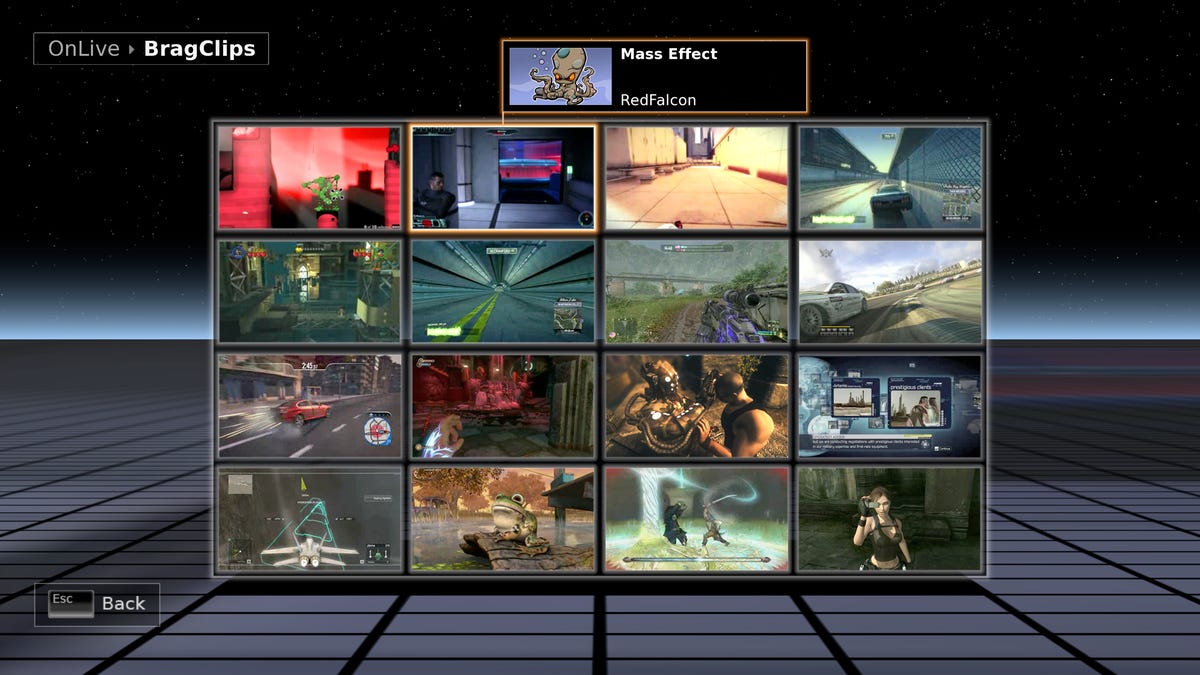
The OnLive system includes social features such as 'brag clips,' which allow players to share 15-second videos of game action they want to brag about.

(Credit: OnLive)

All told, McGarvey said, OnLive offers a full suite of standard social features including friends, clans, rankings, leader boards, tournaments and more.

From the outset, OnLive isn't partnering with any of the first-party publishers--Microsoft, Sony, and Nintendo, meaning that franchises like "Halo" or "Zelda" won't be available. And that makes sense, since those companies are hardly likely to want to sign up with a company whose very technology may obviate their longstanding business models.

That means, Perlman and McGarvey acknowledged, that many players who sign up for OnLive's service will still maintain their consoles, and continue to buy games for them. At least for the rest of the current generation of machines, they said. But come the next generation, all bets are off, they said.

And for the nine--to date--third-party publishers who have committed to being involved, McGarvey said, OnLive presents a much more efficient and profitable distribution model than the standard retail structure. That's because the system is all digital, cutting down on physical distribution costs, and because it is designed to eradicate piracy and second-hand sales, both of which are banes of the publishers' existence.

Indeed, McGarvey said that OnLive has gotten strong commitments of titles from the nine publishers. That means, added Perlman, that the planned launch this winter could be accompanied by the most titles of any new gaming system launch in history.

In addition, McGarvey said publishers are eager for the kind of raw data that OnLive can provide about players' usage of the games, including whether they like or dislike games, how much they play, how they play and so on. That data is hard for publishers to collect with traditional consoles, he argued.

Clearly, OnLive has set an ambitious goal: dethroning the console makers as the game industry's kings. And as is always the case with brand-new and publicly unavailable technology, it is far too early to know whether the company or the service can live up to that goal. But if its demo is any indication, OnLive is definitely onto something, and given that the company has been in stealth mode for so many years, it's possible that the console makers will be caught off guard.

Daniel Terdiman is a staff writer at CNET News covering games, Net culture, and everything in between. E-mail Daniel.
Recent posts from Gaming and Culture
Nintendo Black Friday: DSi with $20 in DSiware
Nintendo launches paid video content for Wii
NASA signs 'The Rock' to make it seem cool
Parents take away Xbox; boy dials 911
EA closes Pandemic Studios unit
Modern Warfare 2 tops entertainment industry, not just games
Wii and Wii Fit make their way to Sports Authority
Nintendo's Dunaway: What, Wii worry?
Add a Comment (Log in or register) Showing 1 of 7 pages (168 Comments)
by shootthecops March 23, 2009 11:18 PM PDT
Find: linux

term not found :C
Reply to this comment
by aMUSICsite March 24, 2009 3:50 AM PDT
Find: Mac

Term found :) I'm sure Linux will be supported soon enough, if it works...

p.s.
"more profitable distribution model " I guess that means we end up paying more for the games in the long run...
by codynews March 24, 2009 7:12 AM PDT
Considering the system is just sending pixel data to your computer, I don't see why Linux (even with it's patheticly small market share) wouldn't be supported.
by ma-tarnold March 24, 2009 7:44 PM PDT
"More profitable distribution model" would mean - I think - that they aren't paying for the cost of making game disks, so on and so forth. If everything is digital than there's no need to make it tangible, and that removes a huge cost (think of it like an e-book with Kindle). So while no one can say whether or not the user will pay more until their prices are released, hypothetically we still pay less - the distributors just pay less as well. It's just a matter of proportionally who pays less (user or distributor) than the way things are now.
by itami931 March 24, 2009 10:03 PM PDT
Digital copies of games has already been done. Look into Steam. You would think that not having to pay for the game cases, discs, shipping and other things would make the game cheaper but not really.

This is a terrible TERRIBLE idea and is only good news for those with a mac.
by the_skine March 25, 2009 10:54 AM PDT
ma-tarnold: Lowering costs of manufacturing and distribution of media has rarely, if ever, effected price. For example:

-CDs vs cassettes vs vinyl
-DVDs vs VHS tapes
-Disc-based video games vs cartridges

With all of these, the price for the consumer has either been unchanged, or increased (vinyl prices may be $2-3 more than CDs now, but it's become a enthusiast medium in the last two decades).
by jeffbuffalo March 28, 2009 8:03 PM PDT
So many gullible people ...

Rather than being cheaper, delivering gameplay via internet streaming is far more costly to the publisher than a DVD or Blu-Ray. For a game publisher to provide 30 hours of High Definition gaming to the consumer

DVD or Blu-Ray: $1 (print and ship to retail)
Streaming game: $30 (conservatively based on current hosting costs and QoS requirement)

This is an investor scam at best. There's a sucker born every day.
by paul.saulnier March 23, 2009 11:22 PM PDT
I can't see this being sustainable yet. The high amount of HD video streaming for avid gamers will cause quite a hit on the alotted internet bandwidth, perhaps pushing many over their monthly quota. All the ISPs in my area offer a maximum cap of 60 GB. Plus, this is a major nuisance if your connection occasionally cuts out. Cool idea though.
Reply to this comment
by Lerianis3 March 24, 2009 4:39 AM PDT
Yeah, that's the big hurdle for these type of services: the bandwidth caps. Personally, I wouldn't want to do this. I buy a game FLAT OUT and then I don't want to be paying anything else for that game.
Streaming? Only works if the games are in a package and cost less than 5 dollars a month.
by paulsecic March 24, 2009 9:56 AM PDT
WEB TV sucked. I had trouble with iit from day one.
by Hoolock March 24, 2009 11:17 AM PDT
If this does take off as a service (which i hope it does) ISP's will be forced to up the infrastructure to deal with it and offer higher caps, ultimatley if the market is there they have to cater to it. This service will likely put allot of people out of work and consoles will die if it does take off but as for the possibilities of what this can do, they are endless. There will be no game box, disc, instruction or cover charges to any developer who chooses to join the service and sell thier games there. Meaning developers will make a hell of a lot more money and charge less for games. There will be no pereodic updates of £300-£400 consoles that you will have to buy as you will only need the one box. All games will be playable as there will be no own titles that only belong to certain console companys (Halo for everyone). Every game you ever play will run at full spec and everyone will be united under one online service for easy game invites etc. This will obviously move to allow film and television downloads using thier new encryption capability and will cost me no more than i pay now with my XboxLive subscription of £40 a year and the usual £35 a game. There are very few negatives to this product and i really cant wait to start playing every title on the same system, no longer wishing my PC could run crysis.
by bulljustin March 24, 2009 1:08 PM PDT
The current administration is pushing to get the US to equal Japanese broadband penetration. This kind of service highlights the need for those infrastructure upgrades. As long as they ensure their equipment and their communication channels don't get clogged and overrun, this should take off. In a very real sense, this is just the next evolutionary step from World of Warcraft and XBox Live. The potential upsides are too great for the developers to allow them to be strong-armed by the console manufacturers into not using this service. I doubt it will dethrone the consoles, however, as their competition tends to drive innovation. It very well could cause the consoles to put more effort into their own online systems, maybe even renting the console to the user instead of forcing them to buy it outright.
by Rolker March 24, 2009 2:15 PM PDT
I think that this service idea is amazing. Just to think that you won't need to upgrade you PC / console every once in a while is great.
But I'm afraid that the bandwidth limit is a problem. You need a fast, reliable internet connection for this service to work properly, and I'm skeptic that a 5M connection is enough for HD.
Another problem is the resolution offered. They are talking about 760p, but most PC games support 1080p and beyond. So, until they can match that, I think that their graphics quality is a limitation.
And of course, the price - if you need to pay a subscription fee of ~20$/month, it can sum up to more than 240$ a year + whatever you'll need to pay for each title you play. And this title won't be really yours - meaning, you won't be able to sell it as second hand, and I'm not sure what will happen to your game lbrary if the company crashes.
But, this is probably the future. Steam popularized the game digital distributions area, and people are getting used to the idea of having a digital copy of their games, and not a DVD.
And the possibility of playing whatever game you want on a standard PC is just mind blowing. But time will tell if they will be able to deliver what they are promising (and I hope this will be true also outside the US - which is a huge market...).
by selfkill March 24, 2009 2:57 PM PDT
Maybe it's a problem for US residents but it won't be for Europe, Japan, et al.
by conielo March 25, 2009 4:40 AM PDT
Everyone's internet doesn't have a cap.... I live in Finland and here there is no such thing.
by A_Z March 28, 2009 10:22 AM PDT
In theory this is an interesting idea. In practise it would be a monstrous mistake. Who can honestly say they've never had a problem with their internet or cable provider? With such a load on the infrastructure I think it would be taking a huge risk moving everything on-line. And not forgetting that while this may be feasible in certain countries such as the US and Japan, what about the many users who may not have access to a reliable broadband service? Not every country in Europe can boast a healthy broadband infrastructure and what about users in the rest of the world?
by sonymaster101 March 28, 2009 11:52 AM PDT
agreed. well, my main question is, how can they say there will be " no noticeable lag". you can't even ping most websites and get any less than 100 ms. Add a video stream to that, and it could double. most people don't have an internet connection fast enough to sustain the DL speeds required to stream hd video, even if it is only crappy 720p. I can only see this working for those select few who have fat, uncapped pipes for an internet connection. but, chances are if they have that, they'll have a beast of a PC that can play any game thrown at it without breaking a sweat. Now, my question is if they have developed a video stream that supports 720p and can STREAM though a broadband (1.5 Mbps) how come they haven't licensed it out for other uses? It just seems so unreal of a concept I don't even know how they can claim it will work. They would have to have thousands and thousands of servers to even support under 100,000 clients, not to mention you would have to constantly be upgrading the servers and adding new ones. I'm sure most of you guys have seen the demo video, but there is one thing they didn't explain in that. In the demo, the server running everything was probably in the room behind them, and even if he wasn't playing directly off the server itself, the client PC was likely connected to the server on a gigabit Ethernet network, which equals virtually zero lag.

The only way to have video that doesn't lose quality wh3en compressed is to not compress it. thus, the games played on their service wont look anywhere near what they would if run on the client side. If I spent 500 bucks, I could easily upgrade my PC to be able to play games at resolutions HIGHER than 1080p, without the quality loss of compressed video.

Plus, I bet all those **** ISPs will love the sudden explosion of traffic on their networks.
by deanbvfx March 23, 2009 11:24 PM PDT
WOW.
If this system pick's up and has enough support form studio's ( which it does appear to have a fair few big ones) then it could herald a new era of gaming.
This is what Cloud Computing was built for. :D
My only issue is the last console to do this kind of thing never happened - the aptly named Phantom.
Still if they can sell the console block thing for the $100 they were touting it'd be well worth the purchase.
And this would be great for netbook's.
Reply to this comment
by Playos March 25, 2009 8:51 PM PDT
Netbooks would have a hard time handling this... a full speed gpu may not be required but some good horse power is required just for rendering HD video. Don't forget the compression of the video signal as well so you'd need more power for decompression. Maybe in a few years with the next generation of atom.
by yomommathefirst March 23, 2009 11:28 PM PDT
Won't work, And here is why.
Need a fast internet connection And reliable.
The controller looks terribly uncomfortable.
You don't own the game, they just stream it to you,
No DLC/MODS.
They would need Billions of dollars to be able to support hundreds of thousands(Or millions) People playing games at once, Or better yet Playing crysis at 60 FPS on HD.

How many super computers do these people have, And how could they have Made this technology without it getting leaked? For 7 Years at that

Price, which hasn't been announced.

No exclusives From other platforms, and only games from publishers that want to use this.

And Also, Bandwith...
Reply to this comment
by rnaoncfixd March 24, 2009 9:21 AM PDT
1. You don't think that by the time this winter rolls around and everything starts to convert to digital cable and everything that the average person won't be able to have at least 1.5 Mbs to play in standard definition? Also, don't more aggressive/hardcore gamers that play online have 5 Mbs or more streaming in anyways?

2. From what it seemed like, you don't have to stick with that controller (if you are playing on your computer at least). What makes you think that a third party isn't going to make a controller that is comfortable?

3. Fine, I don't own the game. Just like how I don't technically own SPORE, or any other game that uses Securom. I still get to play the game, right? It's still fun, right? Disks get scratched up, lost, or stolen. Also, I can stream the same game on any computer I want, no real install times or anything.

4. You don't know that. They haven't revealed their entire business plan/model for it yet. It's possible that the developers could work with OnLive so that it could happen.

5. Isn't that what the betas are doing to test the system? Let a little bit of people do it at a time, instead of just everyone on at the same time, causing crashes of sorts like a certain bad Apple I know.

6. Not super computers, "High Performance game servers". It isn't hard to keep quiet when the big 3 are so much louder.

7. Price is just s subscription fee and any other bits of hardware should you choose to. If you were smart, you'd just use your HDTV as your computer monitor and goof off with any 3rd party controllers that are compatible with your computer.
Even if the price is 30, 40, or 50$ a month, with as many games as you can play in that time span, it's much cheaper than buying one new game at 60$ a month.

8. It's still much to early to tell if they are even going to get exclusives within their own. We're talking about developers being able to do technically anything they want because their not having to rely on user's systems. They can release at a faster distribution rate at a cheaper cost. They can fix system bugs instead of asking people to download and install patches. Everything is fully at their end to which they have nearly unlimited restrictions.

9. See number 1.
by ewsachse March 24, 2009 10:04 AM PDT
@rnaoncfixd

1. Wrong, wrong, wrong. The digital TV (DTV) conversion is for the over the air (OTA) signal. It has absolutely nothing to do with cable companies. Besides, TV has absolutely nothing to do with internet access. Sure a cable company or telephone company may provide TV and internet service, but the two technologies are separate. Also, aggressive/hardcore gamers typically want to own their own equipment, while here they are just paying for access to servers running the games.

2. The primary controller included with a system is the default controller, so it is what people use to judge all the games.

3. Ever try using Steam on the PC?

4. You do not know that either.

5. Closed beta. This sounds more like a ponzi scheme run by Bernie Madoff.

6. "High performance game server" = "super computer". It is just semantics.

7. People who can afford a $800 to $2000 HDTV really do not flinch at the low cost of a gaming console. Only super hard core gamers play more than 1 or 2 games a month, and they like to actually own their games and equipment.

8. Sure I would really like to see that stuff stream properly. The internet in the US can barely handle streaming of fixed video in SD, let alone HD. Interactive video in HD? Not going to happen with the current state of the internet in the US. The situation is even worse in Europe, so they cannot even consider that market.

9. See #1.
by jinkster March 24, 2009 1:33 PM PDT
This has BS written all over it.

1. How many instances of Crysis could possible run on one computer? Supercomputers are Heavy on the CPU side, but Crysis requires lots of GPU power.

2. This sounds like trying to go back to the days of a central location where all the CPU power resides. This model doesn't work with games. You mean that one computer running 10 instances of Crysis can run it better than 10 computers each running one instance of Crysis? Aside from GPU power and bandwidth, they need to compress and send the video data on the same sever. LOL....OK.

3. Games require inputs from the user to be detected and acted on in very small amounts of time, even having a 30-40 ms lag would be extremely noticible in a game like Crysis. For simple, non-lag type games with would be ok though.

4. In this day and age of the internet, NOTHING this good stayes under wraps for long.

5. Its almost April 1st.

6. Compression technology is pretty mature now. For someone to say that they have come up with a 200:1 compression scheme that can be done in 1 ms, why make a video game system for this to make you money? This could be the foundation for SO MANY software products...
by rnaoncfixd March 24, 2009 2:04 PM PDT
@ ewsachse

1. Meh
2. Meh
3. Yup
4. So all around assumption. YIPEE!
5. Open beta's coming out soon
6. Meh
7. Meh
8. Meh
9. See number Meh.

I understand the counter points, I just wanted to support a new idea that I've been waiting to hear. Oh well, there go my dreams, crashing on flight Oceana 815.
by Renegade Knight March 26, 2009 12:44 PM PDT
@rnaoncfixd

Good point on Spore. That's why I regret having bought it. It's why I won't buy another game that does that kind of crap. I've used up most of my installs. Of those one computer died. One needs reformated and will be losing that install. The last needs service which of course will wipe the hard drive as SOP. That's 3 installs dead. They upped me to two more but that's not going to last since I can't even get back to where I was and I already know those will be refomated leaving me with none. I can't even dump the game since I already know it's not worth the hassle. This path is not worth repeating. Anytime you can avoid online activation you will be saving yourself hassle.
by tbonehauer March 28, 2009 3:22 PM PDT
the real problem with the controller is the L-I-V-E buttons. Many people were unhappy when Sony first came to town with their square, circle, triangle, x control setup...L-I-V-E is just stupid...whats wrong with A, B, X, and Y. They make sense if you place them so that its:
Y
X B
A

with that setup the X and Y buttons are like the X and Y axis and the A and B are set up the way they have been since NES...so people are used to that. L-I-V-E is a bad idea.
by Tod Smith March 23, 2009 11:34 PM PDT
This is literally a pipe dream! It's Sony's Cell business model to the MAX.

Have 3 Mbps DSL here. This means Wii quality games on my PC. Cable doesn't guarantee the bandwidth for lag free anything.

Show me fiber to the curb and I will believe this!

Models Similar:

1. Cell (SOLD)
2. Phantom (Dead)
3. VOD (Jury Still Out)
Reply to this comment
by Shaun822 March 24, 2009 6:35 PM PDT
I keep hoping we will get fiber to the curb where I live but comcast has a gigantic monopoly in my area so the chances of FiOS are slim to none.
by 8301 March 24, 2009 12:03 AM PDT
I'm sorry, but someone's going to have to help me out on the claims that the service has no lag.

As I understand it, the service sends video to your display. You then send feedback via the controller to the service. This is fine if you live close to the OnLive servers, but what if you don't? If the data takes, say, a quarter of a second to go one way, that means that, not including reaction time, there will be a half-second delay between the server giving you information and you acting on it. This applies to "offline" play as well as multiplayer.

Isn't that worse than the current model, where the only delay in the player's actions is reaction time and lag only surfaces when players on other consoles are involved? Just saying.

Other than that, I like the concept, and love the dedicated media controls on the controller.
Reply to this comment
by Lerianis3 March 24, 2009 4:41 AM PDT
The lag isn't really an issue, considering that the human eye can only process 60fps (there are SOME variation from person to person, but that's the baseline). Now, a half-second delay would only lower this to...... 30fps.... still more than good enough for most people.
by deanbvfx March 24, 2009 5:41 AM PDT
@Lerianis3

a half second delay would be 2fps. not 30fps.
a sixthy delay would be 60fps. so in that 60th of a second your mouse sends signal to PC, it moves your polygons your Gfx card renders it out, its shown on your screen. rinse and repeat.
This way its you move mouse, goes to pc, signal sent to their servers, their servers figure out polygons, stream the footage back, your PC still has to then on top of this decode the 720p footage too. then rinse and repeat.
I get an internal lag of 5ms, which thats as fast as my display is, if i start lagging at 80fps it get's close to unplayable. 20-40 is my average and thats the stage where its only my mouse signals being sent to servers, not me streaming footage back.
Kudos to them if they figure out how to minimize the lag.
by zidanetribal21 March 24, 2009 12:05 PM PDT
@deanbvfx

I think you're unit conversions are incorrect.
[(60 frames)/(1 second)] * (0.5 second) = 30 frames
by jinkster March 24, 2009 1:45 PM PDT
@zidanetribal21

2 FPS is correct.

1 FPS = 1000 milliseconds

2 FPS = 500 milliseconds

0.5 = 500 milliseconds
by MajorSlax March 24, 2009 3:36 PM PDT
@ posters above

it doesn't matter if it's 2FPS or 30FPS.

30FPS is fine if it means one frame every 30th of a second. Nevertheless, if you get a 0.5 second lag, followed by 30 frames at the speed of 60FPS, that is technically 30FPS (hey you got 30 frames in one second, right ?), but you definitely see the lag, and that's the potential problem. Instead of considering FPS, consider continuous lag time. Regarding that, each person will have hos own standards. Personally, I consider having a .5 second lag every hour or so a maximum, more than that and I'll change platform. If Onlive together with my ISP can provide that, awesome, I'm interested. Otherwise, gimme my games on DVD or downloaded on Steam back.
by ciaran54 March 27, 2009 4:03 AM PDT
the fps will not be minimized much, its just that the 30-60fps will be 1/2 second late
by askermana271275 March 24, 2009 12:16 AM PDT
Is there a link to the site anywhere.
Reply to this comment
by aMUSICsite March 24, 2009 9:16 AM PDT
All the news posts seemed to not bother with linking to the site, but found it was www.onlive.com
by askermana271275 March 24, 2009 3:43 PM PDT
What is the countdown on there website for.
by QMT March 24, 2009 1:29 AM PDT
Good luck dealing with latency.
When the end user has to send controller inputs all the way back to wherever, and wait for a video frame to come all the way back form wherever, lag is going to happen. Period.
Reply to this comment
by rapier1 March 25, 2009 10:37 AM PDT
Yeah, unless they figured out a clever way to go faster than the speed of light lag issues will be a significant bottle neck. They can't even use a CDN for something like this because the content isn't static. They'll need to have a significant number of geographically distributed server farms to handle this. I'm also wondering how scalable this is going to be. They can oversubscribe to a certain degree but probably not more than 5 to 1.
by NewsReader_ March 24, 2009 2:12 AM PDT
I'll give them the benefit of the doubt on the latency/lag issues. The game play will have to conform to these limitations most likely. My problem with this is scale. XBOX Live can support 100's of 1000's of simultaneous players. The hardware required to do anyhting close to this in a hosted model is going to be astronomical.

Could be a threat as networks get faster though. Microsoft, Sony, and Nitendo will have plenty of time to adapt however.
Reply to this comment
by Lerianis3 March 24, 2009 4:45 AM PDT
The hardware costs ARE prohibitive, to be blunt. In our homes, in order to get 60fps in... Crysis... you need a FREAKLOAD of high-end hardware, or are going to have to be lowering the video settings big time (lowest quality settings in Crysis, anyone!).
by 3rdalbum March 24, 2009 2:44 AM PDT
This is a pipe dream. A narrow pipe dream.
Reply to this comment
by Playos March 25, 2009 9:03 PM PDT
I think technically it's a broad pipe dream... since we'd need full FiOS roll out
by Wookiee-1138 March 24, 2009 3:40 AM PDT
I'll stick with Steam for the time being, Thanks.
Reply to this comment
by 86lg4b4c March 24, 2009 3:52 AM PDT
ok,they lost my interest when he said "founder of web tv".fail
Reply to this comment
by Ukendthed March 24, 2009 7:12 AM PDT
I think you fail.
Steve Perlman was founder of WebTv.
http://en.wikipedia.org/wiki/Steve_Perlman
by 86lg4b4c March 24, 2009 11:42 AM PDT
hey,ukendthed,thats what i said,he failed and so did you in getting my comment.now we now who failed you
by ddhboy March 24, 2009 4:00 AM PDT
I'm saying this won't pick up. You'd be hard pressed to find gamers willing to pay full price for a game and not actually own the software to run it, but have it piped to them via cloud computing. Especially if you're using this on say a laptop and you go out of the country or someplace you don't get an internet connection.
Reply to this comment
by Lerianis3 March 24, 2009 4:46 AM PDT
You hit the nail on the head with the 'what if you are overseas, want to play this, and don't have an internet connection' issue. Until broadband is ubiquitous in the world, with NO interference by governments........ this won't work.
by blusky08 March 24, 2009 3:03 PM PDT
Most average people rarely leave the country--maybe once per year if lucky.
by ddhboy March 24, 2009 4:30 PM PDT
Yes but will most average people accept paying an access fee for OnLive and then pay full price for a game that they don't technically own? And what happens when they don't want OnLive anymore? That's right, they loose their entire video game library. I doubt that this will catch on. Hell, Steam has a much better shot of doing something similar for an additional fee and succeeded because at least on steam you'd still get a copy of the game.
by Y_Less March 24, 2009 4:28 AM PDT
"In addition, McGarvey said publishers are eager for the kind of raw data that OnLive can provide about players' usage of the games, including whether they like or dislike games, how much they play, how they play and so on. That data is hard for publishers to collect with traditional consoles, he argued. "

Steam?

"Another social feature in the Xbox Live mold is what are called "brag clips." These are essentially 15-second replays of game action that players can share with friends if they want to show off their prowess. This is possible, Perlman said, because OnLive is continually recording the last 15 seconds of action. "

Fraps?

"Clearly, OnLive has set an ambitious goal: dethroning the console makers as the game industry's kings. "

There is HUGE debate over this point, go on Google and you can find loads of top sites arguing one way or the other well over the PC/Console issue. There is no way you can claim this with no evidence at all.

I can't see how this is better than existing models and can see A LOT of reasons why it's worse! It's never going to take off unless they can get a server in every city, town, village and hamlet in the world to alleviate lag. It doesn't matter HOW compressed the data is - size and lag are pretty much unrelated. I could get a 1GBPs satellite connection - massive throughput and massive lag, or a direct but small connection, small on both.
Reply to this comment
by hysonmb March 24, 2009 4:55 AM PDT
If this actually works as advertised, I'll be (1) shocked, (2) in line to buy one.

People said that Xbox Live would never work, streaming video from Hulu would fail, there was no way you'd get an HD video stream from Netflix... never count them out until they've had a chance to show themselves. The people who put this thing together have knowledge well beyond what most of us posting here can claim about hosted services. If you look at the model, all they are sending you is video and all you're sending them is inputs from the controller. They're in beta now and happy with the performance. One would think that they would be forward thinking enough to be preparing now for the possible influx of gamers when they launch. If it comes in at a low price point, a lot of people will buy it just to try it out.

I am as skeptical as anyone else, but, I'm not one to give reasons as to why something won't work when it is working. Bill Gates talked about digital distribution for the next Xbox years ago. The only difference would be that you'd download and play locally in that case. I have high hopes for this service and hope they can pull it off.
Reply to this comment
by BlueSuedeShoes March 24, 2009 12:11 PM PDT
I have a 20Mbs line from Verizon and I still can't get HD streams from Netflix. I don't think the technology is there to replace the console just yet. I'd say consoles have at least one more generation before something like this becomes a realistic replacement.
by dreidogg March 24, 2009 6:40 PM PDT
I have a 20MB connection via Verizon FiOS as well and I have no problems receiving HD streams form Netflix.
by hysonmb March 25, 2009 5:18 AM PDT
I have a 8MB connection from Comcast and watch HD video from Netflix on my 360 which is connected with a wireless bridge. If you can't get an HD stream with a 20MB connection you'll need to get Verizon to fix whatever problem you're having.
by Renegade Knight March 26, 2009 12:39 PM PDT
So far we have spent our free and bonus points on content. No plans on paying real money for digital crap that will die when the xbox dies. When that happens at least I can sell the games and get something back.
by kelmon March 24, 2009 5:09 AM PDT
Wonderful idea and I wish them the best of luck with it! Fingers crossed that the service works in practice as well as it does on paper.
Reply to this comment
by qbte March 27, 2009 12:28 AM PDT
Actually, I don't even think this works on paper.
by gsekse March 24, 2009 5:28 AM PDT
Neat idea, but high capacity bandwidth to the average user is limited. Hell, the ISP's are griping about pier to pier bandwidth loads now. It's like the streaming movie thing, it only works when you have a download area to stage the file prior to viewing due to streaming speeds changing or stopping momentarily.

The infrastructure needs vast upgrades to deal with this level. Presently, there isn't much of a business plan to pay for such an upgrade. If something comes along that makes people want to pay an extra $20 month for a faster internet, then maybe...

For now, there is still a significant dialup crowd, let alone higher bandwidth stuff.

Another example of someone building something in the hopes that "They will come".
Reply to this comment
by Alienange March 24, 2009 5:31 AM PDT
Prepare yourselves for the most epic fail in gaming history. What will happen to that full game purchase when OnLive goes under? This service is money out the window and I hope gamers aren't so gullible as to fall for this kind of ridiculous gaming system.
Reply to this comment
by Wild Eep March 28, 2009 2:33 PM PDT
I think it's important to consider that OnLive should (theoretically) last as long as the company exists. If the company goes under, it will do it early, and if it doesn't, everyone's happy, and no one should loose their games until they've been way outdated.
by teknogeez March 24, 2009 6:06 AM PDT
Seems like a good idea. Shouldn't think lag would matter too much - street fighter seems to run fine on MMORPG, and I don't think you're likely to get a game with more exact timing required... With games developing the way they are, the average video quality of a game is going up faster than the rate of internet connection speed. There would need to be a somewhat large jump in your average internet connection speed to support something like this, which is not a problem IF the demand is there.

Games are going to go this way eventually, they already are - You can't play a full version of an Xbox Arcade game without being online. Whether this is to become a leading name or the next big thing is irrelevant - what will happen is that the hosting of things that we currently buy in shops will become more and more digitialised. This encompasses all media, and it is much easier to maintain security and distribution for something which can only be used from one place. With this will come new ways to hack things - there are ways to connect to Xbox live, and play online without paying any subscription, using local software on your pc to emulate the xbox live server connection.

I can see this, or an idea like it, taking off big time.... eventually. For the meantime though, I can see people getting pissed off with this, and it never really getting a big enough player base to be cheap enough to warrant.
Reply to this comment
by NiGHTS4EVA March 24, 2009 6:10 AM PDT
this thing probably plays like killzone 2 with the input lag =p
Reply to this comment
by dodgeman007 March 25, 2009 9:29 AM PDT
lag will just depend on the game your playing and not everyone plays games online....
Showing 1 of 7 pages (168 Comments)

E-tailers linked to 'scam' blame customers

Priceline, Classmates.com, and Orbitz say customers should read the fine print before complaining about being charged to join loyalty programs they didn't want.

The 411 on early-termination fees

Verizon Wireless has doubled its early-termination fees for smartphones, but what does it mean for the rest of the industry?

About Gaming and Culture

At the tech culture nexus of video games, fire art, Legos, 3D virtual worlds, social networking, aviation, hacked Roombas, and much more.

Add this feed to your online news reader

Gaming and Culture topics

advertisement
advertisement

Inside CNET News

Scroll Left Scroll Right