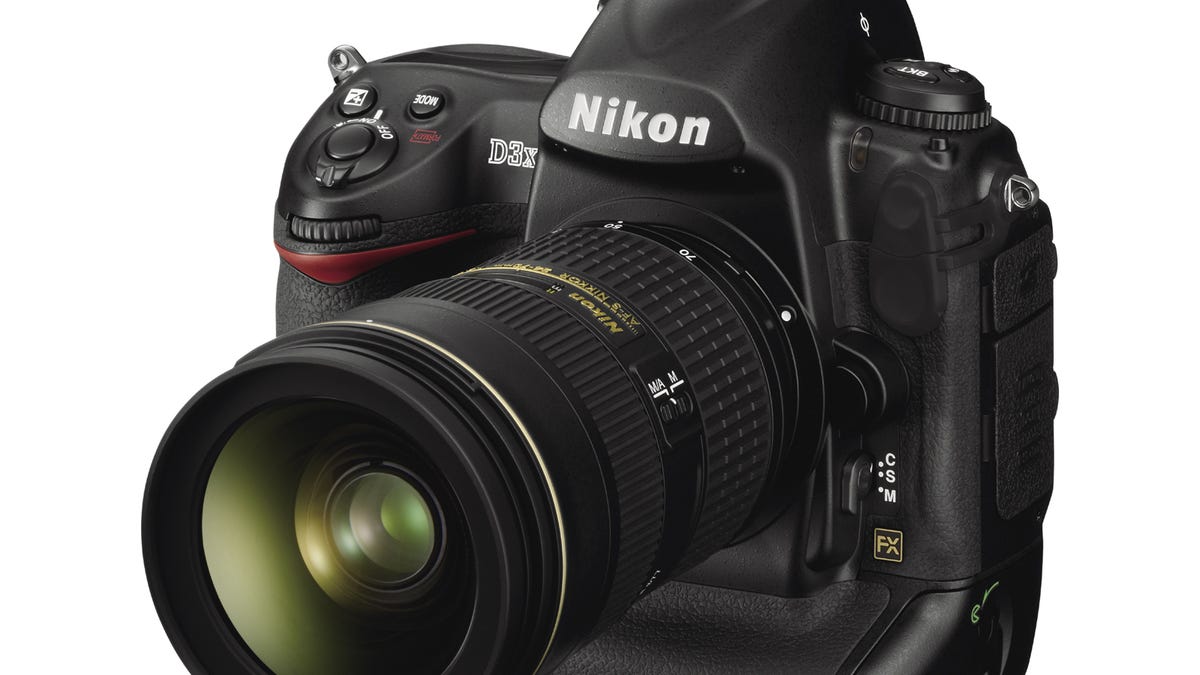
Nikon hits 24.5 megapixels with D3X
The Nikon D3X's body is identical to the D3.
(Credit: Nikon USA)Though almost everything you need to know about the new Nikon D3X leaked Friday, the 24.5-megapixel dSLR Nikon dubs its "extreme professional" model formally debuts today, November 30. What didn't leak was the price: $7,999.95. Start saving your pennies now.
There's quite a bit of speculation as to how similar the sensor in the D3X is to that in the Sony Alpha DSLR-A900; Nikon says it's "a Nikon designed sensor" that may (or may not) be manufactured by Sony, which usually means they're pretty similar. However, the A900's sensor has a pixel pitch of 5.9 microns, while Nikon's is surprisingly smaller--5.49 microns. So, they're pretty much different sensors, with different performance characteristics. The D3X's sensitivity range runs from ISO 100 to ISO 1600, with a Lo 1 of ISO 50 and Hi 1 and 2 of ISO 3200 and ISO 6400. The camera will also offer a 5:4 (8x10) crop mode at 20.4 megapixels, along with the same 10.5-megapixel DX crop mode as the D3, and support.
With all that extra data to process, it's no surprise that the D3X isn't quite the speed demon the D3 is for burst shooting, though 5 frames per second at full resolution is certainly zippy enough for most. (Nikon didn't provide info on the number of frames, however.)
The rest--body, AF system, viewfinder, and Expeed image processor--is all identical to the D3, and Nikon claims you should expect similar performance. It's also compatible with the D3's accessories.
Pitting the D3X against the Canon EOS-1Ds Mark III when the Nikon becomes available in late December will certainly make my cold winter days a little more interesting.
On Sale Now: $7,439.00 - $7,999.95
View the latest prices for Nikon D3X (body)
Senior Editor Lori Grunin has been covering digital imaging for two decades, but her memory's kind of sketchy on the details. You can hear about it every week on Indecent Exposure, the podcast she co-hosts with Matt Fitzgerald. 

John
http://headsetplus.com
I'd put my money into lens than a body. Yes I've owned numerous high end Nikon digital cameras greatly enjoying them. That being said I much more prefer film, so have my clients.
My clients don't require immediacy so digital isn't important for them thus me. What they want, for their productions, is high quality photos; when compared to print or digital reversal film, slide film, is stunning.
Remember it's not the camera it's the photographer.
Cordially, my two cents
First of all...I have grown tired of full-frame. There is actually nothing special about full-frame. There isn't a lens made today or for the foreseeable future that is actually capable of handling the needs of the full-frame sensor. You can print incredibly sharp, heavily detailed 24x36 prints from a Nikon D300, Canon 50D, or Sony Alpha 700 with ease. You also get better light response and overall color saturation from the smaller sensors that these aforementioned APS flagships utilize.
Full-frame may or may not have a purpose for some people for some reason...but beyond what APS can do for you, nothing will replace film for highest quality, ultra-croppable image density at monster-sized prints...and for a fraction of the price of any and all full-frame digital cameras, period.
I've gone back to APS because I care about quality, speed, and photography as an artform...not as a perpetual escalation of gargantuan phallic symbolism. What matters most cannot be exemplified any further through utlilization of a full-frame sensor...not depth of field, not ISO, nothing. What matters most is what's on either side of the camera. Enough is enough!
- by thunderpro March 11, 2009 1:13 PM PDT
- Okay, I picked up one of these about a month ago. So here are my observations:
- Like this Reply to this comment
-
(15 Comments)1. This is not a camera for a photojournalist, sports photographer, or member of a newspaper photography staff. If you are one of these, I'm sure you already have a D3 that your company provided to you. The D3x does have a lower ISO range, but who cares unless you are one of the above, in which case you aren't purchasing your own cameras anyway, and a D3 (or a D700) would be fine.
2. The D3x is not a Sony, get over it...and move on.
3. The color array is spectacular. You will see this, as I do on flesh tones.
4. If you aren't shooting in RAW, go purchase a D40...because this is all you'll ever need.
5. For you DX frame purists (I also shoot a tweaked out D300), the bigger the sensor, like in an FX, (size, not necessarily Megapixels) the more accuracy it can capture, among many, many, many other things.
6. If you do a good bit of post production (photo editing, etc), you will love the extra megapixles...trust me.
7. The D3x is built out of excellent materials with great quality.
8. I believe it was designed for fashion and studio photographers (that's what I use it for), for which it's perfect.
9. If you were (like I was) in the market for a medium format digital back camera, like a Hasselblad, the D3x has less pixel count, but also is about 1/5 the price, but packs a nice size sensor, faster frame rate, higher ISO setting, more robustness, greater real world compatibility, and you can use your nikon lenses.
10. I don't believe the D3x was designed to compete with the top of the line Sony, or ANY prosumer grade camera like a 5D. So, stop comparing ISOs and FPS.
11. The D3x filled a gap that was disparately needed between the Canon 1Ds-Mark III and the medium format digital backed cameras. In case you have no idea what I'm talking about, check out the ISO/FPS of the medium formats digitals...you'll see what I mean.
12. Once again, the D3x was most likely designed for outdoor/studio fashion, and all other studio work. I don't think it was designed for taking snaps of your kids nightime soccer game. If that's what you are looking into buying a camera for...check out a D40.