After navigating some rough seas, Sony's Electronics division has been starting to right the ship.
Over the past year, the company has been forced to rethink its product lineup and catch up to competitors in some cases, but now the Japanese electronics giant's U.S. division is looking ahead and betting big on the future of flat-panel televisions and high-definition media.
CNET News.com sat down with the head of Sony Electronics' U.S. operation, Stan Glasgow, to talk OLED (organic light-emitting diodes) TVs, Blu-ray Disc, the importance of the PlayStation 3, consumer electronics, and the dwindling margins for manufacturers and retailers on notebook PCs.
During our chat, Glasgow made it clear that Sony is only focused on TVs when it comes to the impossibly thin OLED technology and that soon the company's 3mm-thin TV will be even thinner. And, though the company just won a long and drawn out format war with HD DVD, Glasgow spoke openly about the limits of Blu-ray and what the medium still lacks. Plus, he sounds pretty high on the mini-notebook concept, even if he won't admit the company is developing a product yet.
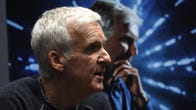
Stan Glasgow, president of Sony Electronics USA
(Credit: Erica Ogg/CNET News.com)The following is an edited and condensed version of the interview.
Q: You have an 11-inch OLED and said you'd be putting $200-plus million into the next stage of investment. How big are we talking here in terms of screen sizes?
Glasgow: In the short term, which is a couple of years--I'm not going to be more definitive than that--we have targeted a 27-inch. We've showed it as CES, we've targeted the initial investment, and that's what we're looking at in the short term. Certainly in the longer term we'd like them to be the same size as LCD. We'd like them to be 52 inch, 46 inch, 36 inch...it's just a matter of time.
What about affordability? How long until these are affordable for the mainstream consumer?
Glasgow: It's going to be years and years until price points come down to where they're anywhere close to LCD. In the not-too-distant future, you'll have a choice in LCD at this size, or you can buy an OLED at the same size at a premium. I almost see it as a potential--and I don't know this, nobody knows the answer--I almost see this as the upper end of flat-panel television.
We can continue to make it thinner. It's 3 millimeters now, but it can get thinner. Eventually it's printable on a plastic substrate that can bend. But I don't think it's going to take many years to get to that level.
What about applications in other devices? I know Samsung's talking about monitors next year.
Glasgow: We are focused on TVs. Our interest is strictly television at this moment. I'm not saying that will never change, but at this moment that is the most complex area to go after. The bigger you make these, the more complicated they are. They're much simpler to make smaller. So it'd be easier to jump into cell phones, and other types of products, but that's not what we're interested in doing. We're interested in television as our major focus. Our engineering is focused there, and our investment is focused there.
Speaking of televisions, the experiment mentioned last week, with Hancock coming out on the Bravia Wireless Internet Link, is that a one-off kind of thing? Or is there more in the works there?
Glasgow: I'd say maybe it's a step above an experiment. It's brand new what we're doing, how we're doing it. We're trying to excite people by giving them content. It's streaming so we don't have the content protection problems...(But) people's bandwidth across the country is very different.
Prototype OLED TVs
(Credit: Michael Kanellos/CNET News.com)The big problem in the United States is we don't have enough bandwidth to really drive content through the Internet and our pipes. Japan has much better pipes, so does Korea, so does Europe. So it's still experimental. we hope to do more in the future, and it's the first one. We're going to try and see what happens.
What about non-Sony content?
Glasgow: It's possible in the future. I'm not going to rule that out; I don't think anyone at Sony would rule that out. (But) we think it's a good first step.
Besides interactive menus feature on Blu-ray, is anyone doing anything that's a really creative use of the medium that we don't know about yet?
Glasgow: There's so much I have no idea about, because we're going to have to open this up as a social network--not just contributions of Sony and other Blu-ray partners. There are going to be contributions from actual customers.
If we had a dream (for) Blu-ray, it would be much more interactive than it is today: No. 1, where you could interface and change things as you want to see them on the screen. No. 2, you could socially interact with other people, it's connected through the Internet...but theoretically you and your friend could watch the same movie, and you could change themes, change endings, all sorts of strange things in the future. Some type of social interaction in the future....And yes, we'll have a lot more (Blu-ray) product out in the next couple of months.
Looking ahead, you're only just getting into Blu-ray. How do you see the future penetration of the format compared with DVD?
Glasgow: That's a good question. DVD took 10 years to really penetrate. We're now in the second year of Blu-ray. My guess is it will probably happen a little quicker in terms of penetration. The pricing is already coming down more quickly than DVD came down. I don't think it will take as long as 10 years, but I don't think it will penetrate to the same percentage because there's a couple of conflicting forces. Certainly, people that want the best picture are going to want it, without a doubt. People that are OK with upconverting DVD players, which is somewhere close to 600, 650, maybe 700 (lines of resolution)--that's not a bad picture either. So a lot of people may be happy with an upconverting DVD player. And (Blu-ray) may not turn over, it may not penetrate to the same extent, because (DVD) was such a big medium change from tape.
But I see it being the major format. It's won the war, that's done. Now it's a matter of: Can we provide an exceptional experience? Can we provide a social part? And can we involve the overall community in, let's say, designing applets and coming up with new things that we can't even think of today?
How critical is the PS3 to your overall electronics strategy here in the U.S.?
Glasgow: I think that there's strength in Sony...it's about having a gaming division and an electronics division, a pictures division, a music division--we've never worked together like we have now. Hancock is a great example. We're so well-connected together. Here we are doing an experiment with a film. We're going to promote the heck out of it through our electronic retailers. The gaming division is working on it at the same time. (The) music (division) is involved. We're operating as a very balanced group. So what I can say is, without the gaming, we wouldn't be as strong and as balanced as we are today. It adds a great deal.
What do you think the effect of these ultra-low-cost computers' popularity will continue to have on the notebook business?
Glasgow: The question is, how important is that in the United States and developing countries? We're doing a lot of research on what consumers want and don't want. And I think we'll get it figured out over time. But is it worthwhile to have a second notebook that starts up quickly, can only do e-mail and connect to the Internet, can't do spreadsheets, and other things you'd normally do? Those are the things we're testing right now.
But what do you think? Do we need fewer devices? Or more?
Glasgow: I'm not the normal consumer obviously. I do an awful lot of e-mail, I connect a lot. I'm not happy with the (BlackBerry-type devices), like this Sony Ericsson I carry around. I find it hard reading, I'm getting older, and it's getting too small. But I don't want to carry my notebook around because it takes awhile to start up. So something in between would be very cool, and it wouldn't bother me to have an extra PC around.
That's sort of what we're thinking in this country. I think the emerging countries are different...But in terms of the U.S., we have a lot of homework to do.
Now, last month there was a report that Quanta was making a mini-notebook for you guys. Is there any truth to that?
Glasgow: I can't say yes or no. I love all the rumors, though.
What do you think about this Blockbuster/Circuit City proposed tie-up as far as retail electronics goes? (Note: later that same day Blockbuster announced its plans to abandon its bid for Circuit City.)
Glasgow: It's fascinating what's happened in the last 10 years in electronics retail. The big have gotten much bigger and extremely successful, like a Best Buy. The smaller guys, regional retailers, have done extremely well. The middle-sized guys have gotten into a lot of trouble. It seems that the companies expanded too much, but haven't prepared the infrastructure properly to service customers.
It's also interesting to watch how well Wal-Mart and Target have been doing, in terms of building more consumer electronics...
Circuit City--we want a very strong No. 2 (electronics retailer). Best Buy is certainly the leading company. We would like Circuit City to be strong. How that gets done--it can be done in many different ways.
My hope is that either by themselves, or by merger, or by working with another company that they'll be stronger than they are today. We think the possibility is there, and we support them. A good, strong No. 2 player in consumer electronics is a positive thing for manufacturers. They've got 800 stores. There are not many companies that have 800 electronics stores.
Turns out, the so-called Netflix box could be even cooler than initially thought.
The tiny black device from Roku was introduced to the world in May as the first box that could stream Netflix's "Watch it Now" option directly to a television.
But the company is saying there could be more where that came from.
(Credit:
Roku)
Roku's vice president of consumer products, Tim Twerdahl, said Wednesday that, yes, more content partners are coming, but, no, he's not saying who just yet. That makes the $99 price tag look that much more attractive.
So who will it be? YouTube seems obvious, as they've been partnering with a bunch of hardware makers lately: Panasonic, Sony, Apple, Hewlett-Packard.
Or what about Hulu, as my colleague and CNET's resident home theater expert John P. Falcone suggests?:
The Netflix vids use the VC-1 codec, but the box can handle H.264 as well. Of course, because all of these players--Apple, Microsoft, Netflix, and Sony--are already trying to sell you videos, it's unclear why they'd want to provide a free competitor that's just a click away. So even if a Hulu option is technically feasible, business considerations may keep it relegated to the drawing board. But hey, we can dream, can't we?
Either way, Roku will have to differentiate. Rumors are flying fast that at E3 next month, Sony or Microsoft (or maybe both) will announce support for Netflix's "Watch it Now" feature as well, for the PlayStation 3 or Xbox 360, respectively.
And though far more expensive than $99, both game consoles have large install bases, and are also far more functional beyond just streaming video.
A former vice president of Hewlett-Packard's printing division has been indicted by federal prosecutors for allegedly sharing with HP confidential information from his previous employer.
First reported by Wired, the indictment was filed Friday in U.S. District Court in San Jose, Calif. As director of sales and business development in IBM's printing division in March 2006, Atul Malhotra allegedly requested confidential information about IBM pricing. Just two months later, Malhotra took the position of vice president of HP's printing division.
In the indictment, prosecutors say Malhotra e-mailed the IBM information, marked "confidential," to an unnamed HP senior vice president on July 25, 2006, and again to another HP senior vice president two days later.
He was fired shortly thereafter, in September 2006, according to HP.
"The activity with which Malhotra is charged was in direct violation of clear HP policies, including HP Standards of Business Conduct," the company said in a statement. "HP detected this activity, conducted an internal investigation, terminated Malhotra's employment from HP, and reported the activity to appropriate enforcement agencies and to IBM. HP has cooperated fully with the government's investigation."
The inventor of the Sugar user interface used in the One Laptop Per Child's XO says his company is developing a version for Intel's own low-cost laptop.
(Credit:
Intel)
Walter Bender said in an interview Thursday with PC World that "a community volunteer is working with Intel on Sugar for the Classmate PC. Sugar Labs helped to expedite the relationship."
Bender is the inventor of the kid-friendly interface, which sits on top of a computer's operating system. His company, Sugar Labs, was spun off from OLPC in May. At the time of the announcement, Bender said Sugar Labs was already talking about sharing the UI with at least four other low-cost laptop makers, including Asus.
He described OLPC as the "primary, but not exclusive, downstream project" for Sugar Labs, and confirmed that the two companies continue to work together on further development of the UI.
That Intel will be working tangentially with OLPC again is notable. The chipmaker left its position as board member of OLPC in January, citing "fundamental differences" between the two companies' visions for low-cost computing. Previous to that, OLPC's founder Nicholas Negroponte had asked Intel to stop selling their Classmate PC platform because it was interfering with sales of the XO. Unsurprisingly, Intel declined his request.
IBM's Roadrunner supercomputer was named the fastest supercomputer in the world Wednesday after breaking the petaflop barrier earlier this month.
(Credit: IBM)
Good news for green tech: The fastest supercomputer in the world is also one of the most energy efficient. That's according to the Top500 supercomputers list, to be released Wednesday at the International Supercomputing Conference in Dresden, Germany.
Twice yearly, the list measures the 500 most powerful computer systems available commercially. This year, the 31st time the list has been put together, the honor of top supercomputer goes to IBM's Roadrunner, which is housed at the U.S. Department of Energy's Los Alamos National Laboratory. It's the first system to reach 1.026 petaflops (1 petaflop is equal to a quadrillion, or one thousand trillion, calculations per second).
For perspective, last year's most powerful computer, Lawrence Livermore National Laboratory's BlueGene/L--also made by IBM--reached 208.6 teraflops. This year that computer ranked No. 2, reaching a max processing speed of 478.2 teraflops.
Fun fact: the fastest supercomputer in the world--used to monitor the U.S. nuclear weapons stockpile--is really just a PlayStation 3 on steroids. Roadrunner is based on the IBM QS22 blades, which are built using advanced versions of the Cell processor in Sony's PS3. It also runs using x86 chips from Advanced Micro Devices, making it the world's first hybrid supercomputer.
In total, Roadrunner takes up 278 refrigerator-size server racks, and connects 6,562 dual-core AMD Opteron and 12,240 Cell chips.
IBM, which continues its dominance of supercomputing, makes 210 of the 500 systems, including 5 of the top 10. Hewlett-Packard is close behind, however. HP makes 183 of the fastest computers, including the No. 8 fastest system known as EKA, located in Computational Research Laboratories' data center in Pune, India.
Rounding out the top 10 is Sun Microsystem's Ranger at No. 4, Cray's Jaguar at No. 5, SGI's Encanto at No. 7, and SGI's Altix at No. 10.
On the processor side, Intel dominates the high-end market with 75 percent of all systems on the list and 90 percent of the quad-core based systems that were ranked.
Supercomputing, which pits the highest-end machines against challenges such as forecasting the global climate in coming decades or finding oil reservoirs underground, is a fast-changing field. The Top500 list once again had the most turnover compared with the preceding list, according to the researchers who compile it.
The main measurement used in compiling the list is the Linpack measurement, which puts each system through its paces by having to solve a dense system of linear equations.
The Top500 acknowledges that Linpack isn't a complete test of system performance, but it's a way to test for performance on a similar problem across each system. The need for a more complete benchmarking system has been under discussion for several years.
Some additional interesting statistics about the June 2008 list:
* Quad-core processors are used in just over half of the systems.
* The bulk of the systems (208 of the 500) contain between 2,049 and 4,096 processors. That's more than double the systems that used that amount just six months ago.
* Four of the top five computers (Nos. 1, 2, 3, and 5) are located in U.S. Department of Energy labs.
* The U.S. continues to be home to the most computing power in the world. Just over half of the systems (257) are located in the U.S. The U.K. is next with 53, followed by Germany with 46, France with 34, Japan with 22, and China with 12.
After "not specified," the most popular application area for these superfast computers is finance (15.2 percent of the list), followed by research (10 percent), geophysics (9.8 percent), information service (6.2 percent), and service (5.2 percent).
J.T. Wang
(Credit: Acer)Acer's been on a roll lately, and Friday it rewarded its top two executives.
The world's No. 3 PC maker appointed Acer Chairman J.T. Wang to CEO of Acer Group, which includes Acer affiliates, and Acer Presdient Gianfranco Lanci to CEO of Acer. Wang will also remain company chairman.
In the release regarding the promotions, Acer noted that since the two took over as chairman and president, respectively, in 2005, Acer's revenue has increased from $9.7 billion to $14.1 billion in 2007.
Gianfranco Lanci
(Credit: Acer)
Taiwan-based Acer was the fastest growing PC company in the world in 2007, and leapfrogged rival Lenovo as third-largest vendor of PCs. It grew both organically and through acquisitions, adding Gateway and Packard-Bell to its ranks last year.
Worldwide PC shipments are on pace to grow 15.2 percent in 2008, according to IDC. That's above the analyst firm's March prediction of 12.8 percent growth. But laptop shipments, which have become an increasing force in the PC market, will peak.
Shipments of portable PCs should grow 34.5 percent this year, according to a PC shipment tracker that IDC released this week. That's up from 33.9 percent in 2007 and way above the projected 13.4 percent for next year. By 2012, according to the firm, portables will increase by only 9 percent.
PC makers such as Hewlett-Packard are betting big on notebooks. The company this week released 17 new models, mostly for consumers.
(Credit: Hewlett-Packard)By the end of the year, PC makers will have shipped 310 million units, close to half (145.1 million) of which are notebooks. The rest are desktop PCs and servers, which together on a global basis still comprise the largest slice of the market, but the difference is disappearing fast.
Portables are especially expected to take off internationally this year, growing from 78 million in 2007 to 109.4 million units this year. That's good news for the industry because notebooks and laptops tend to be pricier than desktop PCs, and they should keep average selling prices higher for a bit longer.
But inexpensive notebooks are stirring up the market too. A reason for the dramatic 40 percent bump in international portable shipments has a lot to do with how the numbers have been counted, according to IDC.
The firm said it had previously not included the rapidly growing low-cost mininotebook segment because of the "use of nontraditional PC designs, including the use of embedded or custom operating systems, (as well as) reduced processing power and storage," IDC said. But now, due to the popularity and computing robustness of the Asus Eee PC, the Classmate PC platform from Intel, and OLPC's XO, mininotebooks are included. Plus, the firm notes, the volume of units shipped are actually rising.
Those three manufacturers have some company in the consumer space. Acer, Hewlett-Packard, and perhaps Dell already have, or plan to release, their own tiny laptops.
The scorer's table, courtside at Staples Center.
(Credit: Erica Ogg/CNET News.com)LOS ANGELES--Never mind the nail-biting lead changes down the stretch, or the dazzling display put on by league MVP Kobe Bryant here at Game 3 of the NBA Finals.
Try also to forget Jack Nicholson holding court from his usual spot at Staples Center. Shrug off the fact that Sylvester Stallone, Eddie Murphy, David Beckham, and Hugh Hefner are all sitting a few feet away. One of the biggest stars in Los Angeles Tuesday night stayed quietly out of sight.
Logging the mind-boggling amount of statistics produced in a single National Basketball Association game is an intense undertaking. And the league has fine-tuned a tech setup to get the job done. A private network, a series of tablet PCs, and a precision PC-powered timing system have to work perfectly in concert to collect, process, and deliver game details posthaste.
Tablet PCs are used to input the more than 500 statistical events in a single NBA game.
(Credit: Erica Ogg/CNET News.com)And in the case of the finals, technology partner Lenovo has used both teams' statistics to predict the future. Here at Staples Center, before Game 3 between the Los Angeles Lakers and the Boston Celtics, I'm told that a technology called the Lenovo Stat has already predicted the winner of the series.
With a plus-minus statistic developed by the PC maker, the Stat determines the best possible five-player combination for each team, and it rates them according to their output and effect on their team. The Lenovo Stat, featured on NBA.com, is also distributed to coaches and players.
In the playoffs, the Boston Celtics have a leading rating of +79, the Lakers are right behind, at +66. We'll see what happens, but so far, the series is led by Boston, 2 games to 1, after the Lakers won Tuesday night (to this LA girl's supreme delight), 87 to 81.
But back to the technology. Before tip-off, I got a look at who and what is behind producing the incredibly detailed and specific real-time stats for a game.
Here is one of the monitors that displays the statistics in real-time.
(Credit: Erica Ogg/CNET News.com)"Stats are the language of our sport--or any sport, really," said Steve Hellmuth, NBA executive vice president of operations and technology. That is why the NBA logs statistics of its games in exhaustive detail. In real time, they are processed and fed to media outlets covering the game.
Ensuring that no potential stats go unlogged during the nearly 500 possessions of a single game requires a technical coordinator, a play spotter, and two people tasked with stat input.
Recorded plays include tipped passes, missed shots, illegal picks, charging fouls, and, of course, points scored, rebounds, and assists. In 1,300 regular-season NBA games, that amounts to more than 675,000 statistical events logged, according to Lenovo. At all 29 NBA arenas, the data input specialists use a no-frills ThinkPad X61 tablet PC.
Behind the NBA's Precision Time system is a ThinkPad that parses the clock's stops and starts.
(Credit: Erica Ogg/CNET News.com)The data is instantly sent to the scoreboards plastered all around the court, the with related graphics appearing on the televised broadcast of the game, NBA.com, as well as scores of monitors scattered about the arena at press tables and announcer booths.
The information is also sent over the NBA's private network to Secaucus, N.J., where a host of inputters log metadata related to game highlights. These contribute to the league's digital-video archive, searchable by players, coaches, TV analysts, and even referees looking for trends and details from the video footage, according to Hellmuth, who has had a hand in developing the high-tech statistics-gathering processes for both the NBA and Major League Baseball.
The NBA's also taken to perfecting the timing of the game with special computers. Down at the scorer's table, closer on the edge of the court, is a ThinkPad, which acts as a "parser." It records every time the game clock is stopped and started again.
The belt pack worn by NBA referees signals when to stop and start the clock. It's held by its inventor, Michael Costabile.
(Credit: Erica Ogg/CNET News.com)It's synched up with a remote unit the referees wear on their belts. Every time one of them blows their whistle, the sound sends a signal to the belt unit, which tells the clock to stop and start. The system, used by most college sports arenas as well, was invented by Michael Costabile, president of Precision Time.
The league uses this method because it's the least error-prone. "A human takes two-tenths of a second" to stop the clock after hearing the referee's whistle, said Hellmuth. "That's why we say 'a game is 48 minutes long, more or less'--because there are humans on every side of it."
It may be sitting pretty atop the PC market, but Hewlett-Packard isn't going to sit still.
The world's largest PC manufacturer plans to roll out 50 new products Tuesday at a conference in Berlin, the largest such product refresh in the Personal Systems Group's history. Of those products, HP added new touches to just about everything, freshening up its TouchSmart all-in-one desktop, commercial and consumer notebook lines, as well as two machines within its high-end gaming brand, Voodoo PC.
While it's that time of year for product refreshes, this is more than the usual speed bump or spec tweak. Though competitors like Dell, Acer, and Lenovo are increasingly focusing on consumer retail PCs, HP is showing that it doesn't want to give up any of the ground it's gained over the last couple quarters.
"They're fortunate for being in right place at right time: being in consumer, and being in retail," said Richard Shim, PC analyst with IDC. "They're showing they're not taking that for granted, and keeping consumers engaged in the products."
It's a tough task when most PCs are made by the same manufacturers with products from shared suppliers. That's where HP hopes its new and improved TouchSmart PC comes in.
It's slimmed down in size--far more minimalist in design concept--and price compared with the original model, but the key is really the improved touchscreen interface. Exterior design used to be a way to stand out, but with a category in decline like desktops, a unique software experience could be an attention-getter.
Offering an experience that you can't get from a Windows-based Dell, or even an Apple iMac, is complicated, said Shim. "That really separates the major players from the minor players, since only the big guys can afford to do this kind of thing. HP is taking advantage of its position in the market."
The new HP-only interface is also a kind of "end-run" around Microsoft's Windows we'll be seeing more often, said Ross Rubin, director of industry analysis for The NPD Group.
It's already happening in the mininotebook category, where instead of being limited to one option for an operating system, PC vendors are offering different flavors of Linux, as well as alternate interfaces that sit on top of Windows.
Design continues to be a priority for HP, as evidenced by the new products, from the high-end to the refreshed line of consumer notebooks, to the new brushed aluminum finish for its commercial Elite line.
But it's the Voodoo brand where HP is most able to experiment with new looks.
Last week, Rahul Sood, Voodoo PC's founder and current CTO of HP's global gaming business, released photos of him cutting his birthday cake with the famously thin MacBook Air. In the accompanying blog, Sood slyly remarked that he "wouldn't be needing this notebook for long anyways."
The Voodoo Envy 133
(Credit: Hewlett-Packard)That's because HP's got its own razor-thin notebook now, called the Voodoo Envy 133. Though the price (starts at $2,099) puts the machine out of reach for most mainstream PC buyers, the ultrathin and light Envy is HP's attempt to position the Voodoo brand name in the same arena as Apple and Lenovo. For now Voodoo still has limited awareness outside the gaming and performance PC enthusiast crowds. As with the Blackbird 002 gaming desktop, the Envy will tie HP's recognizable brand to up-and-coming Voodoo.
The other Voodoo product released Tuesday is a departure for the brand in another way. A new gaming tower, the Voodoo Omen, is unlike anything HP has released before, and has no real counterpart in terms of design in the gaming world. The Omen is stark and simple on the outside, with brushed aluminum tower with the Voodoo logo on the face replacing colorful plastic. It's nearly the exact opposite of last year's Blackbird, or
Despite all this, there's still big challenges for HP ahead as it attempts to differentiate its products from the rest of the field and offer a wide array of products. Not only are they trying to take on Apple in terms of design and innovation, but it's still doing battle with and old, but suddenly resurgent foe, Dell. Plus, Acer is selling notebooks like hotcakes, and even Asus is trying to push its way into the consciousness of the mainstream PC buyer.
So despite the progress the company has made, HP can't get comfortable.
"The challenge for them, is that other guys will do same thing," observed Shim of IDC. "The difficulty for HP is to integrate new technology and new innovation and still remain price competitive."
Pictures of the Eee Monitor, the upcoming all-in-one desktop PC from Asus, have surfaced.
A PC World reporter at the Computex trade show in Taipei snapped a few photos of a company slide showing the Eee Monitor. Head here for the images.
It appears quite iMac-esque--shiny and white with a minimalist design. And although Asus isn't confirming a price just yet, it's a fair assumption that the Monitor, part of Asus' low-cost Eee line, won't have an iMac-esque price tag.
Details surfaced in January suggesting a $499 price point. The Eee Monitor is supposed to use Intel's Shelton platform and include a TV tuner, and a display between 19 inches and 21 inches.
It should be available in September, which is almost a year after new all-in-one PCs from Dell and Gateway began to hit the market.