• On BNET: 3 worst things about the iPhone 3G S
August 26, 2008 10:39 PM PDT

Mozilla Ubiquity, Microsoft IE8, and the fracturing of Web pages

by Rafe Needleman

Mozilla on Tuesday released a public prototype of Ubiquity, a curious command-based interface to locating information on the Web and creating compilations of information from various sources. See: Mozilla offers do-it-yourself mashups for all.

At the moment, it's most capable as a command-line browser. You press the hot key, ctrl-space, and you can just start typing lookup commands, like "imdb Blade Runner." Or, if text is already selected in the browser, your command will act on them. Mouse over a restaurant page in Yahoo Mail, press the hotkey, and type "yelp" for a review, for example.

Ubiquity can find and insert map images into e-mails.

But the most interesting application is Ubiquity's capability to extract items from Web pages and insert them in whatever you're creating, like an e-mail message or a blog post. At the moment I believe the only site you can extract data from is Google Maps, but clearly Mozilla's direction is to build a platform that takes bits of data from Web resources and pastes it together on the user's behalf.

Microsoft, too, is putting resources into a new feature that parcels out Web pages. In the upcoming Internet Explorer 8, the browser supports a feature Microsoft calls, "Web Slices," which is the platform's capability to take a portion of a Web page--like a stock chart on a financial page--and display it as a pop-up widget that's called from the bookmark bar in the browser.
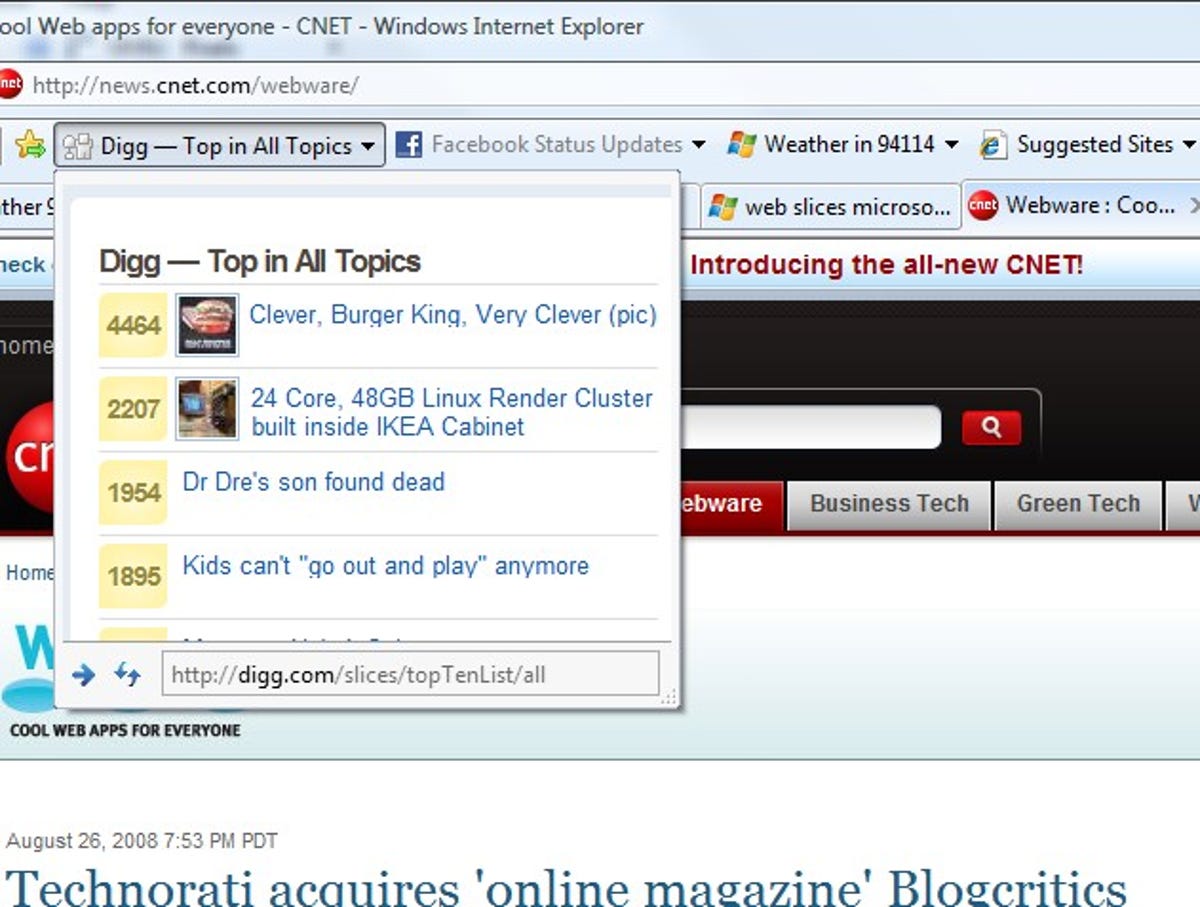
Slices on Internet Explorer are part RSS feed, part widget.

Slices are built using a combination of protocols, including Microformats, RSS, and new HTML tags that IE uses to demark Slices.

Together, Ubiquity and Web Slices lead me to believe we're entering an era of fracturing Web content. Already we have seen content separated from presentation with RSS, and we've given developers access to online data for their mashups via Web APIs. But the growth of Microformat-coded Web pages will make it possible for users to more easily create their own mashups--personal profile pages that have just the pieces of Web content they want, or e-mail messages made up of live maps, automatically updating weather forecasts, up-to-the-minute travel information, and so on.

It means that developers will have to learn how to code pages for modularity. Conceptually that's not that big a deal, although if coding for Ubiquity and coding for Slices is different, it's going to be a technical mess. What I am waiting to see is how managers wrestle with the branding and revenue implications of letting their sites be mashed up and refactored into tiny pieces all over the Web, by anyone. I predict that the sites that give away the most data will reap the biggest benefits, but that will be a difficult leap of faith for many publishers.

See also: ActiveWords.

Rafe Needleman writes about start-ups, new technologies, and Web 2.0 products, as editor of CNET's Webware. E-mail Rafe.
Recent posts from Webware
Firefox 3.5 and the potential of Web typography
Sites that help you lodge complaints
Google App Engine misfires
Microsoft: Bing needs to improve when news breaks
Google finally sued by makers of Finally Fast
Google Toolbar for IE speaks your language
Bing brings out the tweets
Google Search optimized for a mess of phones
Add a Comment (Log in or register) (11 Comments)
  • prev
  • 1
  • next
by andrew.mager August 26, 2008 11:43 PM PDT
It's clear that Mozilla is way ahead of Microsoft now. I wouldn't say they are fracturing content, but enabling it.

Ubiquity's interactivity will help make the web user more modular. And it's way more interactive than anything IE 8 could accomplish.
Reply to this comment
by Lerianis August 27, 2008 12:57 AM PDT
Yeah, Mozilla is way ahead of Microsoft now.... I really expect Microsoft to steal this functionality and codebase at some point and put it into Windows.... heck, I think even Apple with OSX will be doing that!
by Lerianis August 27, 2008 12:55 AM PDT
This looks like it might make things better on the web, but lets face facts here: I don't really have problems with doing things like this right now, copying and pasting things into e-mails, cutting and pasting pictures into e-mails, etc.

Maybe in the future of 5 years from now.... when there are HUNDREDS of BILLIONS of websites, this will be more useful.
Reply to this comment
by Lerianis August 27, 2008 1:52 AM PDT
This looks like it might make things better on the web, but lets face facts here: I don't really have problems with doing things like this right now, copying and pasting things into e-mails, cutting and pasting pictures into e-mails, etc.

Maybe in the future of 5 years from now.... when there are HUNDREDS of BILLIONS of websites, this will be more useful.
Reply to this comment
by Penguinisto August 27, 2008 7:28 AM PDT
Actually, I see a genius in this - though not necessarily for the user.

Being command-line based, it means that the critter can be scripted. Tie it to curl (the little *nix web-browsing utility that does some rather big things), and you can combine the two to do some pretty awesome things from the server-side.
Reply to this comment
by alexcnovak August 27, 2008 10:00 AM PDT
I think this concept helps us more fully utilize all the current tools and websites at our disposal. Specifically, it helps us cut out steps in our daily processes. Also, we see a more intelligent search engine for the masses.

Philosophically, this could be another way to give the Internet back to the people.

On the other hand, one would wonder about the logic behind the search results--is it a matter of availability or who pays more or who knows who?

Overall, I am excited by this concept and feel that the potential is enormous.
Reply to this comment
by apetrelli August 27, 2008 10:20 AM PDT
When a small non-profit out-innovates Microsoft, it says something.

It says that Microsoft is no longer creating new products and innovating for its customers, it is instead in the business of *rationing* technology, of restricting traffic through dense, rich economic pastures to narrow pathways, with toll booths and other accouterments of control. The company is a rent-seeker defending its decade-old turn, not an enabler.
Reply to this comment
by tinyCrunch August 27, 2008 8:49 PM PDT
I?d like to see the time frame in rolling this out. Natural language projects seem to be developing into the mainstream slowly and without much praise. Is this really feasible? polling this issue at tinyCrunch.com. 'same great crunch, now with less fat'
Reply to this comment
by gengaretjax August 28, 2008 9:40 AM PDT
FDLMAO,

IE8/Mozilla/Opera - They are browsers people for all glorified purposes a gateway to the information super highway. Comments like apetrelli and others seen all over the world are misleading and disgusting.

Mozilla is a profitable solution for AOL. Though, you may not see this you should research your choice of stool standing before preaching to the masses.

Microsoft is profiting from MSIE, what developer makes something for nothing? From China to the America's everyone is looking for something to be given in return for work performed.

The model adopted by Time Warner/AOL just seems to appeal to you more...find and dandy. I for one find the Mozilla product nice for what it is however, completely and utterly to much for what I need to do my job.

I find that though innovation between IE6-IE8 was lacking the only bar to hold all other current browser's is built by a company that you call restrictive and dense. So be it...then by deference and association your chosen platform has many of the same failures and features missing.

Each platform can easily be shown to be missing some feature, service or function that I need. Yet, I prefer to stand on a soapbox that is more rooted in physical and tangible things such as hurricane's and geo-politcal issues. However, I'd love to see more ranting and amusing comments from the sheep...

hahahhaha
Reply to this comment
by theproductguy August 29, 2008 10:45 AM PDT
The products of the Internet are evolving into a more connected, interoperable, portable environment of customized user experience. I have been writing about this emerging trend for quite a while now, called Modular Innovation. I am recommending my readers take a look at this article for more insight into some products participating in and contributing to the trend of Modular Innovation....

http://tpgblog.com/2008/08/29/the-product-guys-weekend-reading-august-29-2008/

Jeremy Horn
The Product Guy
http://tpgblog.com
Reply to this comment
by freeword September 22, 2008 8:11 AM PDT
I think is great for the uber geeks to become super uber geeks - and for the web to become more fodder for the people who runs google-adword sites. I am going to learn how to blpck my sites from being mashed.
Reply to this comment
(11 Comments)
  • prev
  • 1
  • next
advertisement

About Webware

Say No to boxed software! The future of applications is online delivery and access. Software is passé. Webware is the new way to get things done.

Add this feed to your online news reader

Webware topics

Making sense of Windows 7 upgrades

faq The basics and the fine print on Microsoft's options for those eyeing the next operating system from Redmond.
• Full Windows 7 coverage

Road Trip 2009: Big Sky Country

CNET News reporter Daniel Terdiman takes his car full of gadgets to the Rockies and the Great Plains in search of tech, science, nature, and more.
• America's Fortress: Cheyenne Mountain

advertisement

Inside CNET News

Scroll Left Scroll Right