IT pays the price for your fun at work
It's clear that the line between work and play is blurring. Many people check work e-mail accounts in their off hours as much as they check their personal e-mail accounts. And who isn't occasionally distracted by something on Facebook or YouTube during the work day?
Security specialist FaceTime Communications commissioned a survey of nearly 530 IT managers and end users to find out exactly how people are using the Internet at work and what impact those activities have on their IT departments.
Ninety-seven percent of end users surveyed reported using one or more Internet applications at work, up from 85 percent last year, and 82 percent say they use Web conferencing, according to the survey due to be released on Monday.
All that Web use has a downside, though. Seventy-three percent of IT managers reported having had to deal with at least one Internet-related attack at work, with viruses, Trojans, and worms being the most common type, followed by spyware.
On average, IT managers reported 34 incidents per month. A typical incident takes 22 hours to fix and can cost a company as much as $50,000 based on an hourly IT worker wage of $70, according to the report.
Social networks and social media sites are particularly popular in office settings. More employees use social media sites at work for personal reasons (82 percent) than for business reasons (79 percent), the survey found. LinkedIn is the most commonly used site for professional purposes, while YouTube, Facebook, and MySpace are the top three social media sites used for personal purposes.
But the most common personal use of a corporate PC is for e-mailing friends and family. Then people like to Web surf; bank; shop; visit music, photo, or video sites; IM with friends and family; and connect with friends via social networks.
Corporations also continue to keep a watch on employee activities on the Web. Nearly 80 percent said they monitor corporate e-mail, 65 percent monitor Web browsing, 40 percent monitor peer-to-peer file sharing, 38 percent monitor IM messages, and 36 percent monitor social-networking activity.
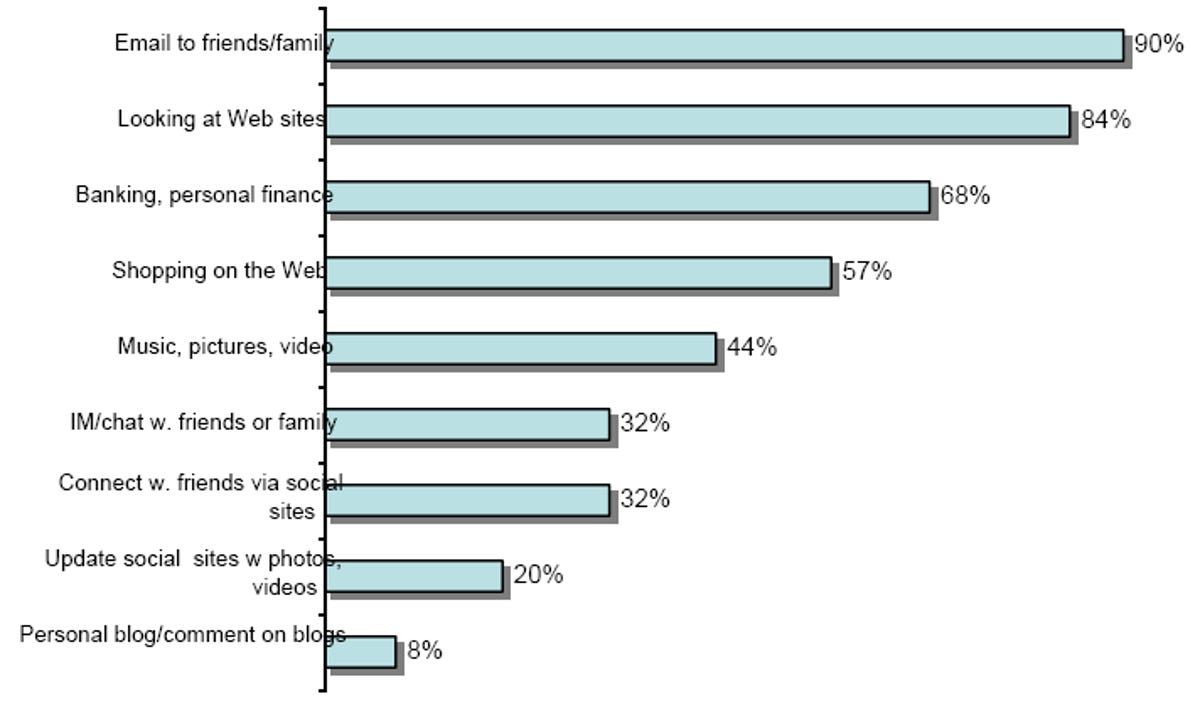
FaceTime's survey found that personal e-mail is the most popular non-work Internet activity for corporate workers, followed by Web surfing, banking, and shopping.
(Credit: FaceTime Communications)
Elinor Mills covers Internet security and privacy. She joined CNET News in 2005 after working as a foreign correspondent for Reuters in Portugal and writing for The Industry Standard, the IDG News Service, and the Associated Press. E-mail Elinor. 


Before computers, it was the phone being used to take care of personal stuff during business hours. Trying to stop the behavior is useless, the only thing companies can really do is teach their employees online safety.
Everyone is resistant to replacing Windows computers with Macs, and of course the IT industry is filled with all sorts of dire warnings about the awful consequences of using Macs and all the reasons Macs can't be used in business. I've found those to be bunk, and have discovered that almost all PC users in our business get along just fine with Macs.
Folks claim that Macs are more expensive than PCs, but those folks don't factor in downtime and lost productivity due to viruses and malware. When you factor those in, the Macs come out to be cheaper--and not just a little bit cheaper, a lot cheaper. Plus I can go on vacation without spending hours on the phone walking people through their virus problems.
It all boils down to perspective.. I've been working in IT industry since 9 years exclusively on windows and never once have I seen my network or sys admin having had to clean up because of a user downloading a virus. You are talking as if the only job for a windows admin is to clean up malware!..
From my [and the users of the 4 companies I worked for 9 years], windows systems are rock solid.. [Provided you keep up with the Microsoft patches and follow good browsing habits]
I'm curious with hardware repairs and downtime with the Mac and PC. As Apple will not authorize anyone to work on their systems outside of their service center, how do you deal with the unavoidable downtime that results from having to send the systems to them? Or do you just work on it yourself and hope Apple doesn't learn about it and void the warranty? I know with Dell/Toshiba/HP/Lenovo/Acer/etc.. .you can be OEM certified and work on the systems right tjhere on site and have a downtime of nearly zero if you have the parts on hand, or overnight if you have to order them. With Apple you are looking at 5-7 business days at the earliest.
This sort of downtime for hardware issues (and hardware fails regardless of brand name) is one of the reasons that keeps Apple out of the corporate world in a wide deployment. If Apple would allow others to service their systems, they could really help their adoption I think, but that would also mean releasing control over the money they could make on that same service.
It's a tricky situation.
What?s my point, actually I have three . . .
1- It is called WORK for a reason
2- Stop your WHINNING and be glad you can pay the rent
3- If you do not like the work, quit, I can hire someone who will not whine before you can clean your desk
Well her dancing bears were not compatible with the version of java we use at work.
So she installed the latest one that broke our in house java apps then she complained she could not get any work done after I fixed it by removing the dancing bears. She reisntalled the bears and started the process all over again and said I did not fix the problem. I refused to talk to her ever again.
As for your actual argument, workers can be held just as responsible for the amount of work they are expected to do if you macro-manage. In fact, they gain perspective on the importance and impact of the work they perform, and they perform it with greater zeal, knowing well that their name is linked to their work(or lack thereof). Most successful large businesses(with the exception of IBM) realize that they want humans at the helm, not monkeys.
Of course, trying to ban leisure surfing entirely would probably result in general dissatisfaction and unhappiness in workers.
No third party application allowed on computers no matter if english is not your native language.
Many of these sites hosting tools to read non english makes you download tained programs or has advertising that forces downloads/installs they did not ask for.
Also banned at my building any major league sport website especially if they are based off of FANTASY SPORTS.
Also banned are instant messengers. If you want to use instant messaging then use the free online java versions.
Anything else found on a pc and it will be formatted asap.
1. no admin access for users
2. a written network access policy signed by all employees that clearly spells out what they can and can't do on our system (with exceptions granted by supervisors on a case by case basis)
3. Terminal servers are locked down through GPO, and web traffic on those servers is limited to company web sites via proxy server.
The admin before me let anyone do whatever they wanted and gave user full admin access to all workstations, the result was one very high maintainance system. When I explained this to the owner of the company, he fully supported my position. The end result is a very trouble-free network that sees very little of the problems mentioned here.
I'm not even an Obama supporter but I believe this is why Obama is ahead in the polls. Working Americans have lost trust in the upper crust to let them in on the action when the company does well. Companies have taken all the benefits of productivity gains and on average leave employees with about what they made last year + the rate of inflation.
Only when the economy is really bubbling do people feel any power to negotiate with employers. People should stand up for themselves though and say I want pay + profit, if the company does well I want stock and stock options.
It should almost be a law that a certain percentage of profit must be allocated to employees, say 10%. Then another law would be that you can not pay yourself and your buddies on the board more than 20 times your average employee salary (not including board members) This would create an incentive for board members to get average salaries up, the more they pay the more they can pay themselves.
- by bruceslog October 27, 2008 2:04 PM PDT
- All users should interface via a Live CD.
- Reply to this comment
-
(26 Comments)All company Apps and databases on the server side, LiveCD not allowed to access server side OS changes, only allowed to access needed programs for Work and updating databases.
Specialized client side software on server only.
Prevents your hundreds of user work stations from getting boinked by malware.
And makes it easier to lock down system via server side only apps and data.
Anybody else working on that one yet ?