CAMBRIDGE, Mass.--President Barack Obama on Friday called on the U.S. Congress to pass energy-and-climate legislation, a move he said would stimulate technology innovation and improve the economic competitiveness of the United States.
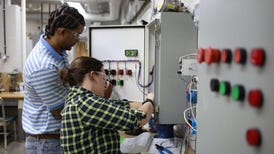
Obama delivered a speech at the Massachusetts Institute of Technology here after touring student laboratories and before attending a fund-raiser for Massachusetts Gov. Deval Patrick.
President Obama speaking on clean energy at MIT on Friday.
(Credit: Martin LaMonica/CNET)A "comprehensive" energy-and-climate bill will address both environmental and economic problems, Obama said. Countries around the world recognize that energy supplies are limited while demand is rising. That situation is giving rise to a "peaceful competition" among countries to develop clean-energy technologies that "will propel the 21st century."
"There are going to be all sorts of debate both in (the) laboratory and on Capital Hill, but there is no question that we have to do these things," he said. "The nation that wins that competition will be the nation to lead the global economy. I'm convinced of that, and I want America to be that nation."
Obama urged Congress to pass an energy-and-climate bill the Senate is now considering, the Clean Energy Jobs and American Power Act. He specifically praised the bill co-sponsor Democratic Massachusetts Sen. John Kerry, who was present at the talk, and Republican South Carolina Sen. Lindsay Graham. The senators co-wrote an editorial in the New York Times earlier this month outlining the main components of a desired bill, which was seen as a key step toward passage.
The House bill, which narrowly passed in May, includes a national mandate for utilities to use renewable energy and a cap-and-trade system in which large polluters can buy and sell permits for carbon dioxide emissions.
The president did not weigh into the details of the existing bills, but he did outline the contours of an energy policy that reduces the country's reliance on fossil fuels while making better use of natural resources.
The ingredients of energy policy should include clean use of coal, oil, and natural gas; "safe nuclear power;" sustainably grown biofuels; and energy from wind, solar, and wave power, Obama said.
"It is a transformation that will be made as swiftly and carefully as possible, to ensure we are doing everything we can to grow this economy in the short, medium, and long term. And I do believe that a consensus is growing to achieve exactly that," he said.
Obama said the Pentagon and energy security hawks are stepping up efforts to reduce oil imports while businesses and environmentalists are working together. Young people, too, view energy-and-climate as the challenge of their generation, he added.
"We are seeing a convergence. The naysayers, the folks (who) would pretend this is not an issue--they are being marginalized," Obama said.
He said key pieces of the Senate bill have been approved in various committees but he warned that opposition to passing an energy-and-climate bill will increase as passage gets closer.
There were about 700 people at the MIT talk, including a number of local green-technology entrepreneurs, investors, and students at the university, which has become a hotbed for energy science and technology research.
CAMBRIDGE, Mass.--A change in national energy policies would help spur innovation around green technologies, but policymakers are motivated by power and pet projects rather than energy security or environmental protection, a panel of energy and business experts argued here Thursday.
The speakers--three academics with expertise in energy and economics and a venture capitalist from Khosla Ventures--delved into the question of what role government should play in energy at the EmTech emerging technology conference at the Massachusetts Institute of Technology on Thursday. On the whole, they were pessimistic about the prospects of effective legislation for promoting a cleaner energy industry.
The talk was timely. Although political debate in Washington has been dominated by health care over the past few months, the Senate is expected to take up a climate change and energy bill as early as next week, following a House version which narrowly passed in May. The broad House bill proposes a national system for regulating greenhouse gases, introduces higher efficiency standards, and calls for a mandate on renewable energy from utilities.
Many companies and investors see energy as a promising area of economic growth, with more than $5.8 billion of venture capital placed in green tech last year. But energy is very different from information technology or other traditional tech industries. Bringing new energy products to market requires not only technology breakthroughs but also coordination among start-ups, large corporations, financiers, and government.
The panelists argued that the House bill of the version is far from perfect but it's an important step because it puts a price on carbon emissions. Under a cap-and-trade program--one of which is already in effect in the U.S.-- large polluters, such as utilities and manufacturers, are given permits to pollute. Those carbon allowances can be bought and sold among participants so that they stay under a cap set by the government.
"We can go into the details about the problems with all the subsidy schemes that have been tried but fundamentally there is this common sense that underlies cap and trade, which is that if something is bad, you should tax it and that is, in effect, what cap and trade does. And that puts things that don't have that bad characteristic in a better competitive position," said Richard Schmalensee, the director of the MIT Center for Energy and Environmental Policy Research.
Right now, there are subsidies and tax credits to promote the installation of solar and wind power. In the federal stimulus plan, the Department of Energy was allotted tens of billions of dollars to fund long-term research and promote development of existing technologies, such as plug-in electric vehicles.
In the past, renewable energy policies have led to boom and bust periods, which resulted in many failed companies, said Henry Lee, the director of environment and natural resources programs at Harvard University's school of government.
To avoid that cycle, the U.S. needs a combination of policies, including tax incentives, research money, and a cap-and-trade program, Lee said. Caps on carbon emissions won't start to take hold for many years, panelists said. So, abandoning existing supports for solar now would essentially shut that industry down, even though the cost of solar continues to drop, Schmalensee said.
Rising oil prices can help drive investments in clean-energy technologies, but the volatility of prices makes sustained investment difficult, said Lee. Another challenge related to energy in the U.S. is the difficulty of locating good spots for wind and solar power projects and the resistance from states over national efforts to build new transmission lines to transfer solar and wind power.
No kind words
In practice, policy making around energy is messy business, the panelists said. It's even harder now, given the fierce partisanship now in Washington and the shaky economic situation, noted Lee.
The trend in energy policy has to been to promote a set of technologies, such as fuel cells or biofuels, for a while but not stay with it, said Lee. Corn ethanol, for example, has been criticized for questionable environmental benefits and contributing to higher food prices, but maintaining the program makes sense because second-generation ethanol could deliver significant improvements, he said.
"One of the problems with Washington is that they fall in love and then they fall out of love after two or three years," said Lee. "But you can't give up on these things after three or four years and in our government we have a tendency to do that. We don't have a lot of patience and it takes time to make things that really work."
Small green-tech start-ups and venture capitalists are now spending a significant amount of time in Washington because energy is heavily regulated. But there's concern that bills are structured to favor certain technologies, said Alex Kinnier from Khosla Ventures, a Silicon Valley venture capital firm that is making an aggressive push into green tech.
"We're all in agreement we want a price on carbon...The thing that concerns us greatly is that the ways these rules can be written can very much bias who the winners are and who the losers are over the long term and can sub-optimize the ultimate solutions," Kinnier said.
For example, incentives to store carbon underground at coal plants will lead many companies into that field. But Kinnier said that policies should also encourage technologies that use carbon dioxide to make a product, such as building materials or chemicals.
Ken Zweibel, director of the GW Solar Institute at George Washington University, criticized the trend toward overemphasizing high-risk, high-reward energy research. "Programs to do practical research have shrunk during the last five years and programs to do high-risk, blue-sky research have gone through roof," he said. Solar photovoltaics are becoming more affordable as prices fall, but proposals to the newly formed ARPA-E are unlikely to yield anything useful, Zweibel said.
He also complained policymakers make decisions based on "very shallow knowledge" and are easily swayed by the media. Fears that China is taking over leadership in low-carbon technologies appear to motivate policymakers more than protecting the environment or concerns regarding climate change, Zweibel and Schmalensee said.
"We are not convinced that we have a global warming problem," said Zweibel. "Let's face it--that's the truth."
Updated September 26 at 6:50 a.m. PT with correction to Alex Kinnier's affiliation.
The House Energy and Commerce Committee passed an energy and climate bill on Thursday that puts a cap on greenhouse gases in a way designed to give heavy polluters years to transition to low-carbon technologies.
The American Clean Energy and Security Act of 2009, sponsored by Congressmen Henry Waxman and Edward Markey, passed through the committee after four days of marathon "markup" sessions where dozens of amendments were considered.
The bill calls for a cap-and-trade system designed to reduce greenhouse gases and a mandate that would require utilities to get a portion of their electricity from renewable energy sources.
Concessions were made during negotiations, causing some environmental groups, including Greenpeace, to withdraw support for the bill and business groups to warn that the impact on new technology development will muted.
Even after the passage through committee by a 33-25 vote, the bill needs to pass other House committees before it can be voted on later this year.
There is concern that the targets won't effectively cut back on global warming emissions. But on the whole, green technology advocates and business people were pleased to see the U.S. move forward with some form of regulation to put a price on carbon emissions.
Carbon regulations will only affect energy-intensive industries such as utilities and industrial manufacturers. Creating a cap that declines over time will stimulate development of energy efficiency and alternative power generation technologies, proponents said.
"As the President's economic advisers said this week, a cap on global warming pollution is essential to our economic recovery and our long-term financial health. The economic benefits of a cap are too big to pass up, and the costs of inaction on climate are too big to ignore," said Fred Krupp, the president of advocacy group Environmental Defense Fund, in a statement.
Other provisions in the bill include a "cash for clunkers" program where consumers get a credit after purchasing a more fuel-efficient car.
A Clean Energy Bank would be created to help finance development of emerging energy technologies, such as algae-based biofuels and enhanced geothermal.
Coal tech and allowances
The cap on greenhouse gas emissions is set at 17 percent below 2005 levels by 2020, and 83 percent by 2050, which is a less aggressive timescale than originally proposed. The cap-and-trade program would allow heavy polluters to buy and sell pollution permits, or allowances.
A renewable electricity mandate would require utilities to get 6 percent of their electricity from renewable sources--sun, wind, geothermal, or biomass--by 2012 and 20 percent by 2020.
In general, businesses prefer a cap-and-trade system over a tax on carbon emissions. A cap-and-trade system works around permits through which heavy polluters, such as utilities and big manufacturers, can buy and sell theses allowances to emit carbon.
The bill is structured so that energy-intensive industries have time to transition to more efficient and less polluting operations by giving them free permits, rather than auctioning them.
In the utility industry, about one-third of the allowances would be free to utilities during the initial years. Giving away these permits is designed to prevent utilities and natural gas companies from spiking up energy cost for consumers.
However, Waxman told committee members on Thursday that he will hold more hearings on allowances to further refine the details, according to reports.
Many politicians from Midwest and southern states that rely heavily on coal for power generation sought to push back the timing of the caps so that technology to pump carbon dioxide from coal-burning power plants can be developed. Many utilities plans to use carbon capture and storage to meet the emissions caps but the technology is still not commercially available.
Meanwhile, politicians from southeastern states that don't have the same sun or wind resources resisted the renewable energy mandate. In addition to using alternatives such as biomass, utilities can partially meet the mandate through efficiency measures.
Policies now being considered to boost renewable electricity generation and efficiency at utilities will make it cheaper to comply with caps on greenhouse gas emissions, said members of the Energy Future Coalition, a group of business, environmental, and labor advocates.
Both the the House and Senate are expected to move ahead with energy and climate change bills in the coming weeks.
The Waxman Markey bill in the House combines both energy and climate regulations in a single bill, while the Senate is working on separate efforts. Committee markup meetings in the House and Senate are expected, starting as early as this week.
One of the key sticking points to passing a climate change bill is addressing the question of whether putting a cap on greenhouse gas emissions will raise prices for energy and by how much. Also, some utility industry executives have said that a limit on carbon is sufficient action on climate change without a renewable energy mandate.
During a conference call with reporters on Monday, members of the Energy Future Coalition argued that the best way to control the costs of complying with greenhouse gas caps is to set national standards on renewable energy and efficiency at utilities. (Click for PDF of analysis.)
"Energy efficiency and renewable energy are going to reduce the amount of carbon that a cap-and-trade system has to deal with," said Marchant Wentworth, the Washington representative for the clean energy program of the Union of Concerned Scientists, which is a coalition member. "In both cases (these standards) establish a market where was not a market before."
One of the provisions of the House energy bill is a national Energy Efficiency Resource Standard (EERS) where utilities would need to run efficiency programs to cut their customers' energy consumption. Nineteen states have already established efficiency standards. The House bill calls for utilities to save cumulatively 15 percent on electricity and 10 percent on natural gas by 2020
These sorts of energy efficiency measures are considered far less expensive than building new power plants--at three cents per kilowatt-hour versus seven to 17 cents per kilowatt-hour--to meet growing demand, while cutting utility bills.
Also proposed is a national renewable electricity standard--already mandated in 27 states--where utilities would need to get 25 percent of their energy production by 2025 from renewable sources, such as solar, wind, geothermal, and biomass.
Diversifying the energy mix with renewables acts a hedge against volatility in the energy markets for fossil fuels and softens demand for natural gas which is used in power plants, Wentworth said.
Under climate regulations, large polluters, notably utilities and heavy manufacturers, would need to ratchet down their carbon emissions in a cap-and-trade system over the coming decades.
Many coal-dependent utilities anticipate meeting caps on greenhouse gas emissions by installing carbon capture and storage technology at coal plants to pump carbon dioxide underground. That technology is still in the research and development phase and is not expected to be commercially available until about 2020.
Meanwhile, efficiency and renewable energy "are technologies that can make a difference between now and 2020," said David Gardiner, a senior adviser at the Energy Future Coalition, on the call.
Transmission upgrade
Critical, too, is the installation of high-voltage transmission wires to carry wind and solar power from remote areas, according to the Energy Future Coalition.
The Energy Future Coalition recommends a high-voltage transmission network dedicated to transferring electricity from wind and solar farms in remote areas of the U.S. to where most of the electricity is consumed in city centers. Members propose that natural gas "peaker" plants that can meet baseload power be part of that grid "overlay" to ensure demand can be met, said Bill White an advisor to the Energy Future Coalition.
All three measures--efficiency, renewable energy, and a transmission lines--will help create jobs, they said. These policies would also help create demand for green technologies like renewable energy and smart-grid technologies.
This year is turning into a crucial year for legislative action on clean energy and climate change.
Although all the major provisions of a House energy and climate bill are now known, after four days of hearings last week, the House Energy and Environment Subcommittee is still seeking to rally enough votes for passage, according to Energy & Environment Daily.
Much of the pushback appears to focus on the cost of complying with greenhouse gas caps, particularly for states that rely on coal, which emits far more carbon dioxide than natural gas.
Under discussion is whether emissions permits, which could be bought and sold in a cap-and-trade system, will be auctioned or granted to utilities and other businesses. The timetable for emission target reductions and the how much renewable energy utilities need to generate is also being negotiated.
States in the south-east U.S. have resisted renewable electricity mandates because other regions have better wind and solar resources. With a combination of hydroelectric, solar, and wind, that region could meet 50 percent of its current needs, according to Wentworth.
LAGUNA NIGUEL, Calif.--Absent having a vote in Congress, the best way for people to tackle climate change is to make clean energy cheap, said President Bill Clinton at a green business conference here on Wednesday.
Speaking at the Fortune Brainstorm Green event, Clinton said through the Clinton Climate Initiative philanthropy, he is involved in a number of projects which show how environmental awareness makes sense for business.
Successful sustainability efforts help provide the political leverage for passing climate change regulations in the U.S., and internationally, Clinton argued.
Former President Bill Clinton speaking at the Fortune Brainstorm Green conference.
(Credit: Martin LaMonica/CNET)The House this week is having hearings on a energy and climate bill that could pass this year, but faces a less certain path in the Senate. Next year, international negotiations on climate change are set to resume in Copenhagen with the purpose of crafting a successor to the Kyoto Protocol.
"The most important thing you can do, unless you have a vote in the U.S. Congress or a seat at the table in the Copenhagen conference is to prove the transformation we are all committed to undertaking is or can be made good economics," Clinton said.
Clinton is involved in projects that touch health and the environment, such as investments in making building more energy efficient or getting energy from landfills. The Empire State Building, for example, earlier this month announced a $33 million energy-efficiency retrofit that will save the owners $4.5 million a year on electricity and pay back the initial investment in under eight years.
Doing this sort of working in developing countries would have a significant impact both on greenhouse gas emissions and on the global economy, he said.
"If I could do just one thing and had the money to do it, I'd do this, I'd do this energy work in countries at middle- and low-income level," Clinton said.
"I am convinced if we do this energy thing right, it will generate not only an enormous number of new jobs and economic prosperity for countries of every income level, it will cause people to re-imagine how they do everything and therefore, the funds will flow to health care and education," he said.
The financing challenge
Even with his confidence in green businesses, Clinton said the details of carbon regulations are still very important. The debate among staffers right now seems to be over how pollution permits will be allocated in a cap-and-trade system--either by giving them to large businesses or by auctioning them off.
His policy recommendations were in line with many of the proposals being discussed in Washington, including a national renewable energy mandate and construction of more transmission lines to move wind and solar energy to demand centers. Changing the federal auto fleet to plug-in electric and hybrid vehicles and mandating energy efficient lighting would help establish those industries.
He said if states resist "decoupling" regulations that give utilities an incentive to be energy efficient, the federal government should mandate it.
Apart from a climate change policy that puts a price on carbon emissions, the biggest barrier to wide adoption of existing green technologies is financing.
The C40 Cities project, working with the Clinton Climate Initiative, sought to secure money from banks for energy service companies to weatherize large numbers of buildings. The energy savings from these retrofits help deliver a return on investments but the economic crisis has derailed some of those projects.
Clinton argued that new financing models need to be developed for environmental projects. Investment banks secure 20- or 25-year financing for construction of coal power plants. Yet cities that want to tap the methane gases coming off landfills to make electricity don't have the same options, he said.
The initiative is involved in a number of projects, including methane-to-energy or smaller scale projects like one in India where people scavenge organic material to make compost fertilizer for farms.
"I'll make you a prediction. I think people in our business will spend more and more time on what to do about urban waste over the next five years because it's a terrific source of new energy and energy efficiency and advances against climate change. It's like so many of these things, it requires the cash up-front," he said.
In addition to solving global problems like climate change, environmental sustainability projects are powerful symbols, Clinton said. Places with lots of sun resources like Arizona and Nevada, which were hit hard by the real estate crisis, could be "virtually energy independent," but people need to see real examples before making bold moves.
"I think symbols are important. The evidence of success spurs people to take new risks and make new investments," he said.
Updated at 8:15 a.m. PDT to change references to the Clinton Climate Initiative rather than the Clinton Global Initiative.
LAGUNA, NIGUEL, Calif.--What do you get when you put the CEO of a coal-dependent utility on stage with two environmental advocates to discuss whether coal can be clean? A surprisingly civil discussion with more than just straight "pro" and "con" positions.
The CEO of American Electric Power, Michael Morris, spoke on the same panel with Michael Brune, the executive director of the Rainforest Action Network, and David Hawkins, the director of climate programs at the Environmental Defense Council on Tuesday at the Fortune Brainstorm Green conference here.
AEP is the second-largest electricity generator in the U.S. and gets 73 percent of its power from coal. The company is now in the process of building a new coal-fired power plant in Arkansas and investing in a demonstration facility to store carbon dioxide from burning coal underground.
Carbon capture and storage, where carbon dioxide is isolated and pumped underground, is considered vital technology to making coal less polluting. Coal is the source of about half the electricity in the U.S. and about 70 percent around the world. At the same time, underground storage of coal--a major contributor to carbon emissions--is opposed because it is not proven and because coal causes many environmental hazards.
AEP's Morris believes that global warming from the build up of greenhouse gases like carbon dioxide in the atmosphere needs to be addressed through carbon regulations. But to think that coal will stay in the ground in naive in his view.
"It's a prism of answers with energy efficiency and renewable energy. But you're kidding yourself if you think you are taking coal off the board," he said.
The technology, being tested in AEP's demonstration facility, is not fully operational and needs to become more efficient. The company is seeking Department of Energy loans to build a larger facility. Energy Secretary Steven Chu is a "big believer," Morris said.
A climate change law that restricts carbon dioxide emissions is likely to come out in the next year, said Morris, who made clear he intends to meet emissions limits in large part with underground carbon storage.
He estimated that building carbon, capture and storage equipment on coal plants pushes the price of electricity up from three to four cents a kilowatt-hour to five to six cents.
To Michael Brune of the Rainforest Action Network, pursuing carbon, capture, and storage technology diverts valuable resources from cleaner sources of energy while making the climate change problem worse.
"The reality is there is no such thing as clean coal. There is not a single commercial plant in the U.S. that captures carbon emissions and stores them underground," he said. "Within the next 10 or 15 years, we could find a way, technologically speaking (to do it). I'm not saying it can't be done. I'm saying we shouldn't try."
Brune said the technology is not yet safe or economical. Coal also has several other bad pollutants, such as mercury, and the source of many environmental and health problems.
"Where does coal come from? It still comes from mountaintop removal...It still pollutes billions of gallons of water a year," he said.
By contrast, the NRDC supports investments for the development of underground storage of carbon dioxide from coal, said Hawkins. The reasoning has more to do with politics than the environment, though.
To pass a climate change law that sets the U.S. on a path of reducing carbon emissions in the coming decades, members of Congress from coal-dependent states need to be convinced, he said.
"We have two ways to do things. We can change the Congress or we can change the Congress' mind. We don't have time to change the Congress," Hawkins said.
The NRDC, like other environmental groups, is also fighting to address other environmental problems from coal, which Hawkins called "fixable problems."
The other reason to forge ahead with research in underground carbon storage is for the U.S. to take leadership in climate change to other countries, notably coal-dependent India and China.
"The way to get China and India to take this seriously is for the United States to treat this seriously," Hawkins said.
Coal: a difficult conversation. From left: Fotune's Adam Lashinsky, AEP's Michael Morris, Rainforest Action Network's Michael Brune, and NRDC's David Hawkins.
(Credit: Martin LaMonica/CNET)Software company Carbonetworks on Monday is expected to announce it has secured $5 million in series A financing, led by clean-tech venture firm NGEN Partners.
The company's software could be described as a carbon accounting package. It allows corporations to do an inventory of their greenhouse gas emissions and provides them with an application to manage a program to cut down on those emissions.
Carbonetworks' applications provide companies with a way to account for their carbon emissions as they would other assets and liabilities.
(Credit: Carbonetworks)A company could, for example, achieve reduction goals by making data centers operations more efficient or purchasing carbon offsets.
There are already regulations in Europe to restrict emissions of carbon dioxide, a greenhouse gas. But for the most part, most corporations around the world aren't mandated to reduce emissions.
But Carbonetworks CEO Michael Meehan said that demand for his company's software is already high, noting that billions of dollars worth of carbon is being traded every year.
That's because companies are voluntarily tracking their pollution or they anticipate regulations will be put in place in the next few years.
"The U.S. market dwarfs anything in the world. So even if it takes a long time, it's worth waiting for," Meehan said.
Even without a federal mandate to reduce greenhouse gases in the U.S., existing state climate laws represent half of the country's gross domestic product, he added. "We still believe things will happen much sooner than five years."
For NGEN, the investment in a software company represents something of a departure. The clean tech venture fund is focused primarily on energy generation and energy efficiency.
Meehan said the equity investment will be used to expand the company's sales staff and operations.
Separately, another carbon-trading start-up, CarbonFlow, is expected to announce initial funding on Monday.
CarbonFlow's software is aimed at project developers looking for a way to record and manage carbon emission reduction projects by following regulated market guidelines, according to the company's Web site.
Will money start to flow to carbon software?
CarbonFlow has raised $2.9 million in its first round of venture funding from Clean Pacific Ventures, OVP Venture Partners, and Meridian Energy Limited, a New Zealand renewable energy supplier, which is a strategic partner.
The San Francisco-based company's founders are carbon emissions trading expert Karla Bell and Neal Dikeman, founder of merchant bank Jane Capital Partner and a contributor to CNET's Green Tech blog.
CarbonFlow's software, which is still under development, is being designed for managers of carbon emissions-reduction projects that want to monetize their carbon credits.
For example, a developer could install a solar energy project that replaces the use of kerosene lamps. The reduction in carbon dioxide emissions from that solar array can be sold on carbon trading exchanges.
The credits are bought and sold by heavy polluters in Europe that are mandated to reduce emissions as well as organizations that make voluntary reductions.
CarbonFlow's hosted software service will give project managers a way to manage projects and provide the audit documentation required to comply with the Kyoto Protocol and other state or regional climate change regimes, said Dikeman.
A schematic diagram of what CarbonFlow's carbon emission project management software does.
(Credit: CarbonFlow)"Think Web 2.0 multi-tenant (software as a service) version of a 'classic' supply chain portal, with document management capabilities underneath, laid on top of UN environmental guidelines in order to hammer the transaction costs and lost productivity caused by the global nature of carbon projects," he said via e-mail.
Dikeman said that he's leaving Jane Capital to focus on the venture. Meridian Energy will use CarbonFlow's software to manage its carbon business, he said.
Also on Monday, another carbon-tracking software vendor, Carbonetworks, is expected to announce its series A round of $5 million.
Carbonetworks' hosted application is aimed at corporations that are doing their own carbon emissions programs, rather than renewable energy project developers. It's designed to give companies a way to create an inventory of their carbon footprint and manage different options for reducing it, which could be energy efficiency programs, purchasing offsets, or carbon trading.
Energy utility executives say that the environment and greenhouse gas regulations top their worry list.
Researcher Platts and consulting firm Capgemini on Tuesday published the results of a survey that asked 100 executives from the utilities industry what their biggest concerns are.
Although there are no federal regulations to restrict greenhouse gas emissions, utility executives are already preparing.
Ninety-five percent of respondents said that the industry's focus on environment has increased from 2006. Global warming, climate change, and carbon emissions were the top environmental issues, according to 77 percent of the participants.
The reason that utilities are taking carbon emissions so seriously is because of impending regional regulations, including the Regional Greenhouse Gas Initiative (RGGI) in the northeast United States.
But there is also a much higher awareness of global warming and carbon emissions in the general public, which ultimately utilities feel they need to respond to, said John Christiens, vice president of Capgemini's energy and utilities practice.
"There's a lot of people talking about a carbon tax, or talking about a carbon cap and trade system, so many executives think the carbon trading will be a reality very soon," said Christiens. "Awareness has reached a certain point and executives recognize this only a matter of time starts to affect their business."
Complicating matters is the anticipated growth of electricity demand. Christiens said demand is anticipated to double by 2030 from what it is today.
To address the growth and prepare for carbon emissions regulations, utilities are looking seriously at energy efficiency technologies and renewable sources of electricity, such as solar and wind.
But even with the rapid adoption of renewable energy, it's still not enough to meet the growth in demand, Christiens said.
"There is a growing interest in an attempt to maximize deployment of those technologies. But most people understand the demand issue and it certainly cannot meet all demand growth. There will have to be investments made in carbon technologies as well," he said.
As a result, utilities are exploring so-called clean coal, which includes cleaner-burning techniques and storing carbon emissions underground, as well as the expanded use of nuclear power.
Utilities are also looking at advanced metering technology and smart grid infrastructure so they can curtail electricity use during peak times of the day.
On the question of deregulation, the study found no consensus, with utilities predicting that there could be more or less.
The aging workforce was also one of the top five concerns of utilities.
The CEO of ConocoPhillips, Jim Mulva, on Tuesday made a pitch for regulations to restrict carbon emissions. His comments came at CERAWeek, a confab of the energy industry's giants.
In his speech, Mulva argued that the incumbent energy companies need to be involved in the creation of rules that favor low-carbon technologies.
Like its competitors BP and Royal Dutch Shell, ConocoPhillips is developing some alternative-fuel technologies such as synthetic natural gas made from coal, which Mulva said is cleaner.
He said right now the U.S. is lagging other countries in establishing regulatory frameworks, a dynamic that "risks a further loss of geopolitical influence."
ConocoPhillips is certainly not the first oil company or electricity utility to call for carbon regulations. For example, the consortium of businesses called the U.S. Climate Action Partnership was founded last year by General Electric, Duke Energy, and companies from other industries.
Still, it's significant that Mulva decided to deliver this message to his colleagues on the first day of CERAWeek, a conference put on by energy consulting firm Cambridge Energy Research Associates.
Another speaker was Rajendra Pachauri, chairman of the U.N. Intergovernmental Panel on Climate Change that shared the 2007 Nobel Peace Prize with former U.S. Vice President Al Gore for work on climate change.
Reuters reported that Pachauri joked he felt like "he was walking into a lion's den" when attending CERAWeek.
ConocoPhillips CEO James Mulva
(Credit: ConocoPhillips)There are currently seven climate change bills in various stages of development in Washington, D.C., according to Earth2Tech, which lays out the differences.
Although many people believe that a tax on greenhouse gas emissions is the simplest structure, more likely is a federal "cap and trade" system, which has successfully been used for other harmful gases and is being pursued in regional regimes.
Polluters would be given an emissions allowance, or cap. If they fall under that threshold, they can sell those allowances to participants.
ConocoPhillips' Mulva said the government should set a "value on carbon avoidance" and gradually implement regulations as low-carbon energy and carbon storage technologies mature.
He also said that most consumers don't realize that conversion to different energy technologies will take years.
"We need to realistically educate the public on a simple fact--that it will take many years to develop alternative sources at the scale required for sustainable economics," he said.
- prev
- 1
- next