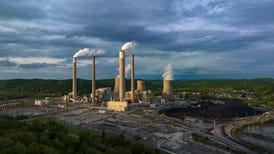
GE's 2.5-megawatt wind turbines, installed at a wind farm in Germany.
(Credit: General Electric)Power company Caithness Energy has given General Electric a $1.4 billion contract to supply wind turbines and 10 years' worth of maintenance for an Oregon wind farm, GE announced Thursday.
The massive 845-megawatt wind farm, Shepherds Flat, will be located near Arlington, Oregon, but span approximately 30 square miles and cover parts of Oregon's Gilliam and Morrow Counties.
GE estimates that it will supply 338 of its 2.5-megawatt wind turbine models to be installed between 2011 and 2012. Although they have been used in Europe and Asia, the company says the Shepherds Flat project will include the first U.S. installations of these specific GE turbines.
"When completed, [the Shepherds Flat project] will be larger than any wind farm currently in operation around the globe," GE said in a statement.
Of course, that comment depends on how you decide to calculate what constitutes a single farm and whether it matters if the wind farm is on land or in the ocean. In July, for example, Texas announced plans to host two 750-megawatt offshore wind farms in the Gulf of Mexico.
Regardless of whether this wind farm will be the largest, or among the largest in the world, there's no question that once completed, it will make a significant impact on power supply.
Shepherds Flat, which has been contracted to provide to power utility Southern California Edison, is predicted to generate about 2 billion kilowatt-hours per year. That's enough power to supply about 235,000 households annually, according to statistics provided by GE.
That power does not come without significant layout costs. New York-based Caithness Energy predicts that the project setup will cost $2 billion, including necessary improvements to area roads and power connection equipment to the grid in order for the wind farm to be operational.
GE and Caithness Energy have also touted how the project will bring some jobs to American workers. An estimated 400 workers will be hired for construction of Shepherds Flat, scheduled to break ground in 2010 and be complete in 2012, and an estimated 35 permanent workers will be hired to operate the wind farm. The estimated number of jobs to be created for the wind turbines' assembly, in a GE plant in Pensacola, Fla., was not disclosed.
Mitsubishi Motors has kicked its Drive@Earth global sustainability initiative into high gear. The company recently announced plans to develop the pure electric, four-passenger Mitsubishi i-MiEV (Mitsubishi Innovative Electric Vehicle) for global markets.
Mitsubishi partnered with the state of Oregon and Portland General Electric for the project. PGE is installing a network of charging stations across its service territory in Oregon and the addition of i-MiEVs further facilitates its support of next-generation electric vehicles. PGE currently has more than a dozen charging stations running.
"We are developing a model charging station infrastructure across our service territory to advance the electric vehicle market in Oregon for our customers," said Jim Piro, PGE president and CEO. "Our customers are number one in the nation in purchasing renewable power so clearly they are committed to sustainability. We expect Oregon to be one of the top markets for next generation electric vehicles. We look forward to partnering with Mitsubishi and the state of Oregon on this important project."
The i-MiEV is smart, roomy, and can run and 80 miles on its lithium ion battery pack.
(Source: Mitsubishi Motors)
The Maui Electric Company and General Electric are joining up to test a unique smart-grid technology on the Hawaiian island's electrical grid.
The Maui, Hawaii, project includes the usual smart-grid tech: developing a substation with battery storage capability to remove and store excess electricity generated from connected wind and solar energy sources. The electricity supply is then released from the substation to the main power grid when it's needed during peak usage times.
Many companies are interested in smart-grid energy technology. Google wants users to confront their home energy use appliance by appliance. IBM is jockeying to be a key supplier for smart-grid tech to utilities. Venture capitalists are investing in smart-grid start-ups.
What's interesting about the Maui Smart Grid project is that it's enlisting regular people to allow their appliances to participate in an electrical grid experiment.
General Electric released news of its Maui Smart Grid project via its employee-authored research blog, From Edison's Desk, on Wednesday.
"For example, consumers may 'opt in' to utility programs that automatically adjust high energy consuming devices, such as water heaters, during periods of peak demand and higher electricity prices," Devon Manz, an energy systems engineer and the project manager for General Electric's Maui Smart Grid, wrote in his blog.
The goal of the project is to see if regulating consumer energy demand can be used to deal with the fluctuations in energy production from renewable resources, according to Manz.
The work will help "GE identify the most relevant technologies for enabling significant penetrations of wind and solar power around the world," he wrote.
Clearly, it's an area the company is truly interested in.
GE's Consumer and Industrial division has already been experimenting with "smart appliances" used by Kentucky residents. The appliances wait for a signal from the power grid that it's a good off-peak time to run non-essential systems.
The wind turbine shortage is growing, General Electric has confirmed.
The industrial conglomerate said in its conference call with analysts last Friday that the backlog of wind turbines--i.e. orders that have booked but can't ship--has grown to $12 billion. That's up from $11 billion in the fourth quarter and more than twice the size of the backlog in the first quarter a year ago.
A wind turbine in Massachusetts made by Vestas.
(Credit: Martin LaMonica)Earlier this month, wind park developers and analysts said that a shortage of wind turbines has forced power providers to push projects into the future and juggle supplier agreements. Some have even speculated that the billion-plus acquisition of Airtricity earlier this year was prompted in part because the company had priority from certain manufacturers when it came to new turbines. We called GE several times in early April about the shortage, but they didn't return requests for comments.
GE sold $1.8 billion in turbines during the quarter. Orders were up 40 percent. In all, 569 turbines shipped.
Wind turbines can produce kilowatts and even megawatts of power. Some of the largest turbines have a propeller span that surpasses the wingspan of commercial airliners. Thus, you just can't rush these things out of the factory. Skyrocketing demand, particularly in Europe, has caused the demand. Although supported by subsidies, wind power is actually the renewable power source that's closest to the cost of getting power from natural gas plants. (And some places are quite windy. Ireland could get close to all of its power from wind if enough turbines and energy storage devices were installed.)
The margins on the wind business are lower than a lot of other divisions at GE, but the company won't be walking away from it because of that. The business has a 15 percent operating profit, according to CFO Keith Sherin, according to published transcripts of the call.
The solar guys, of course, have been dealing with a shortage of silicon since 2004.
Want some turbines to build a wind power park? Get in line.
High demand--coupled with the engineering challenges of building turbines that can extract hundreds of kilowatts or megawatts of power from the wind--has created a shortage. Wind park developers, thus, are being forced to jostle their plans and supply line relationships to keep projects on track.
The town of Hull, Mass. installed wind turbines last year. This is their medium-size turbine, a Vestas V47 that can turn out 660 kilowatts of electricity.
(Credit: Martin Lamonica)If you order now, you might not get turbines until late 2009 or later.
"There has been a backlog for a significant period of time. The lead time is around a year to a year and a half," said Myke Clark, vice president for policy at Finavera, which develops wind parks and wave energy parks. "It is a pretty significant problem for developers to find turbines."
Finavera has avoided much of the pain, he added, through equipment acquisition strategies and close relationships with suppliers.
The shortage may also have been a factor in the purchase of Airtricity, which operates wind parks, for $2.7 billion earlier this year by Scottish and Southern Energy, some have speculated. Airtricity had committed contracts for turbines. The company's main operations are in Europe but it is expanding to North America and Europe.
The solar industry has been struggling with shortages since 2004 when the German government beefed up subsidies. Growing demand in Spain, California, and Canada has exacerbated the problem.
You can look at the situation from both a pessimistic and an optimistic perspective. On the down side, the shortage puts a cap on the growth of wind power, which is one of the more cost-effective sources of renewable energy. There are a limited number of manufacturers of large turbines--General Electric, Vestas, etc.--so the picture won't change quickly. These things are big (the span of the blades can be larger than the wingspan of a 747) so it's not a manufacturing task for the lighthearted. Some start-ups are coming out with small turbines for individual buildings, but it represents a sliver of the market.
On the positive side, the shortage means demand is high. As a result, investors seem to have high confidence in wind.
"It is easy to get financing. It is difficult to get turbines because there is such a demand for them, so there is a big delay for that," Graham Brennan, program manager for renewable-energy research and development at Sustainable Energy Ireland, the government's green-technology arm, said in a recent interview.
On the other hand, the U.S. is contemplating letting several alternative energy incentives and tax credits lapse. That could cut the shortage, at least in the U.S. way back, said one analyst.
Industrial giant General Electric has invested approximately $4 million into Think Global, the Norwegian company that specializes in electric town cars.
The investment exists, in part, to aid another investment by GE in lithium-ion battery maker A123 Systems. GE has invested $20 million into A123, which is working with General Motors on the Chevy Volt. Think, which has been getting its lithium-ion batteries from a company called EnerDel, has now signed a deal to also get batteries from A123.
An artist's rendering of the Ox
(Credit: Think)Think started rolling cars off the production line late last year. The company's first car is a resurrection of an electric car Ford hawked last decade. It goes 100 miles on a charge and is made for city driving. It only sells the car in Norway but will expand to other cities in Europe and may bring it to the States in 2008 or 2009.
At the Geneva auto show, Think also introduced the Think Ox, a five-seater that is larger than the original car, and the Think City, a plug-in hybrid.
Prior to the GE investment, Think had raised $85 million. It's not cheap getting a car company off the ground.
- prev
- 1
- next