April 21, 2009 11:00 AM PDT

Google tries jump-starting 3D Web with O3D

by Stephen Shankland
  • Font size
  • Print
  • 23 comments

Updated at 11:20 a.m. with links to the project.

Google on Tuesday released software called O3D to bring accelerated 3D graphics to browsers, a significant effort but not the only one to try to endow Web applications with some of the computing muscle that PC programs can use.
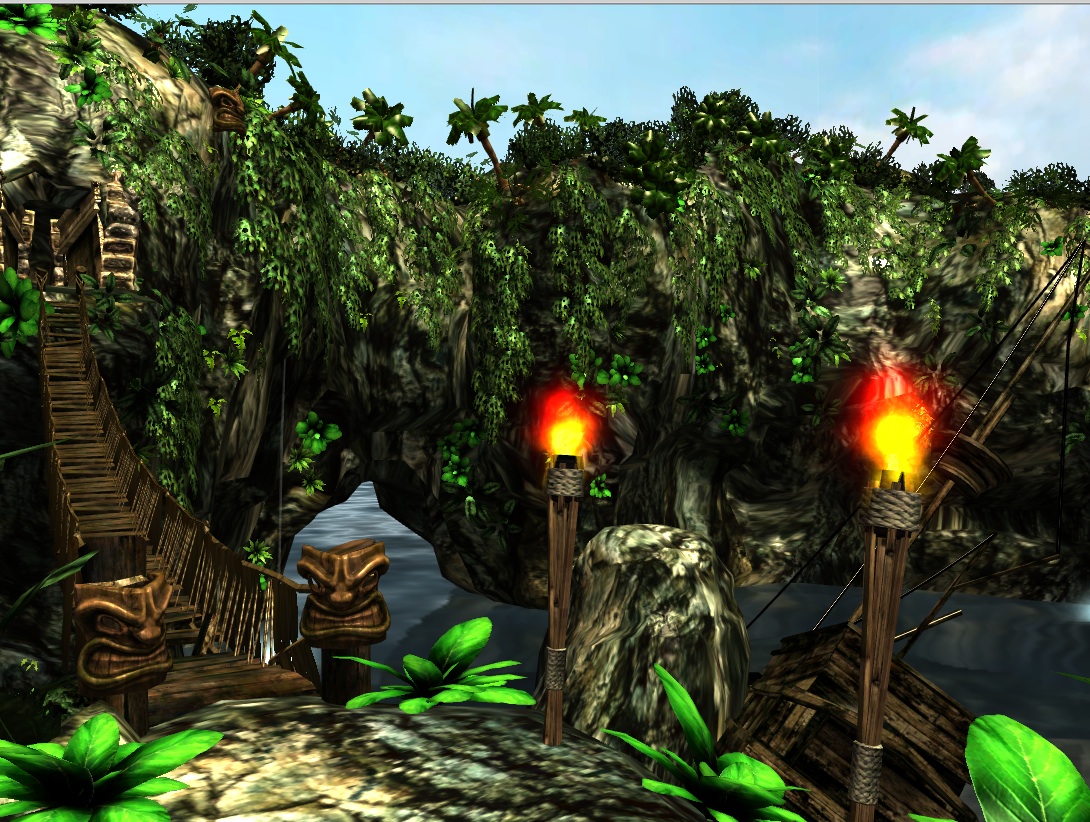
Google's O3D lets browsers show accelerated 3D graphics such as this island scene.

Google's O3D lets browsers show accelerated 3D graphics such as this island scene.

(Credit: Google)

O3D is a browser plug-in for Internet Explorer, Firefox, Safari, and Chrome that works on Windows, Mac OS X, and Linux, but Google hopes that eventually, the technology will be built directly into browsers. It provides an interface that lets developers' Web-based JavaScript programs tap directly into a computer's graphics chip, which could mean better games and other applications.

Google touted the technology in a blog post. It includes a video demonstration, complete with a soothing voice-over and a spacey ambient-music soundtrack, for those who don't want to install the plug-in.

Google isn't the only one to aspire to 3D Web. In the 1990s, a technology called Virtual Reality Markup Language (VRML) bubbled up but never caught on. Today's Internet is a different beast, not least because major powers such as Google, Yahoo, and even Microsoft are advancing the frontiers of what can be done with a Web-based application.

"The time is right for 3D content to move onto the Web," said Henry Bridge, associate product manager.

Mozilla wants 3D, too
He's right, at least in the eyes of his peers. Firefox backer Mozilla and the Khronos Group, which oversees the widely used OpenGL 3D interface standard, announced their own effort to build a 3D Web interface.

The two efforts, while tackling the same basic idea, use different approach.

"OpenGL tends to be a lot of code to write, even for something simple, but OpenGL gives you a lot of control," said Engineering Director Matt Papakipos, who previously ran the architecture group at graphics chip power Nvidia. "Ours is at a higher level. It takes fewer function calls, so it's easier to get stuff on the screen."

Google believes that it's possible that multiple 3D interfaces will be supported in browsers of the future. "Ultimately, there's going to be at least two," Papakipos said, pointing out that 2D graphics in the browser has two technologies at present, SVG and Canvas.

Google has been working on the open-source plug-in software for two years, Bridge said. The plug-in is intended less for regular users of the Web and more for programmers trying to explore what can be done with 3D on the Web.

Appealing to gamers
Although Google has applications such as Google Earth that would benefit from 3D acceleration, the company knows well that games are the real draw.

"If you look at how we use 3D hardware, 20 years ago, it was CAD (computer-aided design). Today, it's for playing games," Papakipos said.

There are plenty of casual gamers who might be interested in Web games that today might run with Adobe Systems' Flash technology. But hard-core gamers are a pickier set, eager for the latest graphics card with the best performance. So how well does O3D perform?

"We can push it to the wall. There's not really any difference between native performance and our performance," Papakipos said. However, he added, that's just for the graphics component of the game. Ordinary computing operations that use JavaScript are much slower than native software running on a computer, he said.

Stephen Shankland writes about a wide range of technology and products, but has a particular focus on browsers and digital photography. He joined CNET News in 1998 and since then also has covered Google, Yahoo, servers, supercomputing, Linux and open-source software, and science. E-mail Stephen, or follow him on Twitter at http://www.twitter.com/stshank.
Add a Comment (Log in or register) (23 Comments)
  • prev
  • 1
  • next
by Chapmaniac April 21, 2009 11:54 AM PDT
"Gamers" don't play on Web page plugins but kids who munch downl Cap'n Crunch while watching Saturday morning cartoons will likely follow the link the commercials tell them to go. Those (cereal makers') sites may use this plugin so their visitors can guide Spongebob through a 3D maze.
Reply to this comment
by Hugh_Isaacs_II April 22, 2009 2:18 AM PDT
Everyone with a 360, PS3 or that plays PC games thinks it's necessary to state "gamers don't".

The sad part is that they're outnumbered, so they don't really define the industry.

Well since I fit the demographic and have a PS3 and 360 in my house and play PC games, I'll say that gamers don't have a problem playing Quake Live or Tetris in their web browsers.

How can you predict what will be done with this plugin when no one but Google has made anything with it so far?
This isn't Flash, it's a javascript add-on.
by phatrice April 21, 2009 2:22 PM PDT
another waste of time and money
Reply to this comment
by knowles2 April 21, 2009 6:35 PM PDT
how is it a wast of money, Everyone thinking working towards 3d web, google just making if it goes down that road it is able to control the technology and standards and most of all making sure those standards are compatible with it advertising technologies. They are investing to protect there revenue stream all the while developing new stuff.
by W1gglesnarf April 21, 2009 2:50 PM PDT
Could be interesting if it works right. And yes gamers do play webplugins if they have no other means to play a game... playing a flash game at work comes to mind.
Reply to this comment
by wiredchicken April 21, 2009 5:28 PM PDT
This sounds very interesting, but will it interfere any programs dealing with graphics on my web browser?
Reply to this comment
by paulimusmaximus April 21, 2009 5:30 PM PDT
As soon as I saw this, I was like hmm, I remember this from 12 years ago. And of course, vrml. I used to be into all the 3d sites. Who knows if they'll catch on this time or not. I was a teenager at the time, I think I'd be less interested this time around.
Reply to this comment
by gggg sssss April 21, 2009 5:57 PM PDT
wonder how this will tie into Sketchup
Reply to this comment
by ddcool1124 April 21, 2009 6:58 PM PDT
VRML never cought on because it took 30 minutes to load a page on a 14.4k
Reply to this comment
by jonathan0766 April 21, 2009 8:04 PM PDT
Completely off topic, but I just noticed a Microsoft ad running along side this article that was touting IE 8 as being optimized for MSN. Those people at Microsoft have a serious sense of humor.
Reply to this comment
by BOTNET April 21, 2009 8:38 PM PDT
dude, seriously keep it on the topic
by BOTNET April 21, 2009 8:41 PM PDT
I see this is finally step forward to kill Adobe Flash from places where it does not belong
Reply to this comment
by tonypee April 22, 2009 8:44 AM PDT
places where it doesnt belong? how does a 3d plugin kill flash? except if you mean flash doing 3d, which will be 3d accellerated at some point soon i'm sure.. making them quite similar- except that you wont have to program your whole game in god-ugly/slow javascript!
by BOTNET April 23, 2009 2:00 PM PDT
they created temporary plugin hoping this would be part of core javascript in next X years meaning there will be no plug in required. There are a lot of places where developers use Flash just make few menu effects (you will need no plug in for that in the future).

btw, this is not strctly about 3D, this enriches 2D as well (look at o3d.Canvas)
by exitreality2 April 21, 2009 10:32 PM PDT
A great start with O3D, I do hope that Google adopt open standards so everyone can benefit and interoperate.

ExitReality web 3D app already achieves this on Internet Explorer, Firefox, Google Chrome, Apple Safari and Opera browsers.

It also supports all graphics cards in laptops, you don't need a gamers machine to experience 3D multiuser worlds anymore.

All standard web picture, video and audio content are supported too along with Interactive Flash.

Full support for Khronos groups Collada format and ISO X3D open standards and MPEG4 avatar standards also.

http://www.exitreality.com
Reply to this comment
by lafatak April 22, 2009 9:24 AM PDT
As a developer whose main activity is assisting marketers [of many types of products and services], with all aspects of their web presence, I am very excited to see this progressing. Our company has always seen the future of the web [browser] as a virtual 3D experience.

To that end we have been allocating a large portion of our resources to learning in Second LIfe. I don't see myself as a gamer at all, just exploring a new type of Market Place. The greatest stumbling block has been that our clients need to join and learn to use it.

When 3D web becomes more fully evolved, there will be no need to join something like Second Life. There will be an 'avatar' class created which will be the basis of each person's unique idently on the WWW as we visit virtual 3DE market places [flying around a virtual WWW] as easily as we now punch in a URL.
Reply to this comment
by eboon April 22, 2009 11:33 AM PDT
I'm sure the quality and performance will be no where near that of local software but come on people, think of what you can do with it... second life would have a field day (though the developers may not be too happy about having to completely rewrite the interface), and I'm sure there's many other uses.
Reply to this comment
by Len Bullard April 24, 2009 7:11 AM PDT
If you've seen the code required to display even a simple shaded sphere, it's easy to see O3D is unsuitable for mass market content creation. Layers built over the API can do that and certainly some will give it a shot, but until the tools arrive, content will be hand built and more expensive than even in the mid-90s.

Two questions:

1. What feature of O3D makes it innovative or differentiates it from the wealth of 3D plugins already available?

2. Is there any reason other than the source, Google which failed publicly and spectacularly with Lively, to present this as a "web3D standard" candidate when the Google developers have no experience with developing standards for 3D on the web and have yet to demonstrate how a standard based on their experiments would unify 3D web products or markets? We have the X3D standard, we have the Collada specifications, and we have first class browsers to support them with years of development experience. On the other side, we have a handful of developers, an IP-encumbered lump of code and the Google brand.

Honestly, this announcement is very old school from a time when all it took was a lump fo running code to jump start a standard. I do believe the business professionals have come to understand the meaninglessness of such announcements and have come to rely on the survivability and contract-based control of the standard (see participation agreements) as the basis for accepting that such are genuine candidates.

Google is devolving into Microsoft fast. There was an honest above board way to go about this project and instead, they retreated inside and decided to wage war for profit. Very old school. It appears that Google's ability to scale the learning curve is dramatically foreshortening.
Reply to this comment
by jessehattabaugh April 24, 2009 12:13 PM PDT
The HTML5 Canvas element was built to support more than 2D drawing. Google should be working on the 3D context API for the canvas tag instead of a non-standard plugin. We've already got Flash.
Reply to this comment
by Atomic1fire April 24, 2009 8:11 PM PDT
While the most recent flash plugin can do 3d (without the aid of something like papervision) I don't see why o3d is a bad idea, if its opensource, and can be hooked into gears (saving game data, and allowing offline gameplay of 3d js games) I think it could possibly make the web more interactive.
Reply to this comment
by dkinzly April 26, 2009 10:39 AM PDT
How can it be removed?
Reply to this comment
by coolnerd123 April 26, 2009 4:13 PM PDT
All I can see coming from this seemingly pointless plugin, is more free smiley advertising type rubbish and more malware exploiting weaknesses in the software.. Hurrrrrah to progress?!
Reply to this comment
by jymmyt April 28, 2009 4:55 PM PDT
Len Bullard wrote :
"It's easy to see O3D is unsuitable for mass market content creation. Layers built over the API can do that and certainly some will give it a shot, but until the tools arrive, content will be hand built and more expensive than even in the mid-90s."

This has been done by Unity3D. A game engine with an authoring tool that is usable by anyone who is proficient with content development. The authoring tool produces executables for osx, windows, www, and the iPhone. This need has been well filled by Unity3D, and i am quite surprised google didn't just buy them.

Also, for those who might be confused, flash is not a 3d API.
Reply to this comment
(23 Comments)
  • prev
  • 1
  • next
advertisement

About Webware

Say No to boxed software! The future of applications is online delivery and access. Software is passé. Webware is the new way to get things done.

Add this feed to your online news reader

Webware topics

15 sites that went kaput in 2009

Web sites launch all the time, but they also shut their doors. We highlight 15 that bit the dust this year.

Top 10 news stories of the decade

Let the debate begin: Was the iPhone more important than iTunes? Was anything bigger than Google finding a great business model? CNET offers its list of the 10 most important stories of the '00s.

Inside CNET News

Scroll Left Scroll Right