• On TechRepublic: 10 cool USB flash drive tricks
February 4, 2009 12:01 AM PST

Google Latitude keeps tabs on friends' locations

by Stephen Shankland
  • Font size
  • Print
  • 44 comments
Google Latitude

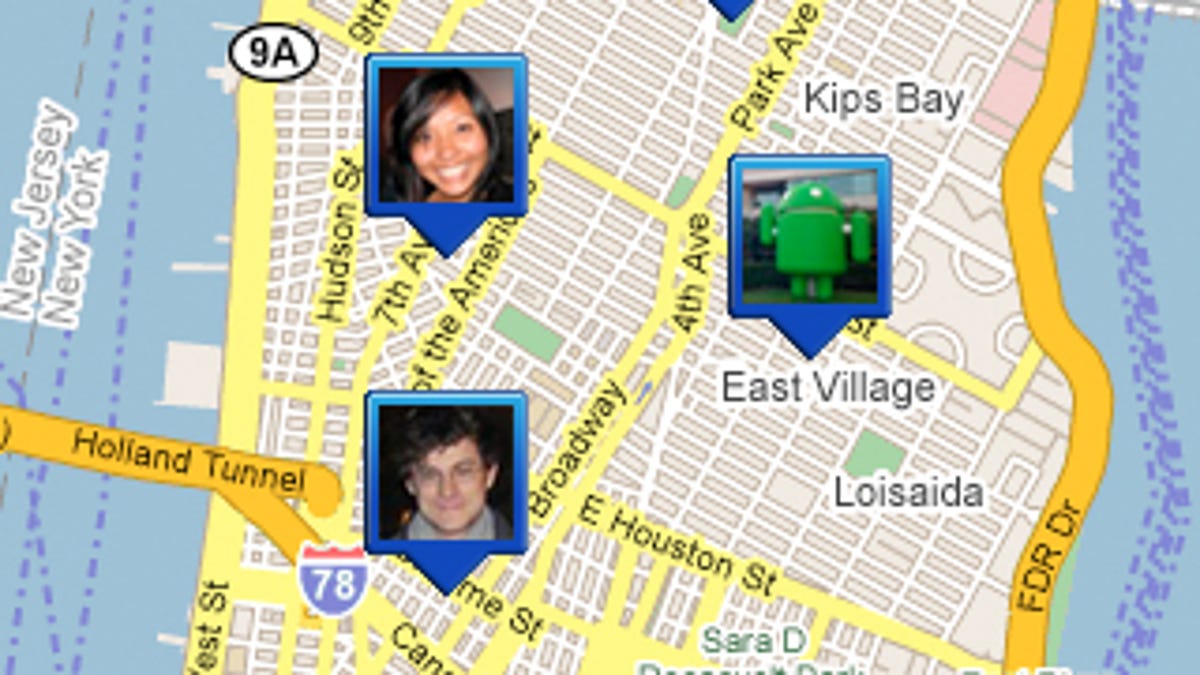
Google Latitude shows your friends on a map--as long as they've agreed to share their location.

(Credit: Google)

Just because the Internet has broken down geographic barriers, don't assume that Google doesn't care about geography.

The company plans to launch software called Latitude on Wednesday that lets mobile phone users share their location with close contacts. Google hopes it will help people find each other while out and about and to keep track of loved ones.

"What Google Latitude does is allow you to share that location with friends and family members, and likewise be able to see friends and family members' locations," said Steve Lee, product manager for Google Latitude. For example, a girlfriend could use it to see if her boyfriend has arrived at a restaurant and, if not, how far away he is.

To protect privacy, Google specifically requires people to sign up for the service. People can share their precise location, the city they're in, or nothing at all.

"What we found in testing is that the most common scenario is a symmetrical arrangement, where both people are sharing with each other," Lee said.

The software spotlights Google's fixation with mapping and location technology. Location is an important part of navigating the real world, and Google clearly sees its geographic services as a way to establish a more personal connection with customers who today use Google chiefly for the virtual realm of the Internet. And of course money is involved, too: Google hopes its mapping technology will lead to location-based advertising revenue.

Google's power is firmly lodged in search and search advertising, but the company is trying to expand to broader online services, too. That includes online documents and various aspects of social networking, which are much more personal services and ones that put Google into more direct competition with rivals such as Microsoft, Facebook, and Yahoo. Like using Google profiles to contact information with select contacts, using Google Latitude tells Google who's who in your social graph.
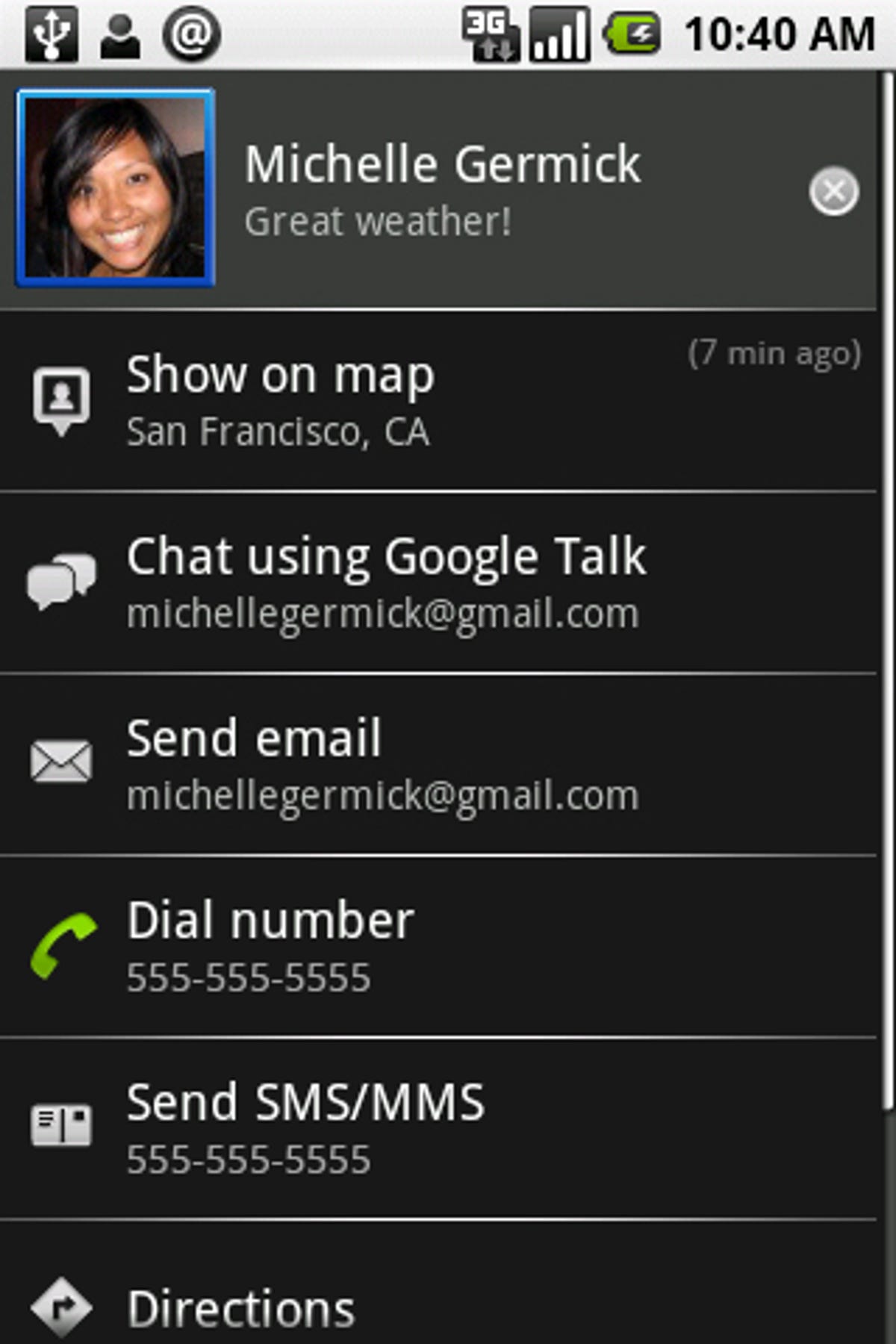
Latitude lets you contact somebody who's close by.

Latitude lets you contact somebody who's close by.

(Credit: Google)

How it works
Latitude is part of Google Maps for Mobile, the company's mapping software for mobile phones, but also can be used through a gadget loaded onto its iGoogle customized home page. It'll work in 27 countries at launch, Google said.

Initially, it will work on most color-screen BlackBerry phones, most phones with Windows Mobile 5.0 or later, and most Symbian-based devices such as Nokia smartphones. An update to the Google Android operating system now being distributed to the T-Mobile G1 phone also enables it, and iPhone and iPod Touch users will get the option "very soon," Lee said.

Latitude uses Google's technology to judge a user's location not just by GPS satellite, but also by proximity to mobile phone towers and wireless networks.

That's a much more automated approach than the manual "check-in" process used by Dodgeball, a service that Google decided in January to shut down.

Other competitors exist, though. BrightKite and Loopt offer mechanisms for people to find each other by mobile phone, for example. Then there's MobiFriends, Tripit, and Dopplr.

And Google's clearest competitor, Yahoo, offers some competition with Fire Eagle. That service doesn't provide location information, but it does provide a mechanism to centralize people's geographic privacy choices, in effect taking care of some of the social graph management when it comes to location information.

To use the service, you need a Google account to record who has permission to see your location. For choosing who gets to see your location, you can use contacts stored with Gmail or Picasa, Google said.

The white lie
With the service, you can hide from specific people or disappear altogether. And you can manually set a specific location if, for example, your phone can't show it with sufficient precision or if you wish to tell someone a white lie about whether you really aren't going to go to the candy store.
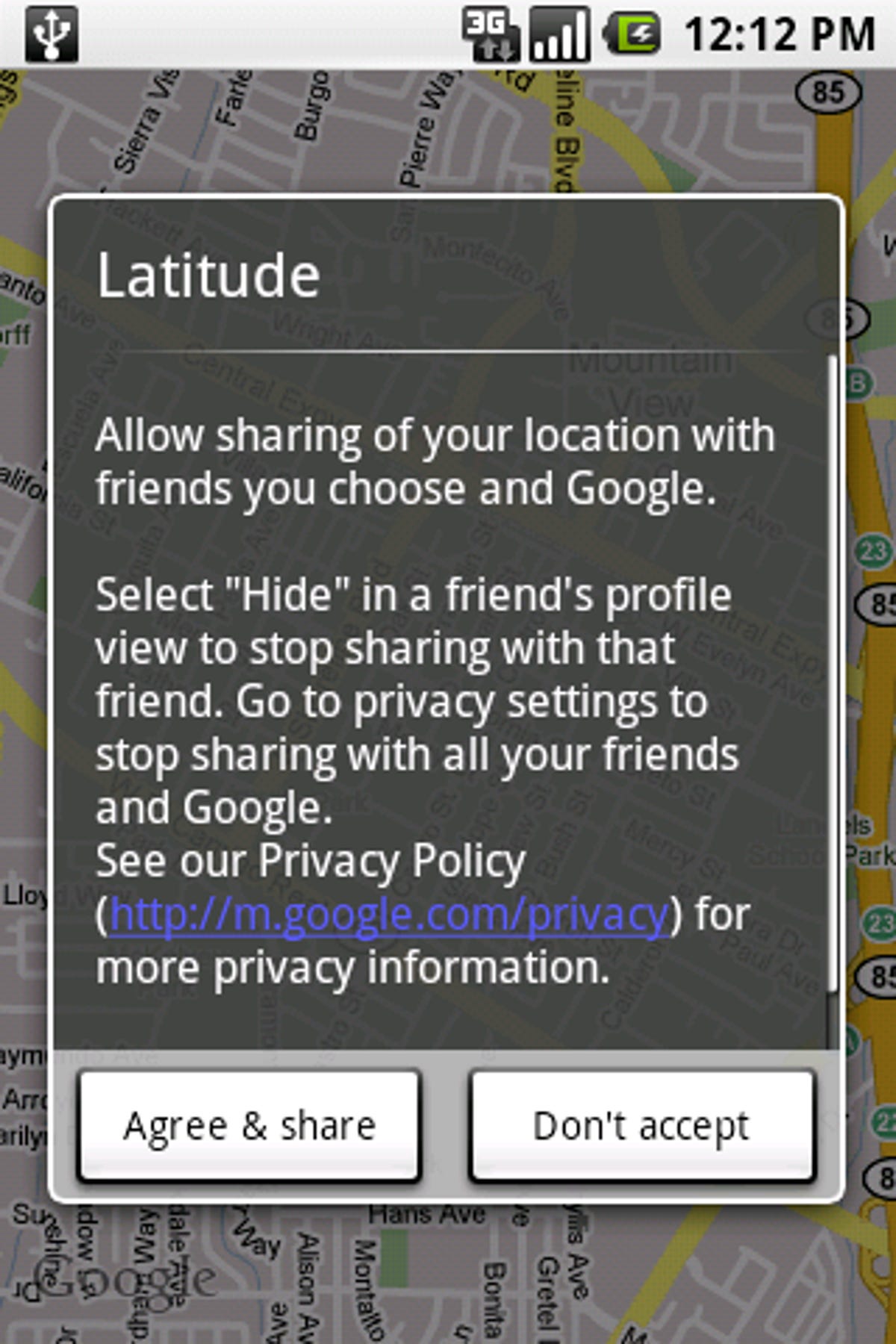
People must agree to share their location before Latitude will work.

People must agree to share their location before Latitude will work.

(Credit: Google)

Google envisions two broad classes of people with whom you might want to share location information. First is a small, close-knit circle of friends and family with whom you're willing to share your exact spot. Second is a larger group with whom you're happy to share city-level detail, convenient for finding out when somebody's in town but not much more.

When somebody is close, the software lets you contact the person various ways--by calling or sending an e-mail or text message, for example. It also lets you hide from that specific person.

Privacy is of course a significant concern when it comes to sharing this sort of information. If you want to use Latitude, you must specifically enable the service.

Meeting your pals at a bar is an obvious example of the software's possibilities, but there are softer cases I see as useful, too.

Lee pointed to a case where a friend's girlfriend, though far away in Seattle, will "virtually place herself next to him." That sounds a little sappy for my tastes, but I can still relate. My wife is on the other side of the country right now, and it would be heart-warming to see just where. There are a lot of occasions where technology is better for maintaining relationships than it is for establishing them, and this looks like one to me.

Stephen Shankland writes about a wide range of technology and products, but has a particular focus on browsers and digital photography. He joined CNET News in 1998 and since then also has covered Google, Yahoo, servers, supercomputing, Linux and open-source software, and science. E-mail Stephen, or follow him on Twitter at http://www.twitter.com/stshank.
Recent posts from Wireless
Man texts Greece to get rescued in New Zealand
Cisco predicts wireless-data explosion
Google launches Nexus One phone support
Nook back on sale
Linux founder endorses Google's Nexus One
BlackBerry has spyware risk too, researcher says
FCC: iPad use could further strain AT&T 3G
Obscene tweet gets Vodafone rep suspended
Add a Comment (Log in or register) Showing 1 of 2 pages (44 Comments)
by mozzor February 4, 2009 1:14 AM PST
Google now knows where you are 24/7! Oh the madness!
Reply to this comment
by t8 February 5, 2009 1:18 PM PST
Only if you want them to know. Not so mad when you consider that you might want to know where your kids are.
by dnyhan February 4, 2009 1:33 AM PST
This will be handy if you want to cheat with somebody's girlfriend or if you want to break into their house, you'll know when they're not at home, especially in rural areas.<br />And you'll know when they're on holidays, so you can move in and trash the place.
Reply to this comment
by GBlanston February 4, 2009 4:35 PM PST
Yes, this will be very handy. All you need to do is:<br />(1) Buy a stranger who lives in a rural area a new smartphone<br />(2) Convince that stranger to let you track their movements<br />(3) Wait until they are out of town<br />(4) Break in and trash the place.<br /><br />Very handy indeed!<br /><br />NOT
by ronanhiggs February 4, 2009 3:20 AM PST
Google is entering a crowded space (http://bdnooz.com/lbsn-location-based-social-networking-links/) with established companies such as Locle, Rummble, Aka-Aki, Nulaz and Belysio, but with a service lacking in differentiating features. <br /> <br />Google seems to be forgetting their own message, that location is a commodity (thanks to their own geoLocation API). A compelling mobile friend finder application needs more than to show where friends are. <br /> <br />However, Googles established install base of Google Maps for Mobile will give the established players a run for their money. <br /> <br />One has to ask why is Google getting into the "buddy finder" software business. Their mission is to sell more advertising. They should be focused on providing the tools and technologies to established companies to drive more location-based, mobile and social traffic that can be monitized with Google's AdWords machine.
Reply to this comment
by Shankland February 4, 2009 7:08 AM PST
One feature Google has that a lot of earlier competitors lack is huge brand clout, a huge audience, and an ability to promote its new ideas on its search page. The world didn't need Chrome, but something like 1 percent of the world is using it now. Not a lot in terms of market share, but a lot in terms of absolute numbers, especially given how new it is.
by February 4, 2009 7:43 AM PST
Competition breeds better products and supplies.
by rmplrmpl February 4, 2009 12:06 PM PST
I'd rather say that the others try to do too many things. I don't want another social network, another way to send mail, another user profile and home page, not any of all this stuff !!! My phone's applications are just fine, and regular email works everywhere and with everyone. No need for another vendor lock-in. <br />I only want to know where my friends are, with a non-intrusive application. It should do only one thing, and do this well. At Google they seem to get this. (Not having to screech for venture capital, like these startups probably do, may help as well though)
by rozizobo February 4, 2009 4:37 PM PST
Google has enormous brand power and a huge customer base to offer its new services to.
by t8 February 5, 2009 1:23 PM PST
The day that Google enters some markets is the same day that they become no1 in that market. Such is the power of Google.
by Joetwopointoh February 4, 2009 4:56 AM PST
Considering the all encompassing way the various aspects of Google's services are coming together to paint a complete minute by minute picture of the activities of individuals who sign up for all of them, one would would hope that the slogan "Don't be evil" would be met with the user corollary "Don't be stupid."<br /><br />Bit by convenient bit, people succumb to the allure of technology and queue up to give away every last morsel of the privacy they once had.<br /><br />So line up kids! Soon there will likely be a convenient Google chip complete with your openID! <br /><br />lmao
Reply to this comment
by February 4, 2009 7:42 AM PST
It wasn't too long ago that folks were saying the same thing about Microsoft.
by linhlh February 4, 2009 6:57 AM PST
Somebody please tells Obama to install this software on his Blackberry.
Reply to this comment
by t8 February 5, 2009 1:19 PM PST
Ask him yourself, he already has.
by jonathan_bennion February 4, 2009 8:29 AM PST
The ad possibilities for businesses/events between your location and friends are infinitely cool &gt; imagining the in-person response to an aggressive ad pitch sent to your phone by an establishment you happen to be walking by.
Reply to this comment
by renGek February 4, 2009 10:39 AM PST
employee: hello boss *cough* I'm too sick to go work today<br />boss: ummm ok but why are you in vegas then.<br />employee: dooh, stupid phone.
Reply to this comment
by sadchild February 4, 2009 11:38 AM PST
step 1, grab girlfriend's cell phone without her knowledge<br />step 2, install latitude<br />step 3, show up at party while she's making out with another guy<br />step 4, fill in your own answer: __________________________
Reply to this comment
by Shankland February 4, 2009 3:24 PM PST
Here's Google's official comment on this possibility:<br /><br />"We continue to look at ways to reduce the chance that users could do this. We have implemented a feature on the BlackBerry version of the software to display several notifications (i.e. pop-up messages) to your device which informs the user that your phone's location is being shared. We hope to extend this to other versions of the software soon."
by Rod Roddy February 4, 2009 11:50 AM PST
Is it me or does Google REALLY like maps? they map everything. The Earth, the Moon, who knows whats next...buried treasure? Anyways, I wish they would put a bit more effort into getting Gmail out of Beta(after like 5 years) and focus on better junk mail filters. Enough with the maps!
Reply to this comment
by smellyoulater February 4, 2009 12:36 PM PST
If I want someone to know where I am, I can: <br />1. Call them. <br />2. Email them. <br />3. Light my house on fire, call 911 and hope they see me on the 10 o'clock news. <br />It's always worked before, why get Google to do one more thing for me that I can already do for myself?
Reply to this comment
by queticomn February 4, 2009 3:43 PM PST
/me ^5's smellyoulater Love the comment. :)(:
by Alessandro Machi February 4, 2009 5:32 PM PST
Can I track stolen stuff, or stuff that I think might get stolen?
Reply to this comment
by potusag February 4, 2009 7:26 PM PST
this creeps me out more than anything. i DO NOT want to be digitally followed everywhere i go. they say only you can decide who uses it, but we all know that this is just another way for the NSA to spy into your personal life.
Reply to this comment
by Shankland February 4, 2009 8:28 PM PST
Well, somebody with a subpoena can already track the location of your cell phone use. If you don't want this to factor in, better not install the software.
by Inconnux February 7, 2009 11:53 AM PST
I completely agree, this sounds VERY creepy. I can see its uses, but my 'gut feeling' is not good!
by spokes February 4, 2009 8:04 PM PST
This is absolutely amazing stuff. Who would dare to dream. So, I need to ask a political question. Do we really want to give more and more power to the government? We really do need to answer that question and act on it.
Reply to this comment
by geek_grrl February 4, 2009 8:09 PM PST
Great--this will just make it easy for pedophiles to hook up with their victims. We still can't stop kids from communicating with weirdos via MySpace or chat rooms. Now they'll be able to follow them 24/7!
Reply to this comment
by Reality_Chk February 4, 2009 9:48 PM PST
People posting here appear to believe Google invented this technology for locating folks.<br /><br />Nothing could be further from the truth. The cell phone companies were mandated by laws passed by the US government to do this and make it available to Police agencies, and other government agencies. The Cell phone companies were also authorized by US Government passed laws to make this capability available to other corporations if they were "partners" or "affiliates" of the Cell phone company..<br /><br />Google is just allowing the average cell phone user to benefit from this same technology for the cell phone users benefit. In this case the Cell phone user, not the US government is authorizing Google to collect location information from the cell phone companies and provide it to the individuals authorized by the Cell phone user..<br /><br /><br /><br />Many police agencies and corporations had access
Reply to this comment
by Reality_Chk February 4, 2009 10:12 PM PST
Please note that this is a free service derived from the right of the Cell Phone User to information about him / her self. Others, as partners of the cell phone company might cell this information.<br /><br />Google is providing the information about the location of a cell phone user to a third party at the request of the cell phone user. Google is also receiving the same information as part of the same deal.<br /><br />Google does plan to make money on the information, but not from the Cell Phone users whose location is being provided directly.
Reply to this comment
by xu_ankai February 5, 2009 6:37 AM PST
"Just because the Internet has broken down geographic barriers, don't assume that Google doesn't care about geography. "<br /><br />What an awful way to start an article... Are you kidding? Google Maps? Google Earth? Wow.
Reply to this comment
by shelby_sf February 5, 2009 6:46 AM PST
I am sorry, but, HELL NO.
Reply to this comment
by huniii February 5, 2009 6:54 AM PST
This isn't really a new concept... 'Loopt' has been out on the iphone (and essentially does this same thing)....*yawn*
Reply to this comment
by zcollvee February 5, 2009 7:38 AM PST
Google Latitude The worlds BEST stalker too :)
Reply to this comment
Showing 1 of 2 pages (44 Comments)
advertisement

Google's social side aims for some Buzz

Facebook and Twitter are the darlings of the social-media world, not Google--which hopes to change that with Buzz, betting it can organize your online social life.

Watching the birth of a gaming start-up

Stewart Butterfield and his friends are back at it with a new company. CNET's Daniel Terdiman was given exclusive, behind-the-scenes access as they built it from scratch.

About Wireless

Check out the latest wireless news on CNET News, featuring the latest news on cell phones, mobile gear, VOIP, and internet access via broadband and wireless connections.

Add this feed to your online news reader

Wireless topics

advertisement
advertisement

Inside CNET News

Scroll Left Scroll Right