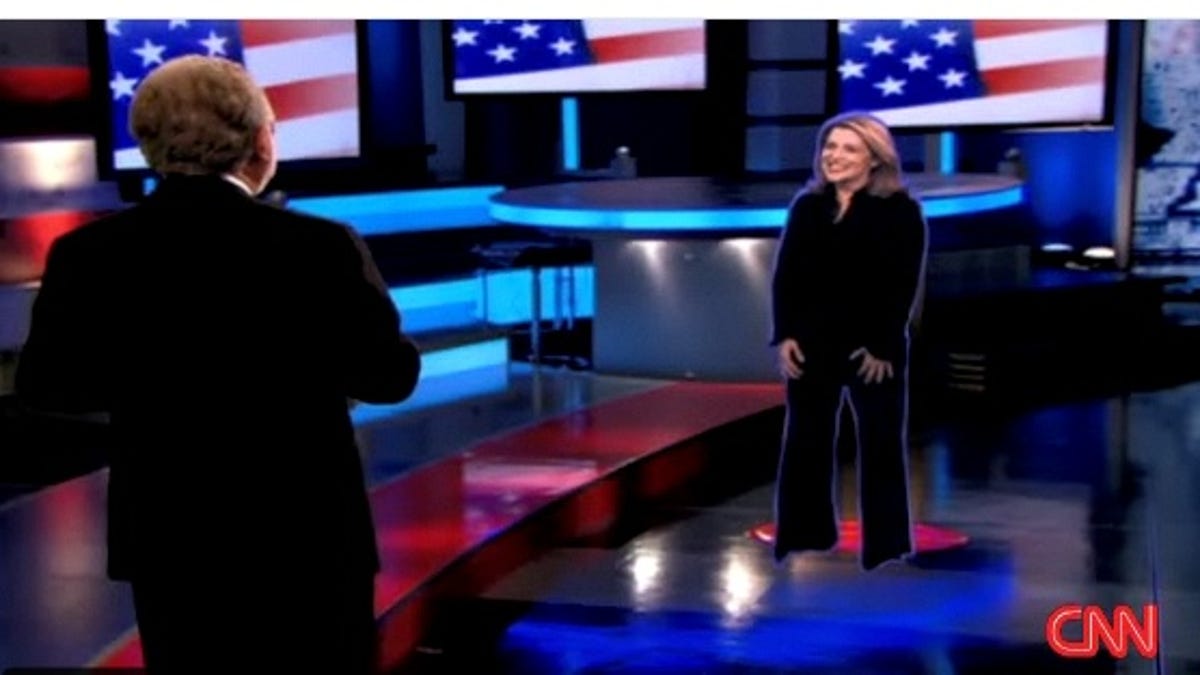
CNN's human 'hologram' on election night
CNN's Wolf Blitzer speaks with correspondent Jessica Yellin, who was beamed into the New York studio from Chicago.
(Credit: CNN.com)Update 11:00 a.m. PST: Several readers have pointed out that CNN's technology was not true holography, and the story has been updated to reflect this.
Holy holograms, was that Princess Leia on CNN during election night?
No, it was just Jessica Yellin, a CNN correspondent. CNN beamed her image from Chicago to the CNN press center in New York City, where Wolf Blitzer and the rest of the team were covering election returns.
Yellin, who claimed she was the first person to be beamed in a "hologram" on live TV, explained for the audience how this was done. (See video below.) She said she was standing in a tent outside of the Obama headquarters in Chicago where the CNN crew had set up 35 high-definition cameras in a ring. She stood in the center of this ring and the cameras picked up her every movement and transmitted the image in 3D to the studio in New York.
While CNN is touting its special effects from election night as a '"hologram," that may not be technically the case. CNN's "hologram" seems to have been done using overlay images and a green screen to virtually put the reporter in the same studio as Wolf Blitzer. But true holography uses a different technique to create a true 3D image of a person standing in the studio. According to Wikipedia, "holography is a technique that allows the light scattered from an object to be recorded and later reconstructed so that it appears as if the object is in the same position relative to the recording medium as it was when recorded. The image changes as the position and orientation of the viewing system changes in exactly the same way as if the object was still present, thus making the recorded image or hologram appear three-dimensional."
True holography technology has been demonstrated by many other companies. Telstra, the Australian phone company, used a hologram earlier this year to beam its chief technology officer from Melbourne to a business meeting about 460 miles away in Adelaide. Cisco Systems has also used holograms in demonstrations to talk about its telepresence products. Cisco's telepresence solution does not transmit hologram images, but it does use high-definition cameras and TV screens to make executives in different locations feel like they are having an in-person meeting.
For the most part, holography is still too expensive for most companies to deploy commercially.
Whatever technique CNN used, there's no doubt that it looked it cool. And it conjured up some futuristic thoughts of Star Trek and Star Wars. But as a viewer watching the broadcast in my living room, I thought the whole thing was a bit silly and sort of annoying.
At one point during his interview with Yellin, Blitzer commented that he felt bringing Yellin into the studio via hologram created a more intimate setting for their interview. He said he liked the fact that there weren't oodles of noisy people standing behind her.
But I disagree with Blitzer. It seems to me the whole point of sending correspondents to events is so that viewers at home can get a taste of what's happening in those places. I actually wanted to see the throngs of people in Chicago, standing behind Yellin, shouting and cheering for Obama.
It's that excitement and feeling like I am there with the reporter that makes me want to watch TV news instead of just reading a story in a newspaper or online.
I realize that CNN wanted to show off its fancy new technology. And I applaud the cable network for pushing the envelope in its use of technology. But I don't really mind the old-fashioned cutaways to correspondents in remote locations. CNN and other news stations have plenty of reporters and pundits sitting in its studios every night of the week. There isn't anything terribly interesting about that to me. For an event like this, when Blitzer is talking to someone who is actually at Obama's headquarters, I want to see what she is seeing.
What about you?
Marguerite Reardon has been a CNET News reporter since 2004, covering cell phone services, broadband, citywide Wi-Fi, the Net neutrality debate, as well as the ongoing consolidation of the phone companies. E-mail Maggie. 


From Cathode Ray Tubes to Plasma to LCD Flat screens to Holograms in our living rooms!
I very much enjoyed the tech!
Although CNN called it a "hologram," and modeled it after Star Wars, it will mislead many people. The only way this technique can be used is via a television set or other display medium in which two pictures can be overlaid. Wolf Blitzer could not actually see Jessica Yellin, except on a monitor.
If so, why is everybody calling this CNN thing a hologram? It's just a VR image formed from multiple video shots.
COMEDIANS: The People Behind the Laughter (search around, Amazon.com)
which deploys live characters that actually walk around in a 3D Comedy Bar doing Stand-up and other tricks.
LAUGHING MATTERS
http://www.time.com/time/international/1995/951127/multimedia.html
I give them credit for cool factor alone. For a night like last night, with the noise of the crowds it was a very unique way to get an isolated interview. Is it useful for day-to-day, no. But they'll probably use it anyway. Still very cool.
Those touch screens are laughable as well. They serve no purpose in moving the story forward.
It's just Wolf Blitzer talking to a blue screen overlayed with Jessica's video. A real hologram would entail a projection system beamed to a position near Wolf and he would've been able to move around her like she was physically standing in front of him. In order to achieve something like this, they'd need some sort of visible overhead or underfloor projection system.
From the edges of Jessica's image, you'd see some blue screens remnants, and that basically is what the computer used to extrapolate her image to separate from the background and is then overlayed to Wolf's broadcast camera.
So in essence, Wolf was just talking to a empty area of the room and was not Jessica at all... he is basically interacting based from his TV monitors.
He was standing in the middle of a live studio. Generated in Chicago Jessica's 3-d image model was processed (and alpha channel generated) Then using telemetry data from mult NY studio cameras, the 3-D image model of Jessica and her key signal where sent via IP to NY and then using an Ultimatte, matted into the program feed. And as different cameras where selected, different perspectives of the 3_D where automatically inserted into the feed.
All this was done in REAL TIME, not hours spent in Post Production.
What it was was some fairly clever online synchronization of multiple cameras overlaying in real-time onto a CG model of the presenter which was synced to the pan/tilt/zoom of the main studio cameras.
She was shot against a green screen in the "tent" and chroma-keyed into the shot in the studio. Wolf Blitzer could not see her in the studio, she appeared on a monitor as they always do with live green screen work.
A shame they have to try and make something that is really quite a neat trick combining motion tracking, multiple HD viewpoints and live co-ordination of cameras to the CG view into "a hologram"...
I wouldn't call this clever, as technique is already been done a million times by weather reporters. The Weather report is usually done with the weatherman stands in front of a blue screen and interacts with the weathermap or a projection of it. In this case, instead of a weathermap, Wolf and the studio was projected to Jessica who is standing in front of a blue screen. And the overlayed images are then transmitted to CNN...
They could've probably done the reverse here, as instead of the studio overlayed in Jessica's blue screen, it seemed that they overlayed Jessica and on top of the studio feed and used a computer to extrapolate her image delimited by the blue edges on her edges, which is then overlayed to Wolf's live feed.
What sets this apart from your ordinary garden-variety nightly-news weather report is that the images from the foreground image (in this case the remote reporter) is captured and converted to a 3D computer model. Using inputs from the studio cameras (pan, tilt, zoom) and a design model of the studio, the computer calculates the exact position, scale, and orientation of the foreground image, and generates a fully rendered foreground image. This, by means of a matching mask, is keyed over the studio camera image in exactly the same way as the weatherman gets keyed over his weather map.
The difference here is that if the studio camera moves, or if the studio view changes to a different camera, the computer generates a corrected foreground image. Another critical difference here is that because the rendering system "knows" what the empty studio looks like, it can also analyze the background image and identify anything that shouldn't be there (such as the program host) and cut that out of the key mask, allowing the foreground image to blend in *behind* elements in the background.
A better comparison with what CNN did would be to call this an extension of the "first&ten" system that puts the electronic lines on the football field. That system works in a similar fashion, adding a 3D rendering to a live camera shot. The difference is that for CNN, the 3D rendering was a reporter instead of an orange line.
But as Marshall McLuhan said "the medium is the message" and honestly it doesn't seem like there is anyone at CNN who is thinking about the impact of how varying modes of representing information effects the information itself...or maybe they completely understand and just don't care.
Also incorrect is the use of "beamed in" or ?transporter room,? referencing a ?technology? in Star Trek, where the subject's physical molecules were transferred and re-assembled at the destination site. Besides, the "hologram" of Princess Leia in Star Wars could not be a real hologram because the holographic image is projected by a single source (from R2D2?s single projection lens).
So don't blame CNN for calling it a hologram. They call it a hologram because it was modeled after incorrectly named visual effects in Star Wars. But it was already in the public consciousness, and just like the argument that the 21st Century began in 2001 instead of 2000, debate as much as you want, but you won?t convince the general public.
As far as cnet - well, it's just reporting what CNN called it. And 99% of the public will call it a hologram, because they don't know or care what a hologram is, it looks like the "hologram" in Star Wars, which is exactly what CNN was aiming for. We can debate whether it is tacky separately.
It was even crappy for that, she was floating right and left on that supposedly 'projector' thingie, so it was done like crap.
I thought it was real funny, though, the idea...
(this technology itself is not news since a long while)
and you watch it and see how it is... i tried to search for this vid on you tube its not yet posted..
- by blueshore November 5, 2008 10:56 AM PST
- A bit impressive, but still a FX. Perhaps if a water vapor screen and some projectors were used, then a nice pseudo hologram could be done for in-studio.
- Reply to this comment
-
Showing 1 of 3 pages (56 Comments)In any case, it is good to see some ideas turning into realities, even if there are no fully developed.