At SXSW, attendees confront Twitter saturation
So many people are using the "#sxsw" tag in their tweets that it has become extremely hard to filter for worthwhile panels and parties. That is creating an opportunity for other services.


AUSTIN, Texas--By now, the story of how Twitter exploded onto the scene at the 2007 South by Southwest festival is legend in technology circles.
But here at SXSW 2009, the notion of the perfect match among community, service, and event seems flipped on its head. Many people are discovering that a monumental oversaturation of tweets is reversing the value that Twitter offered at SXSW 2007 and SXSW 2008 for finding friends and great parties.
At SXSW, the standard is for everyone to include the tag "#sxsw" in their tweets. For example, on Friday, I was looking for sources for a different story and tweeted, "If you are launching an iPhone app at #sxsw, or know someone who is, please let me know. Thanks!"
That's a great convention because it allows anyone wanting to know what's going on to search Twitter for posts using any search term important to them. That has proven useful for people wanting to find out what's going on after earthquakes, the Mumbai terrorist attacks, the Hudson River airplane crash, and many other events. At SXSW in 2007 and 2008, this was a big part of how people navigated their experiences.
At a conference with scores of panels and seemingly just as many parties, being able to determine what's worthwhile is crucial for people trying to get the most out of their time here.
This year because of the conference's impressive growth and Twitter's broader mainstream appeal, it has become almost impossible to find the same value as in the past. I did a search for the "#sxsw" tag on Saturday afternoon and found that there had been 392 tweets with the term in just the previous 10 minutes. That number mushroomed to more than 1,500 in the previous hour.
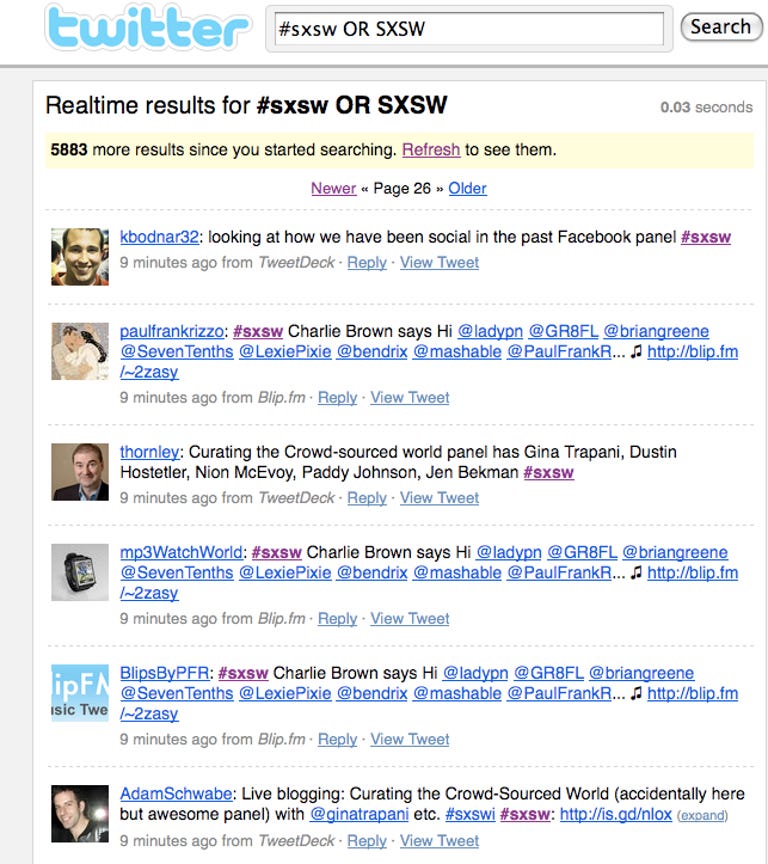
While those numbers demonstrate that people here are without question using Twitter like never before, it also means that it's never been harder to find what you're looking for amid the flood of posts about the panels, barbecue, Web celebrity spottings, and deep thoughts about social media.
This has forced people accustomed to relying on simple Twitter searches to get creative to find the nuggets they need.
"I've been purposefully putting the ("#sxsw") tag...to as many things as I can, even just going to my hotel," said David Kadavy, a user-interface designer from Chicago. "I started looking (for the tag) at first. But there was just so much of it that I started just looking (for) the people I'm following and filtering for the (tag)."
That's fine for people who are sitting at a computer, but many people using Twitter at SXSW do so on mobile phones. And being the cutting edge of the digerati set, the most common device in evidence here is the iPhone. But Kadavy said he hadn't found a way to do the kind of filtered search he wanted, and as a result, seemed hard-pressed to accomplish what he'd need to while on the go.
Some at the conference have found themselves being aware of the oversaturation dynamic and have been trying to reduce the number of tagged tweets, hoping to cut down on the flow.
"I was definitely guilty yesterday," said Andie Grace, a senior staffer with the Burning Man organization. "I grabbed my phone to tweet that I was grabbing my luggage (at the airport)....But I stopped myself from Twittering and I thought if everybody did this, it's going to be useless. So I stopped myself because I would like to search and see what panels my friends are finding interesting and where they're planning to be."
To be sure, there are plenty of ways people can see what their friends are tweeting. But the never-ending flow of tweets with the "#sxsw" tag are forcing attendees to find alternatives.
That, of course, has presented opportunities to other services to gain the kind of passionate users that Twitter engendered during SXSW 2007 and SXSW 2008. In fact, some services are even incorporating Twitter, creating a way to get the best of both worlds.
"I just got (to SXSW) but have been watching from afar, and it did seem a little crowded," said Mario Anima, the director of online community at Current.com. "It seems like (a lot of) people are also using Brightkite and Foursquare to keep in touch."
Anima said that Foursquare, a brand-new service from the team that created--and then sold to Google--Dodgeball, is particularly useful for navigating SXSW because it allows people to post updates about what they're doing and where they're going that are then incorporated into their Twitter feeds. That way, their Twitter followers can see what they're doing without also being a Foursquare member.
Of course, SXSW 2009 may well prove to be where Foursquare itself explodes, a la Twitter in 2007. The service was under wraps until just a few days ago, and its iPhone application was added to Apple's App Store just in time for the conference.
Using this method to see what your friends are up to at SXSW, Anima said, frees people to use Twitter for broader purposes. For example, he said, it means that instead of trying to find within the "#sxsw" search flood what friends are doing, users can look for trends, like what people are saying are good panels.
Even that method might be overly cumbersome, however, given the hundreds, or thousands, of tweets being sent each hour at the conference.
To Laura Roeder, a consultant from Venice Beach, Calif., there's another solution altogether.
She said that she's been following SXSW Baby, a blog and Twitter account where the best of SXSW is being aggregated, allowing followers to restrict the information overflow.
"Last night, they re-tweeted a Gary (Vaynerchuk) party," Roeder said, speaking of what have become famous impromptu wine parties at SXSW, "so I knew about that."