March 10, 2006 10:00 AM PST
Week in review: Origami unwrapped
- Related Stories
-
Week in review: Unfolding Origami
March 3, 2006 -
Week in review: Last call for BlackBerry?
February 24, 2006 -
Week in review: Washington wrangling
February 17, 2006
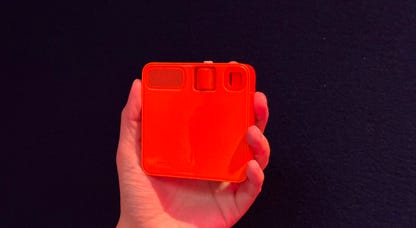
In a preview demonstration, Intel showed CNET News.com several of the ultramobile PC devices, including an example of the kind of hardware that will ship in the next few weeks as part of the Microsoft effort.
The first devices have a 7-inch touch screen and standard x86 processors, and can run full versions of desktop operating systems, including the Windows XP variant being used for Origami. In later generations, due for release probably next year or later, the devices could have the pocket size, all-day battery life and $500 price that Microsoft and Intel are aiming for.
The first-generation devices are likely to get about three hours of battery life.
Whatever the merits of these devices, reality still trails Microsoft's ambitions. The first-generation devices are bigger, pricier and more power-hungry than the software maker had hoped. Microsoft acknowledged that instead of being a mass-market hit riding a wave of prelaunch hype, these devices are likely to appeal only to the most hard-core gadget fans.
"This is definitely our first step in looking at the area of ultramobile PCs," said Mika Krammer, a Windows marketing director for Microsoft's mobile platforms. "To really hit the mass market...in the hundreds of thousands and the millions of customers, we have to improve," Krammer said. The devices that begin shipping in April are likely to be more of a niche product, he said.
Many CNET News.com readers were left unimpressed with the announcement, and some even questioned seemingly conflicting strategies.
"It would seem to me to be bad timing to 'launch' these things in the shadow of Windows Vista," wrote Frank McNulty in News.com's TalkBack Forum. "For a new hyped product not to be able to run Vista, which is not that far away, would have negative influence on the "geek" and first adopter buyer."
Microsoft expects greater mass appeal to figure in the release of its next operating system. Aiming to recreate the excitement that accompanied the launch of Windows 95, the software giant is gearing up for a massive campaign to launch Windows Vista.
Chairman Bill Gates has tasked the Windows marketing team with repeating its achievements with the launch a decade ago, a challenge that will require convincing scores of people to line up at retail stores to purchase the operating system. The marketing budget won't be finalized until the end of Microsoft's fiscal year in June, but "regardless of that, we're still being held to that goal," said Dave Block, a senior product manager for Vista.
One of Microsoft's chief goals is to spur businesses and consumers into buying higher-end versions of Vista. Microsoft announced last week that there would be six major versions of Vista, including a new "ultimate" edition of the OS that will combine the best of the company's corporate and home features.
Inside Intel
Still, the Origami project was the big buzz as analysts, executives and industry insiders met in San Francisco at the three-day Intel Developer Forum, eager to see what the chipmaker has to offer next.
During the conference, Intel gave a name to the next-generation chip innards, on which it's basing its counterattack against Advanced Micro Devices: the Intel Core microarchitecture. Derived from the design of the Pentium M processor, the architecture puts major emphasis on lowering power consumption and the older priority of boosting performance.
Core microarchitecture is designed to deal with two related pains in computing--excessive power consumption and resulting waste heat. Improving performance per watt gives Intel a new sales pitch at a time that it faces financial troubles and market share losses to rival AMD.
Intel also demonstrated two quad-core processors, "Clovertown" for servers and "Kentsfield" for PCs, directing attention toward the future and away from a more troubled present. Both chips are built using
See more CNET content tagged:
Microsoft Origami, Week in review, ultramobile PC, Microsoft Windows Vista, Intel
13 comments
Join the conversation! Add your comment
What are the markets? Medical charts, maybe a few others that can live with small simplified forms, a few early adopters. Otherwise this thing is an overpriced hammer looking for a nail.
I'll be pleased if any increase in demand causes a drop in miniature component prices, but as a package this thing's a mystery.
ambitions. "
*sigh* Hasn't that always been the story? Longhorn, TabletPC,
Media Center, original Xbox, Xbox360, etc., etc....
The reality never lives up to the ambitions.
You get a 3 hour battery life in a 2 1/2 pound computer with no cd/dvd drive, and no keyboard.
I use a Sony T350P notebook that has a 7 hour battery life in a 3 pound computer, WITH a great keyboard AND a CD/DVD RW drive!
Origami sounds like a big step backward to me!
2. A small external display gives quick and easy access to common/favorite applications such as a mini-Outlook and a mini-Media Player;
3. Full PC features with a port extension peripheral and/or a dock;
Missing are:
- Windows Tablet and/or Windows Mobile features;
- TV/radio tuner/reception;
- Auxilliary memory slots;
- Better battery life;
- Hype
Then comes Windows Vista merge with Windows Tablet and Windows Mobile...
Sigh...
climax of the Origami hypefest, interest has dwindled to hardly
any. Even Microsoft's evangelist, Robert Scoble, has moved on to
other topics.
I can see an UMPC with a talkingdesktop interface software and a headset. This would allow me to leave my regular desktop behind and let me control a mobile computer with speech recognition and then listen to it talk back as I am walking around.
Maybe these UMPCs will really show the benefit of an interactive software product like www.talkingdesktop.com on a mobile computer platform.
Deb
recognition, I'd expect it to be an added feature. But don't hold
your breath waiting. Scientists have been trying to do this since the
early 60's, and it hasn't happened yet.
All we have now is are brute force and awkwardness approaches
using waveform pattern matching. They are crude, slow, very
subject to errors, and not too tolerant of voice variations. There's a
long way to go......