- Related Stories
-
Cypress CEO: Time to take a different tack on energy
July 18, 2006 -
With hefty funding, solar start-up takes on big guns
June 21, 2006 -
Two novel solar firms nab venture funds
June 20, 2005 -
Energy heats up high tech
July 12, 2004
(continued from previous page)
Most other solar makers sit at 15 percent to 18 percent efficiency. Still, a physical limit is a physical limit and silicon makers acknowledge they are approaching a barrier. Additional layers made of different materials could be added to silicon panels to harvest more energy, but that adds to the cost.
Progress in the industry instead revolves around reducing the cost of the panels. So far, it's working. SunPower, among others, has figured out ways to automate many factory procedures. It also builds factories in the Philippines, where labor remains cheap. Panels are also getting thinner, which reduces the material needed and increases efficiency.
Right now, it takes about nine to 10 years for the cost of a solar installation to pay for itself--meaning the cost equals the amount you would have paid the power company in electric bills. In five years, silicon makers claim they can cut that time in half.
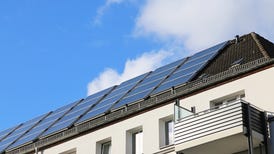
And as an added bonus, solar panels aren't as ugly as they used to be. PowerLight has come out with roof tiles with embedded silicon solar panels, which get installed when a house is built. A complete system can run around $8,000 to $13,000, according to Grupe Homes, which has included PowerLight panels in some homes in a few relatively new developments.
Solar needs real estate
The problem, however, is that solar electricity takes a lot of real estate, said Stanberry. The sun radiates about a kilowatt of energy per square meter on the surface of earth. There are 2.6 million square meters in a square mile. Thus, every square mile gets about 2.6 gigawatts. (A million kilowatts equals a gigawatt.)
On a practical level, solar energy is only going to harvest about 10 percent of the energy that hits a large area, so it takes about 4 square miles of solar panels to generate a gigawatt, or about the same amount of electricity provided by two power plants.
"If you look at the thousands of things that humans do, there are only three things that take up thousands of square miles: agriculture, highways and construction," said Stanberry. "The unavoidable goal of solar technology is how do you cover thousands of square miles inexpensively."
CIGS, say advocates, can do this because the panels are cheap to make. David Pearce, CEO of CIGS manufacturer Miasole, says that his company can erect a factory that can put out 100 megawatts worth of solar panels a year for $25 million. (The measurement means that, if you gathered all of the panels produced by the factory, they could provide 100 megawatts of power at the same time.)
Evergreen Solar, a silicon maker, plunked down $75 million to build a 30-megawatt facility in Germany in 2006. While extra capacity can be added more cheaply than the first 30 megawatts, CIGS still has a cost advantage, says Pearce.
"The battle is going to be won on the manufacturing floor. What we have to do is transfer this into high-volume production," he said at a recent conference.
In 2010, the costs of generating a watt of electricity from a CIGS panel--including installation and other expenses--will come to around $2.50, when you consider the lifetime of the panel. That will be roughly equal to grid power at the time, Pearce said.
By the end of next year, Miasole expects to have the installed capacity to produce 200 megawatts-worth of panels a year. Pearce further added that the company will be profitable next year.
While it trails in efficiency, CIGS is not far away, Miasole has shown a CIGS solar cell that converts 19.5 percent of sunlight into electricity; in a manufacturing environment, that means 15 percent to 16 percent efficiency, the company acknowledges.
So why isn't CIGS a perfect solution? It barely exists commercially and the alternatives don't have a great track record. Thirty years ago, producing solar energy cost about $100 a watt, said Swanson, so the U.S. Department of Energy began to fund alternatives to silicon. Now, it's about $8 or $9 and going down. The alternatives are just getting out of the research phase. Reliability of silicon, he added, is unquestioned.
The fact that CIGS can go on a variety of surfaces also may not be as big an advantage as it looks.
"There is a lot of roof space on American homes," said Ron Kenedi, general manager of the solar unit at Sharp, one of the big silicon solar makers.
Ultimately, the two technologies could co-exist by going into different applications, said Walter Nasdeo, an analyst at Ardour Capital.
"It's a hard question to answer. If you are talking about solar on a house, you're probably better off using silicon, particularly in the near term. It's been around for a long time," he said. By contrast, CIGS might be best suited for large industrial roofs or signs. Then over time, CIGS could build out a network of home installers.
"Right now what they (CIGS makers) face are engineering issues, not technical issues," he said.
See more CNET content tagged:
silicon, material, solar energy, electricity, CEO


- create electricity to power the air conditioning,
- less heat from the sun hitting the surface means less heat to aircondition away inside
Plus the fact that your
- create electricity to power the air conditioning,
- less heat from the sun hitting the surface means less heat to aircondition away inside
Do they take this into account when they calculate the estimated ROI?
Remember the referigerator in your camper that ran on propaine? There are several absorption chillers that use hot water or engine exhaust as the energy input.
The most common application today is in cogeneration, the waste heat from gas turbine or diesel generators is used to air condition buildings.
Solar heated water can also be used. Of ocurse electricity is still needed to run fans and pumps, but using solar heat directly for cooling and heating bypasses the inefficiencies of converting to electricity and then converting to mechanical motion in an electric motor, and finally to cooling.
One advantage of solar input for air conditioning, the available solar energy tracks air conditioning demand.
So CIGS is 100 time thinner. So what? Our Planet's crust contains 27% silicon (outdone only by oxygen at 46%) What could be more plentiful and widely available than sand -- Si02? There is 0.007% copper, 0.00001% indium, 0.0015% gallium, and 0.000009% selenium in the crust. And these elements are not particularly easy to mine in quantities required for gigawatts of solar cells. Do the math. Just the recent upsurge in flat panel display applications threw the indium markets is a tizzy.
Silicon photovoltaic feedstock material manufacturing is merely at a mismatch in planned capacity vs actual demand. This situation will correct itself within two years and leave CIGS in the (SiO2) dust with a nano-sized market share of world PV sales.
no, solar is real. actually, petrolium is simply stored solar, after all.
Either the Toshiba 4S or Mitsubishi APWR reactors provide more power per square foot than solar or wind power ever will.
Personally, I'd like to see more effort put into developing fussion, but until that time, it doesn't hurt to try and get all we can from all possible sources.
But wait, solar is expanding rapidly. Why? As it gets cheaper per watt more and more uses become economical. Those solar walk lights are everywhere, as solar calculators have been for years. Now warning signs and street signs are being lit with solar. Campers are buying solar panels that roll up. Hopefully, port-a-potties will get solar fans soon.
Got a cabin in the middle of nowhere? Why pay hundreds per pole to bring the grid to you? Just buy some panels, batteries, ... for less. Want to wi-fi a city? Just put a small solar panel, UPS, and an access point on every street corner. No need for wires or meter readers.
If solar ever gets cheap enough and durable enough (a big if), how much energy would be created if all roads were covered with spray-on solar panels?
So, conceivably, w/i 5-10 years you could pretty much go off-grid. What that would cost is right now anybody's guess, but if it drops below a loanable $20k net initial entry above standard setup, it'll get VERY tempting. Let's see...rebuild my deck w/a fancy barbecue or go off-grid? Hmmm....
- by Impala1948 September 23, 2008 1:53 AM PDT
- How does Dyesol's DSC technology rate against thin film and conventional silicon based solar? The market cap of Dyesol is still extremely low relative to alternative players across the field.
- Like this Reply to this comment
-
(22 Comments)