The day after the September 11, 2001, terrorist attacks, Emanuel Sachs decided that it was time to get back into the solar-energy business.
Starting in the 1970s, the Masssachussetts Institute of Technology mechanical-engineering professor had made significant contributions to solar, including a cell-making technique now used by Evergreen Solar. But once research funding for solar photovoltaics--converting sunlight into electricity--dried up in the 1980s, Sachs diverted into other fields, including 3D printing to help designers quickly build prototypes.
To Sachs, September 11 was a reminder of the perils of an oil-dependent U.S. energy policy. The events that transpired that day were jarring enough to prompt him to restart his solar research. Nearly eight years later, he is chief technical officer at 1366 Technologies, a company formed two years ago to commercialize the work he had done at MIT.
"I first got into solar photovoltaics as an idealistic young person," said Sachs, who is now in his mid-50s and is on leave from MIT for two years. "What really got me in full-time (again) was some of the same but also recognizing that there were a lot of issues at play, including national security...and climate change."
If idealism played a role in starting the Lexington, Mass., company, the business plan is all about cold, hard numbers. The 20-person start-up has an ambitious economic target: to make solar cheaper than coal in three years. That means producing silicon solar cells at less than $1 per watt, cutting the current costs by about half.
More than a few people believe that 1366 Technologies has a shot at being one of the first companies to hit the long-pursued goal of undercutting fossil fuel electricity on price.
Among those impressed with the technology and management team is Ethernet co-inventor and energy tech venture capitalist Bob Metcalfe, who is on the company's board. Metcalfe's firm, Polaris Ventures, led a $12.4 million round in the company last year. And last month, the U.S. Department of Energy awarded 1366 Technologies a $3 million grant for low-cost solar manufacturing.
Disruptive technology, a step at a time
The name 1366 Technologies comes from the solar constant, or the amount of solar energy that hits Earth's surface: 1,366 watts per square meter. That focus on keeping to the basics, and trying to do it affordably, are what executives hope will set them apart from the solar-tech pack.
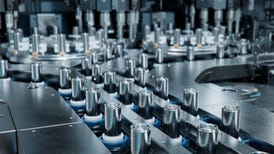
The company's headquarters--a one-story brick building among a dozen nondescript offices in an office park outside Boston--reveal a bare-bones operation. A full-size solar panel hanging on the wall serves as artwork in an otherwise-spartan office. A bank of cubes fronts a small factory floor crammed with solar-manufacturing machinery bearing obscure names like a "diffusion furnace" and a "plasma-enhanced chemical vapor deposition" system. This is where engineers are now producing small numbers of solar cells that put Sachs' ideas to work.
The modest building may not be where you'd expect the solar industry to finally break through the $1-per-watt cost barrier for silicon cells. First Solar earlier this month claimed to crack the $1 cost barrier for its thin-film cells, made from alternative material cadmium telluride, but 1366 Technologies wants to hit that price using silicon--a more common and abundant material.
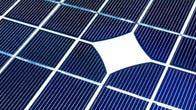
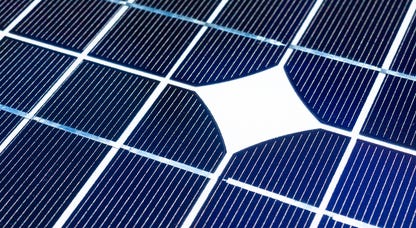
To get there, Sachs and company engineers say they have four innovations they intend to perfect one by one. To understand the improvements, you need to visualize a solar cell--a specially treated slice of silicon--and the wires that connect cells together to make a panel.
Typical polysilicon solar cells--the most common cell material--convert about 15 percent of the sunlight that hits them into electricity. Sachs' work has focused on boosting that efficiency closer to 20 percent by trapping more light and by reducing electricity loss in the wires. The trick, though, is to get that efficiency with manufacturing techniques that don't add cost.

1366 Technologies' first idea, called a "light-capturing ribbon," is to manufacture so-called interconnect wires with V-shaped grooves. Normally, light hits those interconnect wires, which are under the solar cell, and bounces straight out. By contrast, the grooved wires reflect light at an angle so that it can bounce onto a solar panel's glass covering and back down onto the cell. That "internal reflection" squeezes a bit more electricity from the incoming light without having to reinvent the production process.
The second idea is to redesign the wires that carry current on a solar panel to be smaller and less expensive. There are two other improvements on the drawing board, including one that uses reflective wires to trap more light onto cells, but the company is cagey on the exact details.
"Those (inventions) are all chunks of technology, any one of which some might call an incremental improvement. But taken in aggregate, they could be seen as disruptive change," Sachs said. The combination will allow the company to improve the efficiency of silicon cells' conversion of light into electricity by 25 percent without increasing manufacturing costs, the company claims.
Marrying mission with high tech
Executives at 1366 Technologies are well aware that slick technology, or even political support, doesn't guarantee success. For example, Evergreen Solar, the company founded on Sachs' work from the 1980s, is manufacturing cells but is still not profitable. Analysts also anticipate a shakeout among solar manufacturers because of brutal price competition.
There is also a recession that's made raising money far more difficult. The company opened its plant with great optimism last October. But the bad economy has slowed its progress, 1366 Technologies President Frank van Mierlo admits.
He's already had to adjust. In the fall, he had planned to raise money to build a larger factory by next year. Now he's just hoping that the economy turns around enough so that getting more financing is a realistic option. The company's business plan needs to be flexible too: instead of building new solar factories itself, it could license technology to other solar manufacturers, as it already has done, van Mierlo said.
The 48-year-old van Mierlo, who was born in the Netherlands, is a relative newcomer to renewable energy. Like many tech entrepreneurs, he was drawn to the field simply by following the flow of venture capital money. He was also intrigued by big problems like energy security and climate change. The father of two last ran a robotics company spun out of MIT and, after selling the company, spent about a year in an "almost-academic study," deciding what to do next.
He settled on solar because he believes that it has the most potential to rapidly make a difference in the energy industry. But van Mierlo is not blindly optimistic; he knows that his industry still needs to prove itself.
"Right now, solar's contribution to the energy business is next to nothing," van Meirlo said. "So there needs to be a lot of growth, and the only way we are going to get real growth is with healthy profit margins." Of course, his own company also has to live by those words, since it hasn't yet built products at a significant scale.
Sachs and van Mierlo admit that they meet some skepticism when they say cheap solar energy is within sight. Solar-photovoltaic panels have been around for decades yet still remain a relatively expensive purchase for homeowners, anywhere between $20,000 and $35,000.
"Both Ely (Sachs) and I intend to install 1366 (Technologies) solar cells on our houses as soon as they roll off the manufacturing line," Van Mierlo said. If the entrepreneurs succeed, it will be by marrying that long-term vision of transforming the energy industry with the rapid innovation they hope to achieve.
At the company's ribbon-cutting ceremony last fall, Sachs, in a soft but direct manner, implored local politicians and employees assembled to act, rather than talk, about greening the economy.
"The science is understood, the material abundant, the product works," he said. "All that is left is to build the biggest manufacturing industry in the history of human kind. Time is a-wasting."
Day 1: In search of the Google of green tech
In a tough economy, the companies that look a little like a high-tech outfit may be the big winners.
Day 2: They got their green-tech bill. So now what?
The industry is in for the stimulus of a lifetime. But proponents also know the risks of a bureaucratic boondoggle.
Day 3: Making solar cheaper than coal
Start-up 1366 Technologies wants to transform the energy business one solar cell at a time. Can it make renewable energy cheaper than fossil fuels?
Podcast: Green-tech companies adapt
Martin LaMonica explains how green-tech start-ups are changing their business models to adapt to the recession and what Obama means for the sector.
Podcast: E-waste looms behind boom
Without green chemistry practices, toxics coalition warns, rapid growth in the solar industry could lead to a legacy of e-waste like in the electronics industry.
Video: Schwarzenegger's green goals
California's governor believes that "guilt trip environmentalism" has failed. He is striving to make certain technologies more environmentally friendly.
Photos: Electric vehicles, now and later
While consumers wait for a mass-market electric auto, carmakers show off vehicles under development and those already being used.
Video: 2009 Tesla Roadster
The electric car is real. How does it shoulder all the hype?
Photos: Batteries charge up GE
At its research labs, GE shows off some of its projects developing better batteries for electric cars and buses, and the tech that will power electricity grid storage.
Photos: Chasing a solar revolution
A look inside a pilot solar-cell facility where Boston-area start-up 1366 Technologies is chipping away at the cost of solar power.
Photos: Solar business heats up Calif.
The solar industry's annual conference in San Diego illuminates the diversity of technologies for solar-power plants, commercial roofs, or homes.
Photos: Making of an ethanol superbug
CNET News explores the labs of Mascoma, a biotech company seeking a breakthrough in ethanol production by engineering the perfect microbe.
Video: Hydrogen Road Tour revs engines
See the first day, on which a caravan of fuel cell cars are on display, and the first hydrogen filling station in Massachusetts officially opens.
Photos: Peering into energy's future
Organizations from around the world show off alternatives to fossil fuels at the Washington International Renewable Energy Conference.
New grid for renewable energy could be costly
The Wall Street Journal
Electronomics: How the smart grid will power wealth, pt. III
Greentech Media
Obama lays first piece in energy policy puzzle
CNET News
A Dickensian view of clean-tech financing
CNET News
A $2 trillion bet on powering America
CNNMoney.com
How will the recession affect clean technology?
The New York Times
Year in review: Green-tech growing pains
CNET News
Clean-tech investors take cue from biotech
CNET News
It takes a village to sell an electric car
CNET News
Small is beautiful for green-tech newbies
CNET News
Electric Drive Transportation Association
Electric Power Research Institute
U.S. Department of Energy: Smart Grid
Editors: Jim Kerstetter, Zoë Slocum
Design: Ellen Ng
Production: April Fultz