Version: 2008
  • On MovieTome: The 10 worst movies of 2009 so far!

July 2, 2007 4:00 AM PDT

Newsmaker: Down payments on clean tech

See all Newsmakers
If you think buying solar panels for your home is expensive, imagine the price tag for building a wind farm.

With loud cries for energy independence and growing concerns over global warming, renewable energy is seeing an influx of entrepreneurial interest and capital.

Much of that money is being spent on large-scale, commercial projects that require millions of dollars of capital.

That's where General Electric's energy financing division comes in. Along with Wall Street and private capital funding, project financing firms like GE's play an integral part in making renewable energy commercially viable.

Last month, the American Council On Renewable Energy (ACORE) hosted the Renewable Energy Finance Forum in New York where ACORE President Michael Eckhart called on financiers to put their money to work for renewable energy. "You who have your hands on capital, you know you have the power to change things," he said in a keynote speech.

But amid the buoyant atmosphere for investing in renewable energy, some critics are concerned that some areas are attracting perhaps too much investor interest, notably in corn-based ethanol. And renewable energies--wind, solar, geothermal, biofuels, and biomass--rely on government policies, which historically have not stayed consistent over many years.

After the keynote speeches at the Renewable Energy Finance Forum, CNET News.com spoke to Kevin Walsh, the managing director for renewable energy at GE Energy Financial Services, about the investment climate and how financing complements technology.

Q: When I think of GE Energy Financial Services and renewables, I picture massive wind turbine farms. What's the full scope of your financing activities in renewable energy?
Walsh: There are three basic things we're doing right now. One is traditional project finance for wind, solar, biomass and geothermal--that's the bulk of money we're putting out the door.

In the area of biofuels--not to pat ourselves on the back--but we were concerned when we looked at corn-based ethanol.

Then we have a clean tech initiative--we're investing in a company rather than a project. We invested in a battery company A123Systems, a wave power company. We're chasing some deals in the solar space, the smart grid demand response arena--that's interesting. Then there's our carbon arena--(we have) a joint venture with AES to develop carbon offset projects in the U.S. and sell the offsets into the voluntary market in the U.S.

From a capital standpoint, (the carbon offsetting) is just getting started, but the other two areas are well energized and staffed. In fact, with the clean tech initiative, we've increased to $50 million per year that we're going to try to put out the door. That's based on small increments, but that's a space where we want to put more capital to work.

Hearing the speakers this morning, it's clear that there's some concern that the renewable area may be getting overheated, particularly in biofuels. What's your view?
Walsh: I don't think it's overheated. I think you need to be careful about where you put your money. I would certainly differentiate significantly between a wind project that has a power contract (with a utility) and a biofuels project around corn-based ethanol. There are very different risks you're trying to manage. We have people who understand those specific areas and decide whether to do an individual deal or not.

The bulk of what we're doing is wind--we understand it well. There's tremendous growth, and the pipeline for the next six months looks very full. But we also like what we're seeing in biomass. Biofuels, too--we're chasing that too.

In biomass, is that for combined heat and power plants?
Walsh: That or just burning wood waste in some form. We're working on a project that's in the Northeast that we'll hopefully announce soon that looks very promising. And then, of course, geothermal, we like what we see there. We've been doing it for years. We understand that it's about the resource, and we have to have confidence that the resource will be there to supply you for the next 15 or 20 years.

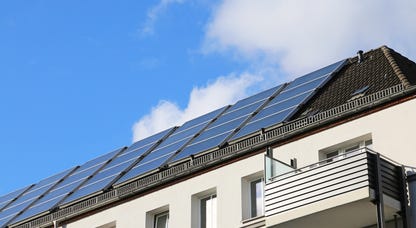
Solar we like. There are challenges getting the costs (of photovoltaic, or electric panels) down, but there are subsidies available to make them work today.

Is your solar involvement only for utility-scale projects?
Walsh: We lean more toward utility scale because we like to put big dollars to work in individual transactions. We are trying to find a way to play in the smaller commercial side, maybe teaming up with other parts of GE used to doing smaller scale projects.

We like what we see in solar thermal. From a cost of power standpoint, it competes very nicely--in the right market. It has to be in the desert market. We have an investment in one in the Mojave Desert that has been there since the late '80s.

Are there any areas that don't look too good to you?
Walsh: As I said, wind looks the best. In the area of biofuels--not to pat ourselves on the back--but we were concerned when we looked at corn-based ethanol. You've got on one side commodity risk with corn competing with food. You've got commodity risk on the other side competing with gasoline, and you definitely can get whipsawed by that. Some of these projects are going to get restructured.

We saw some deals that had some very short-term hedges available, but they were looking for financing in a time period that goes beyond the time of the hedge, so we stayed clear of that. But we still think there will be some smart plays with cellulosic (ethanol) and biodiesel, which has better fundamentals arguably. And maybe Brazilian sugar cane-based. Sugar cane is just a better feedstock--the energy balance is much better. Even though it is a food product, it has a better yield than corn.

More Newsmakers

CONTINUED: Policy support...
Page 1 | 2

See more CNET content tagged:
renewable energy, financing, Kevin Walsh, General Electric Co., Combined Heat and Power

Add a Comment (Log in or register)
Shhhh! Compressed Air Motor = Secret!
by TonyGuitar July 2, 2007 9:25 AM PDT
Taxis running around Paris on compressed air?

Yes! And compressed air motor vehicles by Tata Motors of India for low cost transportation? Also true. Tata to be selling vehicles for about three thousand dollars in India.

http://BendGovernment.blogspot.com

My interest is primarily in the electric car where you plug in for a few hours charging at night.

Plugging in an air compressor to charge a 4,600 PSI air bottle to power a vehicle is just as easy in my view.

Anything to be free of the stinking volatile, price gouging and uncertain gas pump.

Compressed air and electric motor vehicles are being held back by Exxon-Mobile, Chevron and big Auto* [ they buy up advanced battery patents ], but the true dawn of both has arrived. Say hello to *No Gasoline*. = TG

TonyGuitar.blogspot.com
Reply to this comment
Energy for transport
by bigduke July 2, 2007 8:49 PM PDT
All this reminds me of the elimination of street cars and interurbans of the first forty years of the last century. Those with loose cash can buy up rail transport and sell busses on tires in those days, now it is technology patents so no one can use these ideas for a couple of decades.

The finite amount of oil and natural gas should require conservation for future generations.

Our Prius gets double the miles per gallon of most cars on the road, and we use bikes for local travel as well. Who will produce the first 100 MPG vehicle that can carry at least four passengers.

duke
advertisement

Latest tech news headlines

RSS Feeds

Add headlines from CNET News to your homepage or feedreader.

More feeds available in our RSS feed index.

Markets

Market news, charts, SEC filings, and more

Related quotes

Dow Jones Industrials (0.20%) 20.03 10,246.97
S&P 500 (-0.01%) -0.07 1,093.01
NASDAQ (-0.14%) -2.98 2,151.08
CNET TECH (0.21%) 3.30 1,571.59
  Symbol Lookup
advertisement

Inside CNET News

Scroll Left Scroll Right