January 27, 2008 9:00 PM PST

CIGS cell makers battle it out for efficiency crown

Solar cells made from copper indium gallium selenide, or CIGS, are relatively new, but there's already a nice rivalry brewing in the industry.

Tucson's Global Solar has begun to produce flexible CIGS solar cells in volume that can convert a little over 10 percent of the sunlight that strikes them into electricity, which it says is a record.

Scientists at the National Renewable Energy Labs (NREL) have achieved higher results in the lab, admits Global CTO Jeff Britt. NREL has built a CIGS cell on glass that is 19.5 percent efficient and a CIGS cell on a flexible metal substrate that can convert 17.5 percent of sunlight into power.

But mass production is an entirely different story. Many of the CIGS start-ups have had trouble producing high-efficiency cells on a commercial scale. Last year, Miasole delayed releasing its solar cells because the products coming off the line were generally exhibiting 4 to 6 percent efficiency, below the company's 8 to 10 percent target.

"At the start of 2007, we were at a little over 9 percent and now we are over 10 percent," said Britt. The company also said it plans to raise efficiency to 13 to 14 percent in 2008.

Not so fast, says Martin Roscheisen, CEO of Nanosolar, who says the company's flexible CIGS cells, which started coming out last month, are at the same level.

cigs
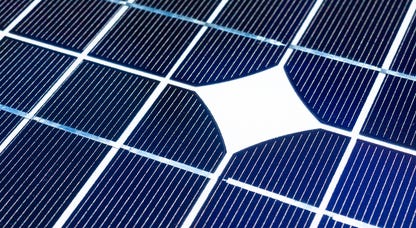
Credit: Global Solar
A flexible solar cell made from CIGS
by Tucson, Ariz.-based Global Solar.

"And we achieve them with a process and a materials stack that's a factor less expensive," Roscheisen added.

Only a few companies have been able to get CIGS cells into production. Silicon Valley's Nanosolar started shipping CIGS cells on flexible substrates in December. Global has been producing CIGS cells for the last three years, but in limited quantities. DayStar Technologies has produced a limited number of CIGS cells, but the company uses a glass substrate.

The CIGS solar cells from these companies all rely on a similar chemistry to convert sunlight to electricity. Where they differ is in manufacturing. Nanosolar uses printing techniques to make its cells while Miasole, among others, sputters the chemicals onto a substrate. (Solopower, meanwhile, binds the CIGS chemicals to substrates through electroplating.)

Global Solar uses evaporation: the active chemicals are immersed in a solution, which then gets removed. Critics, and Roscheisen is lead among them, say evaporation can't cut it.

"Co-evaporation is very slow and very expensive," he said.

Bah, says Britt. Evaporation leads to the highest efficiency cells. It's one of the reasons NREL and other scientists have used evaporation to produce their own devices.

"You get greater control with evaporation," Britt said. "The reason they (other CIGS companies) don't do it is because they don't know how to do it. Efficiency is the key driver to success and you cannot be a success at six percent."

Evaporation is also fast. The company can coat a 1,000-foot roll of stainless steel with CIGS cells in a day, he said.

The next step for both companies will be to move from mass manufacturing to large scale mass manufacturing. Global currently has a facility that can crank out 4 megawatts worth of solar cells a year. In the first half of 2008 it will open up facilities in Tucson, Ariz. and Berlin. By the end of the year, Global will have enough capacity to produce 64 megawatts worth of solar cells a year.

Nanosolar, meanwhile, is building out a factory in Silicon Valley that will be ultimately of producing 430 megawatts worth of cells a year.

Meanwhile, HelioVolt will commence mass production in 2009, and Miasole will jump into the market soon after.

See more CNET content tagged:
cell, substrate, chemical, efficiency, sunlight

Add a Comment (Log in or register) 7 comments
Is this?
by Imalittleteapot January 28, 2008 12:19 AM PST
Is this another one of those science articles that talks about stuff that works in the lab, but in practice never actually works in the real world?

For thirty years since I was kid in school I was told how one day everything is going to be solar powered. I wonder if they still tell kids that.

Anyway, I've been waiting and waiting and waiting. Maybe this is it!!!! WOOO HOOOO!!!!!
Reply to this comment
When will we see it?
by RandyWayne January 30, 2008 7:44 PM PST
We're moving to the Phoenix, AZ area in a few short months and do plan on installing a sizable solar panel system on our home.
It is not cheap.
And I have been hearing about these breakthroughs every 3 to 6 months for years now and nothing has yet to materialize. I hope it does someday, but for now, we're about to invest a boatload of cash on a system that will future proof us against any huge energy spike costs.
Reply to this comment
Photon surface refraction/absorption
by Roger Carmichael February 2, 2008 8:18 PM PST
The company who first realizes the nature of photon interaction with surfaces will be most successful.
Few realize an FM antenna is the optimum shape for
any nanometric absorption of solar lightwaves, ie
to optimize absorption, conductor lengths must be
halfwave to interact with a given wavelength.
We learned this at Nat'l Solar Observatory design
of superpolished solar mirrors to control scatter
Reply to this comment View all 2 replies
Watts/dollar matter!
by bookwerm February 11, 2008 11:34 AM PST
The primary driver is going to be, when the technology is mature, which option offers the highest wattage output per dollar! Dollar cost now is not as relevant, as some methods can be much more expensive up front for "one offs", but can be VERY efficient in large scale production. This is also Watts/Dollar INSTALLED! A very low efficiency system that is also cheap will need MORE area (more land etc) and more structure to hold it up (even if simply tensioned), but I would expect that to be a weak cost driver.
Reply to this comment
by williambhunter May 26, 2008 7:59 AM PDT
The price per watt of solar energy has been coming down consistently, while the price per watt of oil has been rising consistently. The solar revolution will not happen until the two prices cross, than we will see a state change in which solar starts replacing oil based energy for home and building energy needs. To see how fast this can happen, look only to the LED revolution. For years LED costs were coming down at a steady rate, until they finally crossed the threshold of incandescent lights. Within a few years, every new traffic light and every new vehicle tail light was LED based. It happened so quick that no one really noticed. The same will happen for solar in the next few years.
Reply to this comment
Powered by Jive Software

Latest tech news headlines

RSS Feeds

Add headlines from CNET News to your homepage or feedreader.

More feeds available in our RSS feed index.

Inside CNET News

Scroll Left Scroll Right
  • News - Business Tech

    Chrome's JavaScript challenge to Silverlight

    The advent of Google's Chrome browser, software pros say, should spur a big speedup for JavaScript, which would raise its standing against Microsoft's Silverlight technology.

  • Gallery

    Photos: Top 10 reviews of the week

    Here are CNET Reviews' 10 favorite items from the past week, including the TiVo HD XL, Sony Cyber-shot DSC-H50, and the Dish Network's newest digital TV converter box.

  • News - Apple

    Apple watchers spot 'iPod Nano' pix, iTunes hints

    The rumor mill has long been predicting a longer, leaner new version of the iPod Nano, and now it's conjuring up some pictures.

  • Outside the Lines

    EIC Squared: Chrome, iPods, and a Dell-Salesforce union

    On this week's EIC Squared podcast CNET's Dan Farber and ZDNet's Larry Dignan discuss Google's latest rocket launch--the Chrome browser--as well as Apple's iPod event next week and a Dell-Salesforce.com union.

  • Video

    Katie Couric reflects on first Webcast

    The political conventions are over and so are CBS Evening News anchor Katie Couric's first series of Webcasts. CNET's Kara Tsuboi sat down with Couric on the final night of the Republican National Convention to discuss what she liked about Webcasting, some of her most memorable guests, and whether TV news will still be around by the next round of conventions.

  • News - Digital Media

    At 10 years old, whither Google?

    Daniel Sieberg of CBS News looks at how the company grew exponentially from start-up to superstar and part of our culture, but what's ahead?

  • Video

    YouTube plays party politics

    During the presidential campaigning four years ago, YouTube didn't even exist. Now it's a tool candidates must master to get their message across. CNET's Kara Tsuboi stops by the YouTube upload booths at the Democratic and Republican conventions to find out why Google's video site has such a big presence in Denver and St. Paul, Minn.

  • News - Gaming and Culture

    Are Demo and TechCrunch50 fragmenting their audiences?

    With both events scheduled to start Monday, many press, as well as venture capitalists and others are having to choose which one to attend.

  • News - Cutting Edge

    Execs predict next Google-like tech

    On eve of company's 10-year anniversary, researchers and business pundits speculate about what technologies might someday have as much impact as Google.

  • Gallery

    Images: The art of 'Spore' prototypes

    Will Wright and his Maxis team worked on dozens of prototypes to test the elements of their soon-to-be-released evolution game. Here's a sampling.

  • Webware

    At the TechCrunch50, an unfair advantage?

    Inside baseball: How Webware and other blogs can compete with TechCrunch in covering the TechCrunch50 event.

  • Green Tech

    Duke Energy to invest in mini solar power plants

    Can hundreds of rooftop solar panels collectively operate like a central power plant? Duke Energy launches $100 million distributed solar program to find out.